Translation

.يولد جميع الناس أحرارا متساوين في الكرامة والحقوق. وقد وهبوا عقلا وضميرا وعليهم أن يعامل بعضهم بعضا بروح الإخاء‎
FoxLingo German Spanish French Arabic Czech Greek Hungarian Italian Polish Portuguese Romanian Russian Serbian Slovenian Thai Turkish
Showing posts with label Africa. Show all posts

Thursday, July 15, 2010

The Gay Closet; Uganda, and Germany

An expose of gay life in Uganda has Afrogay angry.

They've had a journalist infiltrate the Kampala gay community to try and ferret out what makes gay boys tick. It's not the first time this sort of thing has happened and the only thing that sets it apart is that this journalist has made a clumsy attempt to be balanced. That said, this journalist simply knows too much about the gay community for me to believe that he didn't get embedded deeper than he admits.And that is a great cause for discomfort.
The tactics the journalist are pretty basic and that he seems to be so successful merely attests to the humanity in all of us. But it is also a wake-up call for those Ugandan gay boys who seem unable to take the simplest precautions in this day and age when stalkers, blackmailers and malevolent people are on the prowl, with gay boys and girls as their target.
~
Indeed, for guys who are under pressure, the pressure of one of the most homophobic countries in the world, it is simply too easy to infiltrate us. And, it is possible.

Oh well....

To my friends out there, I must confess I am more paranoid than lots of people. I mean, I have aided connection and lessening of our isolation in more than one way. Yet I continue to be anonymous. I am gayuganda, gug. And that is who I want to be. Gay, and closeted, and damned shy! Some have more to lose than others. Maybe I am just a coward.

Yes, I know lots of people know who I am. But, not to the extent of opening up to people like in this journalist's expose.
Within a period of three weeks, I learnt that gay relationships are almost like straight ones. Those involved charm, seduce, deceive, try to manipulate with money and even plead with whoever they are interested in to give into them and yes, they also get cheated on It was a hot Tuesday morning and I was seated in front of my computer reading an online article about gays in Uganda. The page had a link to a website called icebreakersuganda.org.
I clicked on it out of curiosity. It is probably one of the boldest gay things I have seen in this country. It’s a website that encourages gay people to come out and embrace their sexuality (thus the name icebreaker) and it connects gay people in Uganda. The website has a guestbook link where visitors of the site can update any comments or ideas on their mind about the website.
However, most of the comments posted on the website’s guestbook are announcements of gay people who want to meet other gays for mere company, sex or love. Consequently, this segment of the website has been turned into a “lonely hearts” of sorts for gay people. Some of the posted messages are darkly explicit and complete with e-mail addresses and phone numbers.
One of the posted messages on the website was an announcement for a gay party of sorts. It had a phone number attached to it.
Gay, in the closet, in Uganda? Why the recklessness of those who are gay in Uganda?

Because it is very hard to live in self denial; and sometimes recklessness takes the place of despair.

I was mourning about the closet in Uganda. We are not alone. The German national team, the one which did so well in the World Cup of football? Well, they are a 'bunch of gays' Ha ha ha ha ha!
I am not alone in my woes about the goodness of the closet. Says one former manager of the Bundesliga-
The whole issue of gay players in the Bundesliga is a sensitive issue in Germany. In March former football manager Rudi Assauer provoked outrage outrage by saying there is ‘no place' for gay players in football.
Assauer, who was boss of Schalke in Germany, said: "Perhaps they are OK in other sports but not in football.
"If a player came to me and said he was gay I would say to him: 'You have shown courage.' But then I would tell him to find something else to do.
"That's because those who out themselves always end up busted by it, ridiculed by their fellow players and by people in the stands. We should spare them these witch-hunts."
His outburst is set to enrage world footballing authorities who are making concerted efforts to rid the game of homophobia.
Asked whether he had ever met a gay footballer during his many years as both player and manager, 65-year-old Assauer replied: "No, never.”
Ugh, of course German football is so holy a spot that no gay people make their way into that holy of holies. Self deception at its best

Wednesday, June 30, 2010

UGANDA: Finally ready for male circumcision

The national policy will be launched in July 2010
RAKAI, 29 June 2010 (PlusNews) - The Ugandan government will begin a nationwide male circumcision programme in July as part of its HIV prevention strategy, a senior government official has said.

"We now have a national vision on how to move forward, and a government policy and communication strategy will be launched in July," said Dr Alex Opio, assistant commissioner for health services in the Ministry of Health.

"Circumcision will be carried out in national referral hospitals, district hospitals and health centre IVs [county level health centres] which have the capacity to conduct minor surgeries."

Why the delay?

The government began drafting the policy in 2008 and there has been criticism of the delay in launching the circumcision programme. In terms of the
National AIDS Strategic Plan 2007/8-2011/12, at least 160,000 men should have been circumcised by the end of 2010.

It had taken time to get all the government's ducks in a row. "We needed funding; PEPFAR [the United States President's Emergency Plan for AIDS Relief] has stepped in to give the ministry and its partners US$5 million for male circumcision over the next year," Opio said.

Unlike neighbouring Kenya, whose programme has already circumcised more than 100,000 men, medical male circumcision was relatively new to Uganda, where only 25 percent of the adult men are circumcised.

"Starting prematurely can do more harm than good; we needed to be sure we were truly ready to deliver safe medical circumcision before we launched," Opio commented.

The Rakai Health Sciences Programme (
RHSP), a medical research facility in central Uganda - one of three sites where research confirmed the protective effect of male circumcision against HIV - has circumcised more than 5,000 men, and is expanding its services to local district hospitals.
''Starting prematurely can do more harm than good; we needed to be sure we were truly ready to deliver safe medical circumcision before we launched''
"We have found pretty high levels of acceptance of male circumcision so far - about 60 percent," said Dr Rajab Kakaire, a medical officer at RHSP. "There is a limit to how many men will accept circumcision without an official government policy; some are sceptical about undergoing a procedure that the government hasn't officially endorsed."

Their figures match those of a 2008
study by Uganda's Makerere University and Family Health International, a reproductive health NGO, which found that 62 percent of men in four districts would consider being circumcised.

"It seems quite fashionable now, like somehow men who are circumcised are more civilised, more educated," said David Sembatya, a motorcycle taxi rider, or 'boda boda', in the neighbouring district of Lyantonde, where RHSP provides male circumcision at the district hospital. "I will definitely do it."

James Nkale, a clinical officer at RHSP, said prevention of HIV and other sexually transmitted infections, hygiene, and social status were among the reasons men were so keen to be circumcised. "Men also listen to women, who have better health seeking behaviour and are advising their partners to go for the service."

Misconceptions

Circumcision is a new concept to much of the population and there are some misconceptions. "Of course, the most common fear is pain - people associate circumcision with men wearing skirts and walking with a staggering gait," Nkale said.

"There are also some cultural practices that may be harmful ... some believe it is a curse to have sex with your official wife after circumcision, so the first sexual encounter after the procedure should be with another partner; others believe vaginal fluids are good for healing wounds, so they may have sex before they are properly healed. This is all anecdotal - we don't know how deep-seated these misconceptions are, so we need more studies."

Kakaire said another common perception was that male circumcision was a way of "Islamising" the population; in some ethnic communities the word for male circumcision is "okusilamula", which translates as "to make Muslim". "We discourage the use of that word, instead we use the word "okukomola", which means to trim," he noted.
More on male circumcision
 Zulu king revives male circumcision
 The fringe benefits of male circumcision rollout
 Clinics dispel male circumcision myths
 The cutting edge (multimedia)
Perhaps the biggest fear of male circumcision practitioners and the government is that men will become more sexually reckless after circumcision. "There is a legitimate fear of behavioural disinhibition as a result of being circumcised," Kakaire said. "However, a small qualitative study we did here [Rakai] showed no increase in risky behaviour as a result of the procedure."

The Ministry of Health's Opio said the message that male circumcision was not a "magic bullet" against HIV was central to the communication strategy. "It is just an additional tool in our prevention arsenal - it becomes part of the 'plus' in our ABC [Abstinence, Be faithful and Condomise]-plus strategy," he said.
Getting it right
Kakaire noted that good medical care and counselling were also critical to promoting circumcision, and RHSP has been training nurses, counsellors, and clinical and medical officers for more than two years. In the past year it has trained more than 170 health workers from across the country and is planning to double its training programmes to cope with demand.

One of the reasons this [RHSP] programme has been successful is that the clients get a complete service - from pre-op counselling to the procedure and post-op follow-up," he said. "Clients need to trust the programme for it to succeed."

"We are drawing up a roadmap that will guide the [national] programme," Opio said. "Training is ongoing and we are being careful to ensure that all practitioners of male circumcision follow standards set by our technical guidelines."

Monday, June 28, 2010

The Madonna Of The Townships

Brenda Fassie, the bad girl of South African pop, finally gets her shot at musical (and media) stardom in America


The moment was pure Brenda. Making her U.S. debut at Washington's Zanzibar club in July, South African singer Brenda Fassie sang passionately from the diaphragm for almost three hours straight. As if that wasn't enough strain on her petite body, Fassie determinedly put on a frenetic dance show. Suddenly her breasts popped out of her costume. The audience gasped, but Fassie unabashedly grabbed her bare bosom and thrust it at the crowd. "This," she proclaimed, "is Africa!"

But America, it seems, was not yet ready for that part of Africa. "The promoters asked me not to do that again," she said afterward. Which is too bad, because back home Fassie is known (and loved) for her outrageousness. Ask a South African if he likes her music, and he's likely to reply with some vivid, raucous tale. In the townships, Fassie is nicknamed "Madonna," after the provocative American pop star. Fassie is the protagonist of countless tabloid stories involving drug use, bisexuality and tantrums of diva proportions (one local paper even reprinted—verbatim—an interview with Madonna, replacing her name with Fassie's). Last April, as she accepted a prize at the South African Music Awards, she flashed her legs at the crowd. "Nice, eh?" she asked, as the audience cheered. But when she returned to her table, Fassie abruptly hurled obscenities at a tabloid reporter who was sitting nearby, calling him "a homosexual who sleeps with men to get stories." Later, as a rival performer did a TV interview, she snatched away the microphone. "This is my night!" she insisted.

Fassie has been shocking people all her life. When she was born in 1964, her surprised family was expecting a boy, so Fassie's mother, casting about for a name, borrowed one from U.S. country singer Brenda Lee. By her fifth birthday, Fassie was already earning money by singing for tourists. As a teen, she landed gigs with popular acts and got on the charts with a single, Weekend Special, which received international air play. Fassie's 1980s efforts—bubble-gum pop sung mainly in English—were musically unremarkable. But young South Africans loved the lyrics of songs like Too Late for Mama that reflected the realities of the apartheid era, so Fassie became the princess of local music.

In recent years, with her girly, high-pitched delivery ripened into a strong-woman wail, Fassie has entered a new phase of her career. The kids call her the Queen of Kwaito, a pulsating pop style that exploded out of the townships in the early '90s and that Fassie quickly adopted. Kwaito (slang for "these guys are hot") fuses slowed American house and hip-hop, British garage and Jamaican reggae, held together with laid-back bass lines and percussion from traditional African chants. Like hip-hop, kwaito has become a cultural movement that incorporates lifestyle and fashion. And like hip-hop, it sells. In South Africa, where a platinum album means sales of 50,000 units, kwaito records regularly sell more than 100,000. Fassie's 1998 album, Memeza (Shout), was the first South African recording to go platinum on its first day of release. It has sold more than half a million units, spurred by the single Vuli Ndlela (Accept the Situation), which still remains on the South African music charts. Her latest album, Amadlozi (Ancestors), has sold more than 300,000 units.

Fassie, 36, is doing so well because while such younger kwaito acts as Arthur Mafokate create dance-party standards, her lyrics address more complex themes dealing with African culture and life. In Sum' Bulala (Do Not Kill Him/Her), she asks taxi operators in the provinces to end their violent rivalries. Fassie has also mostly abandoned English and now sings mainly in Xhosa, Zulu and Sotho. With this marriage of tradition and innovation, she and longtime producer Sello "Chicco" Twala (South Africa's Quincy Jones) are creating the best music of her career. Fassie's new approach invites further comparisons to Madonna, who recently reinvigorated her sound with hip electronica. Fassie likes Madonna but doesn't understand the comparison. "Maybe it's because of the way we dress," she says.

Fassie's personal life remains a work in progress. By her own admission, she spent much of the early '90s in a cocaine haze, missing gigs and becoming a promoter's nightmare, until the overdose death of her lesbian lover, Poppy Sihlahla, impelled her to clean up her act. Ridiculously generous with family, friends and even friends of friends, she has been broke many times, and was once arrested for nonpayment of debts. Those experiences have colored Fassie's perception of success. "I'd rather have happiness than money," she says. "People ask for [money]. Sometimes when I don't have it. I make other people's problems my problem because they want me to; they ask me to. So sometimes I wish I didn't have the little money that I do."

The singer tried to commit suicide three times but says she now lives to see her son Bongani, 17, become a successful musician. Fassie claims that her romantic problems boil down to this: "I'm so good and so loving that men don't believe it."

Kwaito surfaced in New York City in July, when Central Park SummerStage, a popular music festival, featured a young, Fugee-like trio called Bongo Maffin, which has been raising its international profile in the last few months. Fassie, who is shopping around for a U.S. distribution deal, badly wants to be the vanguard of any kwaito breakthrough. Exiting John F. Kennedy Airport this summer, she was a pile of giggles, giddy with excitement about playing the U.S. Then she seemed to recall that she was already a superstar. "Brenda Fassie is in the house!" she loudly announced to no one in particular. A few African tourists who happened to be near the gate asked the Queen of Kwaito to pose for photos, and she obliged. Then, suppressing more giggles, Fassie strode out of the airport, ready to make news. 

Sunday, June 27, 2010

U.S. puts on a brave face after latest World Cup disappointment

Maurice Edu

Ghana's history-making 2-1 victory in the round of 16 adds Rustenburg, South Africa, to a lengthy list of cities where American soccer dreams have perished. But U.S. players' reaction is free of the acrimony and anger that marked some previous World Cup defeats.

Grahame L. Jones

Out here in the bone-dry South African bushveld, with the haze of grass fires hanging thickly in the night air, it is difficult to remember all the places where earlier dreams died.

Places such as Montevideo, Uruguay, in 1930; Recife, Brazil, in 1950; Florence, Italy, in 1990; Palo Alto, Calif., in 1994; Nantes, France, in 1998; Ulsan, South Korea, in 2002, and Nuremburg, Germany, in 2006.

On Saturday, Rustenburg, South Africa, was added to the unhappy roll call. It was here, in Royal Bafokeng Stadium, that the U.S. national team's great African adventure of 2010 reached its sad conclusion.
Americans have come this way before. Until the day when the
World Cup is actually won by a U.S. team — and that day will come — defeat is the reality that ends the tournament.

It has to be faced with as brave a face as possible, and on Saturday night it was.

"It's disappointing, it's hard, it hurts" said goalkeeper
Tim Howard, echoing similar sentiments from all the U.S. players. Some walked tight-lipped through the postgame mixed zone, choosing not to stop. Others had only a few words.

For Ghana, it was a different story. By winning, the Black Stars became only the third African team to reach the quarterfinals of a World Cup.

Cameroon, led by the irrepressible Roger Miller and the goalkeeping of Thomas Nkono, was the first, in Italy in 1990. Senegal, with Boupa Diop in rare goal-scoring form, matched the accomplishment in 2002, when South Korea and Japan co-hosted the tournament.

Now, it is Ghana's flag that flies high. The victory was a deserved one. The U.S. had its chances, but for once, luck was not on its side. This time, there was no great comeback, only a partial one. This time, there was no late miracle goal.

Bob Bradley, the team's coach, put it best.

"There were so many attacking plays that seemed to just miss," he said. "The timing would be a little off, the last ball would be a little off, some of our crosses weren't as good as they needed to be."

And so, at the end, the most bruised and bloodied of the American warriors, Clint Dempsey, exchanged shirts with Ghana defender John Pantsil. The two are teammates at Fulham in the English Premier League.

Dempsey then walked off toward the somber reality of the U.S. locker room. Pantsil made a different journey. He ventured to the far side of the stadium where some Ghana fans were grouped.

From them, Pantsil received a Ghana flag, the black star proudly emblazoned on the field of yellow, green and red.

With flag in hand, Pantsil set off on a celebratory jaunt around the stadium's track, the flag waving high above him. The celebration was not staged, it was spontaneous and heartfelt.

And all of Africa shared the moment.

Looking at the game from a big-picture perspective, could Howard, for instance, be happy for Africa?

His answer was quick.

"It's obviously good for the game," he replied, "but I would have liked to disappoint a lot of people and gone through. It wasn't to be."

Earlier World Cups have ended in acceptance, acrimony and anger for U.S. teams.

In 1994, a loss to eventual champion Brazil was seen almost as the natural order of things. In 1998, there was a sour aftertaste, with finger-pointing and accusations among a splintered team. Four years later, a dubious non-call by Scottish referee Hugh Dallas on a handball by Germany cost the U.S. a chance to reach the semifinals. There was anger, then.

This time around, there was simply disappointment.

The successes of the first round, when England and Slovenia were held to ties and Algeria was beaten, raised expectations to too high a level, perhaps. The team and the country celebrated a little too long and a little too soon.

There was bound to be a letdown.

But the U.S. was up against more than Ghana on Saturday night. It was up against a continent. Not that Bradley agreed with that notion.

"I don't think that was a factor," he said. "We had a country behind us. We had great fans in the stadium tonight, and we had a belief that we could win."

So did Ghana.

Long after midnight, the U.S. team bus set off on the long trek back to its base camp in Irene a couple of hours away. The smoke from the grass fires still hung in the air. The moon still hung high in the African sky.

But dawn and a new beginning seemed a long way away.

Saturday, June 19, 2010

New autopsy for Egypt 'police beating victim'

Activist with image of Khaled Said

Activists marched in Egyptian cities to demand a new probe into the death

A second autopsy has been ordered for a young man who human rights activists claim was killed by police in Egypt.

Khaled Said, 28, died on 6 June after plainclothes policemen reportedly tried to search him in an Alexandria cafe.

His family and campaigners claim he was dragged out and beaten to death on a busy street in full view of passersby. His death led to angry demonstrations.

Egypt's interior ministry said Mr Said died after swallowing a bag of drugs when police tried to arrest him.

Prosecutor General Abdel-Meguid Mahmoud transferred the case to Egypt's most senior coroners on Tuesday.
 
Street protests
The United States expressed concern over the death in the northern port city, and Washington welcomed Cairo's decision to launch an investigation.

"We urge the Egyptian authorities to hold accountable whoever is responsible," State Department spokesman Philip Crowley was quoted as saying by AFP news agency.

Campaigners took to the streets of Alexandria and Cairo to demand a fresh investigation after the interior ministry said Mr Said died after swallowing drugs.

Photos of Mr Said's battered face have been circulated in Egypt by human rights activists.

They say his death is evidence that Egypt's emergency law has created a culture of police impunity.

The law, which has been in place for nearly 30 years since the assassination of President Anwar Sadat by an Islamic militant, was recently renewed for a further two years.

Egypt's parliament has said that new legal limits would be introduced, guaranteeing that the law would be used only to counter terrorism and trade in illegal drugs.

But the government's political opponents also claim the legislation is used to target them in the name of national security.

Monday, May 31, 2010

Scott Lively Struggles With Uganda’s Death Penalty

von Box Turtle Bulletin

Lively leads off with the boast that he was “one of the people that helped to start the pro-family movement there. … This was all new to them.” And so they asked him to speak. It’s an interesting boast.  Lively claims credit for parachuting into this lost country and setting up a “pro-family” movement. Those poor Ugandan’s couldn’t have done it without him. But criticizing him for firming up the conditions that facilitated the Ugandans who put forth and supported the Anti-Homosexuality Bill, well, that’s racist to suggest Ugandans weren’t capable of doing this all on their own. (Of course, nobody has suggested such a thing. We’ve only noted his active participation in the process.) Yet there’s not even the slightest hint that this glaring contradiction has ever crossed his mind.

This clip also provides clearer context to Lively’s statement in the documentary where he calls the bill the
“lesser of two evils,” the two evils being the bill itself or allowing the so-called “gay agenda” to take over Uganda. In the documentary, it wasn’t entirely clear whether the form of the bill he was endorsing as the “lesser of two evils” included or excluded the death penalty. In this clip, he’s more clearly against the death penalty, but he really has to struggle with it for quite a while before he gets there. After mulling over a few possibilities for its inclusion, he finally says, “I don’t believe that it’s… that I could support it that way.” Even still, it looked to me as though he was reluctant to say even this much against the bill. He looks as if he still needs some convincing.

Unofficial Rush Transcript
van Zeller:  Why did you go to Uganda?
Lively: Well, I went to Uganda because I was actually one of the people that helped to start the pro-family movement there. They were finding people there, primarily homosexual men from Europe and the United States coming into the country and working to try to change the social values. And they didn’t know what to do. They had never had a pro-family movement. This was all new to them. If we do nothing then we’re going to end up like the United States and Britain and Canada, you know, with a powerful gay movement just basically overwhelming everybody else’s values and forcing their agenda down everybody’s throats. So they wanted to draft some kind of law. And it wasn’t written at that point. It was just sort of the idea that they wanted to do something. So they invited me to come and speak along with a couple of other people from the U.S., and I did.

van Zeller: So then let me ask you very bluntlty. Dr. Lively, do you condemn this anti-gay bill in Uganda?

Lively: It’s my understanding they’re going to remove the death penalty. But if they keep the death penalty in it, yes, I condemn the death penalty for sexual crimes.

van Zeller: But all the other clauses, do you then support the rest of the bill if you remove the death penalty part?
Lively: I would not have written the bill this way. I said don’t emphasize punishment, emphasize rehabilitation. You could be the first country in the world to have a government-sponsored ex-gay therapy, where someone struggling with this would have the option of being able to go into this instead of being punished for it. And them I said, moreover, and as a separate matter, but within the law, you should emphasize marriage in your country. This is how you can deal with this. Nationwide, proactively, you begin the teach the value and the imports of marriage to every child in your schools from, at an age-appropriate instruction, all the way down to kindergarten, in which you help your children to see marriage as their goal.

van Zeller: Some people would even say it was written by some religious leaders such as Martin Ssempa.

Lively: I don’t think he wrote it. I think it was…

van Zeller: He was the influence of the writing of the bill.

Lively: Oh, I have no doubt. I have no doubt, I mean, politics works the same everywhere. There’s always a constituency that’s more interested than other people in a law being passed.

van Zeller: There have been a lot of American Evangelicals who have distanced themselves from this bill. What do you think of that?

Lively: Well I think that there’s, in the United States, the church is too heavily influenced by media opinion, and unfortunately, even pastors can go running for the hills when they think they are going to be smeared. Like I said, I would not have written the bill this way. But what it comes down to is a question of lesser of two evils, you know like many of the political choices that we have. What is the lesser of two evils here? To allow the American and European gay activists to continue to do to that country what they’ve done here? Or to have a law that may be overly harsh in some regards for people who are indulging in voluntary sexual conduct? I think the lesser of two evils is for the bill to go through.

van Zeller: Even with the death penalty attached to it?

Lively: Even with the death penalty… well, if it’s clearly restricted to pedophiles… I still don’t… No, I’ve told them I won’t support it if it has the death penalty in it. So even with that, I think that would do more harm… It’s, it’s, it’s just that’s the sort of vice that you’re sort of trapped in here. It’s two very extreme positions, and they’re… The Ugandans could have gone the middle course, and they didn’t have to go this far. So you’re sort of… people like myself are sort of stuck. Am I going to endorse something that goes too far to protect the whole society? You know, and I guess I have to say just on my principles I don’t believe that it’s… that I could support it that way.

van Zeller: Martin Ssempa said to us that he thought that all of these American Evangelicals that were now distancing themselves from the bill, and particularly Rick Warren, were “wimpy.” That’s what, the word he used. What do you think?

Lively: Well, I think he’s right. I think there’s a lot of the wimp factor in American Christianity. I wrote an essay on that theme several years ago called “Masculine Christianity” And it bemoans the sort of effeminacy that’s sort of crept into Christianity where Christian men, especially, don’t stand up for right and wrong and they run away when pressed with controversial issues. It’s just unfortunate. It doesn’t mean they don’t have good theology. It doesn’t mean they aren’t doing great things in their churches with the families that are there. But the real problem in American today isn’t what’s happening inside the church buildings. It’s what’s happening in the culture.
If I had been Rick Warren and I had been presented with this situation, I would have defended Martin Ssempa…

van Zeller: So you’re still a good friend and supporter of Martin Ssempa?

Lively: Yes. I think Martin Ssempa is a good man. He’s trying to protect all the children of his country from being homosexualized.

van Zeller: Do you think that your ideas regarding homosexuality are better received in Uganda than they are here in the United States?

Lively: [Laughs] Of course. Yeah, that’s a… well, Uganda is a Christian country and America is really not a Christian country anymore. There’s a lot of Christians still, but the people who are the gatekeepers sitting in the seats of power generally are not. And they’re following a very humanistic value system that is anti-Biblical in many ways.

Copyright © Box Turtle Bulletin. All rights reserved.

Friday, May 28, 2010

The Sound of South African House

Shows how SA producers have responded to international attention.

South African house captured the world’s attention a couple of years back when Township Funk by DJ Mujava, a producer from the Pretoria township of Atteridgeville, became a breakout hit. A cut of lithe bleep house with a video that pictured the kids of Pretoria – Mujava included – busting breakdance moves on street corners, it picked up a global release on Warp Records and was hailed as “one of the biggest global dance hits of the last year” in the New York Times.

Ayobaness! - The Sound of South African HouseAyobaness!, the first major collection of South African house, reveals that while the scene is not all cast from Township Funk’s starkly minimal, Afro-futuristic mould, it is certainly a regional offshoot with its own distinct character. House first emerged from the streets of Johannesburg in the form of Kwaito, four-to-the-floor rhythms slowed and crossbred with rap and African hip hop. Ayobaness!, however, suggests that South African producers have responded to international attention by cleaning up their sound slightly, building a percussive, distinctly African house hybrid that’s nonetheless flexible enough to slot into any internationally-minded DJ’s set.

It is, much like its distant cousin UK funky, a party music, packed with rattling percussion and group sing-alongs. The album’s title-track, by one Pastor Mbhobho – a performer who wears a wig and priest’s dress – is thumping house with thick 80s synths, jazzy keyboard runs and a rabble of kids singing the chorus, while Mujava’s Mugwanti/Sgwejegweje matches booming sub-bass with enough percussion to equip a mid-sized carnival.

Fun, but when not full-on, the music explores some more interesting, original areas. DJ Sumthyn’s Wena is a fairly robust cut of minimal house bathed in cold synths, poetess Ntsiki Mazwai offering a stern spoken-word narration lashing out at a cheating man. Aero Manyelo’s Mexican Girl, meanwhile, mixes tense deep house with a swinging bassline apparently influenced by Mbaqanga, a traditional Zulu guitar style. That won’t, of course, be evident to most of the clubbers that get sweaty to it – but it does make for a local variation that stands out on its own in the bustling global village that is 21st century dance music.

US: Act to End Lord’s Resistance Army Violence in Central Africa

President Barack Obama should move swiftly to implement landmark legislation he signed today committing the US to help civilians in central Africa threatened by the Lord's Resistance Army (LRA), a coalition of 49 human rights, humanitarian, and faith-based groups said today. The rebel group has carried out one of the world's longest-running and most brutal insurgencies.

The Lord's Resistance Army Disarmament and Northern Uganda Recovery Act of 2009 was signed into law during a White House ceremony today that included key members of Congress and representatives of civil society organizations. It states that it is US policy to support efforts "to protect civilians from the Lord's Resistance Army, to apprehend or remove Joseph Kony and his top commanders from the battlefield in the continued absence of a negotiated solution, and to disarm and demobilize the remaining LRA fighters." It also requires President Obama to develop a comprehensive, multilateral strategy to protect civilians in central Africa from LRA attacks and take steps to permanently stop the rebel group's violence. Furthermore, it calls on the United States to increase humanitarian assistance to countries currently affected by LRA violence and to support economic recovery and transitional justice efforts in Uganda.


The coalition of supporting organizations includes groups in Democratic Republic of Congo and South Sudan - where communities face ongoing attacks by the LRA - as well as in Uganda, where the conflict originated.

Human Rights defenders in Niangara, a town in northern Congo deeply affected by recent LRA attacks, in a public letter to President Obama published last week, pleaded for concrete and urgent action against the LRA. "We feel forgotten and abandoned. Our suffering seems to bring little attention from the international community or our own government," the letter says. "We live each day with the fear of more LRA attacks. What chance do we have if no one hears our cries and if no one comes to our aid?"

The law was introduced into the US Senate and House of Representatives in May 2009, and has since become the most widely supported Africa-specific legislation in recent Congressional history. The law was cosponsored by a bipartisan group of 65 Senators and 201 Representatives, representing 49 states and 90% of US citizens. Tens of thousands of Americans mobilized in support of the legislation, participating in hundreds of meetings with Congressional offices across the country. 

"For years civilians in central Africa have suffered immensely from LRA violence," said Anneke Van Woudenberg, senior Africa researcher at Human Rights Watch. "This legislation gives President Obama a clear mandate to work with international and national partners to apprehend indicted LRA commanders as part of a comprehensive strategy to permanently stop LRA atrocities."

"President Obama should move swiftly to take advantage of this historic opportunity to help bring closure to one of the worst human rights crises of our day," added Van Woudenberg.

LRA violence has plagued central Africa for more than two decades. In northern Uganda, thousands of civilians were killed and nearly two million displaced by the conflict between the rebels and the Ugandan government. In July 2005, the International Criminal Court issued arrest warrants for the senior leaders of the LRA for crimes they committed in northern Uganda, but the suspects remain at large. Though the rebel group ended attacks in northern Uganda in 2006, it then moved its bases to the northern Democratic Republic of Congo and has since committed acts of violence against civilians in Congo, Sudan, and the Central African Republic. Kony and his top commanders sustain their ranks by abducting civilians, including children, to use as soldiers and sexual slaves.

In December 2008, following the collapse of a negotiations process, Sudan, Uganda, and Congo began a joint military offensive, "Operation Lightening Thunder," against the rebel group, with backing from the United States. In the subsequent 17 months the LRA has dispersed into multiple smaller groups and has brutally murdered more than 1,500 civilians and abducted over 1,600 people, many of them children. LRA violence has often targeted churches, school and markets, and includes the massacre of over 300 Congolese civilians in an attack last December.  

"If left unchecked, the LRA leadership will continue to kill and abduct throughout central Africa, threatening stability in four countries and potentially undermining the referendum in southern Sudan. The LRA is a clear threat to international peace and security," said John Prendergast, co-founder of the Enough Project. "The US now is tasked with leading a global effort to end this threat once and for all."

The law also aims to help secure a lasting peace in Uganda by increasing assistance to war-affected communities in northern Uganda and supporting initiatives to help resolve longstanding divisions between Uganda's north and south. It seeks to increase funding for transitional justice initiatives and calls on the Ugandan government to reinvigorate its commitment to a transparent and accountable reconstruction process in war-affected areas.

"Until now the world has turned its back to the suffering of our people," said Bishop Samuel Enosa Peni of the Episcopal Church of the Sudan's Nzara Diocese, which has been deeply affected by LRA violence. "We are praying for US and international leaders to hear our cries and end this violence once and for all."

Supporting organizations include:
Human Rights Watch
Resolve Uganda, USA
Enough Project, USA
Invisible Children, USA
Refugees International, USA
Athletes for Africa / GuluWalk, USA
Genocide Intervention Network, USA
Global Action for Children, USA
Citizens for Global Solutions, USA
Institute on Religion and Democracy, USA
International Center for Religion & Diplomacy, USA
Foundation for Human Rights Initiative, Uganda
Advocates Coalition for Development and Environment, Uganda
Grassroots Reconciliation Group, Uganda
Centre d'Intervention Psychosociale (CIP), Niangara, Democratic Republic of Congo
Voix des Opprimes, Niangara, Democratic Republic of Congo
Commission Paroissiale Justice et Paix, Niangara, Democratic Republic of Congo
Société Civile Niangara, Democratic Republic of Congo
Société Civile Faradje, Democratic Republic of Congo
Commission Justice et Paix (Dungu-Duru), Democratic Republic of Congo
Encadrement des Femmes Indigènes et Ménages Vulnérables (EFIM), Democratic Republic of Congo
Centre de Recherche sur l'Environnement, la Démocratie et les Droits de l'Homme (CREDDHO), Democratic Republic of Congo
Action Humanitaire pour le Développement Intégral (AHDI), Democratic Republic of Congo
Centre d'Appui pour le Développement Rural Communautaire (CADERCO), Democratic Republic of Congo
Fondation Mère et Enfant (FME), Democratic Republic of Congo
Campagne Pour la Paix (CPP), Democratic Republic of Congo
Fondation Point de vue des Jeunes Africains pour le Développement (FPJAP), Democratic Republic of Congo
Action Sociale pour la Paix et le Développement (ASPD), Democratic Republic of Congo
Programme d'Appui a la lutte contre la misère (PAMI), Democratic Republic of Congo
Groupe d'Hommes pour la Lutte Contre les Violences (GHOLVI), Democratic Republic of Congo
Association des Jeunes Engagés pour le développement et la santé (AJDS), Democratic Republic of Congo
Action Globale pour la Promotion Sociale et la paix (AGPSP), Democratic Republic of Congo
Union d'Action pour les Initiatives des Développement (UAID), Democratic Republic of Congo
Africa Justice Peace and Development (AJPD), Democratic Republic of Congo
Synergie des Femmes pour les Victimes des Violences Sexuelles  (SFVS), Democratic Republic of Congo
Ligue pour la Solidarité Congolaise (LSC), Democratic Republic of Congo
Collectif des Organisations des Jeunes Solidaires du Congo (COJESKI), Democratic Republic of Congo
Nzara Diocese, Episcopal Church of the Sudan, South Sudan
Tombura-Yambio Diocese, Catholic Church, South Sudan
Nabanga Development Agency, South SudaMaridi Service Agency, South Sudan
Young Women Christian Association, South Sudan
Mundri Relief & Development Association, South Sudan
New Sudan Women Association, South Sudan
Gbudue Construction Company, South Sudan
Yubu Development Association, South Sudan
Zande Cultural Association, South Sudan
Yambio Farmers Association, South Sudan
Joint Effort for Support of Orphans, South Sudan

Ethiopia: Government Repression Undermines Poll

International Election Observers Should Condemn Voter Intimidation
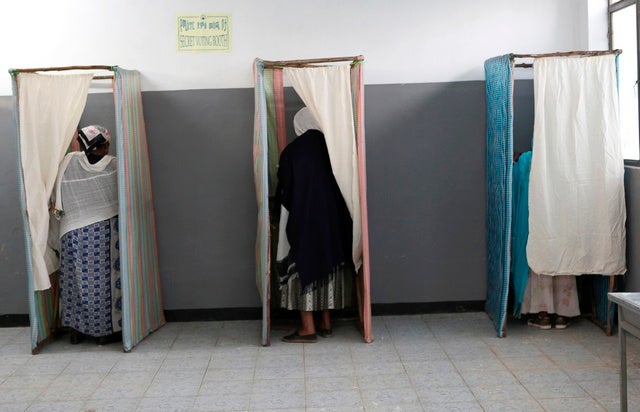
2010_Ethiopia_Voting-Elections.jpg
Ethiopians vote inside a polling station in the capital Addis Ababa on May 23, 2010.

Behind an orderly façade, the government pressured, intimidated and threatened Ethiopian voters. Whatever the results, the most salient feature of this election was the months of repression preceding it.
Rona Peligal, acting Africa director
(Nairobi) - Ethiopian government and ruling party officials intimidated voters and unlawfully restricted the media ahead of the May 23, 2010 parliamentary elections, Human Rights Watch said today.

In assessing the polls, international election observers should address the repressive legal and administrative measures that the Ethiopian ruling party used to restrict freedom of expression during the election campaign, Human Rights Watch said.

"Behind an orderly façade, the government pressured, intimidated and threatened Ethiopian voters," said Rona Peligal, acting Africa director at Human Rights Watch. "Whatever the results, the most salient feature of this election was the months of repression preceding it."

In the weeks leading up to the polls, Human Rights Watch documented new methods used by the ruling Ethiopian People's Revolutionary Democratic Front (EPRDF) to intimidate voters in the capital, Addis Ababa, apparently because of government concerns of a low electoral turnout.

During April and May, officials and militia (known as tataqi in Amharic) from the local administration went house to house telling citizens to register to vote and to vote for the ruling party or face reprisals from local party officials such as bureaucratic harassment or even losing their homes or jobs.

The May poll was the first national parliamentary election in Ethiopia since the government violently suppressed post-election protests in 2005; almost 200 people, including several police officers, died after the 2005 poll and tens of thousands of people were arrested, including opposition leaders, journalists and civil society activists.

In a March 2010 report, "‘One Hundred Ways of Putting Pressure': Violations of Freedom of Expression and Association in Ethiopia," Human Rights Watch described the complex and multi-faceted way in which the government has sought since 2005 to silence dissent, restrict the media and independent civil society, and leverage government resources such as civil service jobs, loans, food assistance and educational opportunities to encourage citizens to join the ruling party or leave the opposition.

The government's efforts to ensure the election outcome continued right up to polling day in Addis Ababa, according to Human Rights Watch's research in different areas of the capital, including in Merkato, Piazza, Wollo Sefer, Meskel Flower, Aya Ulet, Kera, Gotera, Hayat, Kotebe-CMC and Bole neighborhoods.

"Intimidation to register and to vote for the ruling party is everywhere," a resident of Addis Ababa told Human Rights Watch. "If the local administration is against you, they'll be after you forever. They can come and round you up at will."

Residents of Addis Ababa described numerous forms of intimidation in Addis Ababa in recent weeks.

Pressure to Register to Vote
Many people told Human Rights Watch that tataqi, local kebele (or neighborhood) militia members came house-to-house asking to see registration cards and checking if people were members of the ruling EPRDF party.


A couple living in the Meskel Flower area said they were visited on a weekly basis by members of the neighborhood militia who were checking whether they were registered as EPRDF members. The wife told Human Rights Watch:  "One of them approached my husband. ‘We know who you are,' he told him. ‘If you don't want to register, no problem, but then don't come to the sub-kebele and ask for your ID renewal, or for any other legal paper. We won't help you. It's up to you, now." The following day the couple registered.

Pressure to Join the Ruling Party When Registering
Different sources across the capital confirmed to Human Rights Watch that alongside registration, voters were requested to sign a paper, under a heading "Supporter of EPRDF," that included ID number, age, and address.


An Addis Ababa resident said, "There's a lot of pressure for you to obey. They have your name, they ask you to sign. If you don't, it means you're against them. And they can come back to you whenever they want. At the end of the day, you just have to do what they force you to do."

Pressure to Vote for the Ruling Party
Pressure to vote for the EPRDF appeared to take a number of different forms. Pressure was particularly acute among civil servants, people living in government-owned housing, and those living in poor neighborhoods.


An elderly resident living in state-owned housing said local government officials visited her house a few weeks before the elections asking to see her registration card. She said they wrote down her house number and told her, "We are going to check. And don't forget to vote for EPRDF. We provide you the house, we can have it back." She said that she was frightened by the threat and registered even though she had not intended to vote.

Civil servants are particularly pressured to vote for EPRDF, saying that ruling party officials remind them that it is the EPRDF government that employs them. Patterns of intimidation of teachers and others that were recently documented in Addis Ababa echo the examples previously documented across the country by Human Rights Watch in "‘One Hundred Ways Putting Pressure'."
 For example, a teacher in a public school in Addis Ababa said: "A few weeks ago my headmaster called us all. He asked us to show him our registration cards. He wanted to know whom we were going to vote for as well. I refused. He harassed me and said, ‘You better get your card, and vote properly, otherwise after the elections you might lose your job.'"

Residents also described an EPRDF pyramid recruitment strategy called One-for-Five. A coordinator (ternafi) had to identify five recruits or fellow voters (teternafiwoch) among family members, friends, colleagues or neighbors. Coordinators then tried to compel their five signers to go to the polling stations and vote all together.

A woman in Aya Ulet area said, "A neighbor came to me. He said: ‘I know you voted for the opposition last time. Are you going to vote for them again? Do I have to report it to the kebele?' I am a civil servant; I know that party officials and local administrators are the same thing. For fear of losing my job, the next morning I went to his place and signed."

Pressure on the Media and Foreign Diplomats
Simultaneous with the increased pressure on voters, in the weeks before the polls the Ethiopian government of Prime Minister Meles Zenawi acted to restrict electoral scrutiny by independent media and foreign diplomats.


The government issued several codes of conduct covering media and diplomatic activity. Initial drafts of the media regulation restricted foreign and local journalists from even speaking to anyone involved in the election process, including voters on election day, in violation of the right to freedom of expression. Several journalists in different countries told Human Rights Watch that when they applied for media visas to cover the elections, they were extensively questioned by Ethiopian embassy diplomats.

The government told Embassy staff they needed travel permits for any movement outside of Addis Ababa between May 10 to June 20.

"The government has used a variety of methods to strong-arm voters and try to hide the truth from journalists and diplomats," said Peligal. "Donor governments need to show that they recognize that these polls were multi-party theater staged by a single-party state."

Repressive Context of the Elections
Since 2005, Human Rights Watch has documented patterns of serious human rights violations by the Ethiopian government. Members of the security forces and government officials have been implicated in numerous war crimes and crimes against humanity both within Ethiopia and in neighboring Somalia. The pervasive intimidation of voters and restrictions on movement and reporting are serious concerns for the integrity of the electoral process, but represent only one aspect of the Ethiopian ruling party's long-term effort to consolidate control.


The EPRDF's main instrument for stamping out potential dissent is the local administrative (kebele) structure, which monitors households and can restrict access to important government programs, including seeds and fertilizer, micro-loans and business permits, all depending on support for the local administration and the ruling party.

Since 2008 the government has also passed new laws to clamp down on independent civil society and the media. The Charities and Societies Proclamation restricts Ethiopian nongovernmental organizations from doing any human rights work, including in the areas of women's and children's rights, if they receive more than 10 percent of their funding from foreign sources. Since the law's adoption in 2009, the leading Ethiopian human rights groups have closed most of their offices, scaled down their staff, and removed human rights advocacy from their mandates. The new regulatory agency established by the Charities and Societies Proclamation froze the bank accounts of the largest independent human rights group, the Ethiopian Human Rights Council. At least six of Ethiopia's most prominent human rights activists fled the country in 2009.

Another law, the Anti-Terrorism Proclamation, has also been used to threaten with prosecution human rights activists and journalists for any acts deemed to be terrorism under the law's broad and vague definition of the term. Several journalists also fled in 2009, including the editors of a prominent independent Amharic newspaper, and in February 2010 Prime Minister Meles acknowledged that the government was jamming Voice of America radio broadcasts.

Human Rights Watch urged the international election observer teams from the European Union and the African Union to take into account in their public reporting the insidious apparatus of control and the months of repression that frame the 2010 polls.

Ethiopia is heavily dependent on foreign assistance, which accounts for approximately one-third of government spending. The country's principal foreign donors - the United States, the United Kingdom, and the European Union, which provide more than US$2 billion annually in humanitarian and development aid, - were timid in their criticisms of Ethiopia's deteriorating human rights situation ahead of the election.

Human Rights Watch called on the principle donors and other concerned governments to publicly condemn political repression in Ethiopia and to review policy towards Ethiopia in light of its deteriorating human rights record.

"Ethiopia is an authoritarian state in which the government's commitment to democracy exists only on paper," said Peligal. "The question is not who won these elections, but how can donors justify business as usual with this increasingly repressive government?"

Thursday, April 1, 2010

Uganda's anti-homosexuality bill threatens HIV/AIDS fight

Wambi Michael

HIV campaigners fear a homophobic bill currently being discussed by the Uganda parliament will lead to further stigmatisation of the gay community in Uganda and could stop HIV positive people from accessing treatment and hamper the fight against HIV and AIDS.

Being gay and HIV positive in Uganda has never been easy. But life is set to get a lot harder for gay people seeking treatment for HIV and AIDS and other sexually transmitted infections.

Pereza (not his real name) knows better than most the difficulties gay people have in Uganda when it comes to accessing HIV treatment. When the 34-year-old, who works for a private business, first suspected that he was HIV positive he was too scared to go and be tested. "When I finally went to be tested, the counsellor asked me whether I had a partner," he told Panos. "I had to deceive her. If I had risked bringing a fellow man then I don't think I would have been enrolled for treatment."

"It takes courage for any gay person to seek medical treatment in this country," Pereza continued. "Most of us are dying because we cannot access treatment, care and support. You would be ridiculed if you dared to come out to tell a nurse or doctor that you are gay. Everyone would look at you as if you were something dirty."

The difficulties facing men and women like Pereza have recently come to light because of the so-called Anti Homosexuality Bill, a private member's bill currently being discussed by the Ugandan cabinet and which has created a growing climate of fear among the gay community in Uganda.

Already illegal

Homosexual acts are already illegal in this East African country, carrying a sentence of up to 14 years in prison. The bill, which was proposed towards the end of 2009 by David Bahati, an MP for the ruling National Resistance Movement, seeks to up this to life imprisonment. It also proposes the death sentence for a new offence of "aggravated homosexuality" – namely when one of the participants is under 16, disabled, HIV positive or a "serial offender".

An estimated 170,000 people are enrolled in government ARV treatment in Uganda with a further 100,000 expected to enrol by the middle of this year.

Dr. Stephen Watiti, the chairperson of the National Forum of People Living with HIV/AIDS Network, said about 80 percent of Uganda's ARV treatment is funded by foreign donors and any cuts in aid would directly affect HIV positive people. "Removing [any of] that money would be a death sentence to those receiving the treatment," he said.

Watiti said treatment interruptions caused by shortages of the drug could lead to a new drug resistant HIV epidemic. He added that criminalising HIV transmission in both homosexuals and heterosexuals would cause stigma that would fuel the disease, leading to more deaths.

Laban, a university student in Uganda's capital, Kampala, is scared.

"Some of my classmates know that I'm gay," the 23-year-old said. "With this law they are expected to report me to the police. If the bill is passed I will leave my studies and go into hiding."

He is referring to the fact that if the bill is passed anyone who fails to report within 24 hours the identities of any gay, lesbian, bisexual or transgendered person could be sent to prison for up to three years.

Prominent members of society "outed"

Some of the local newspapers have already "outed" prominent members of society they believe to be gay. Campaigners fear the bill could lead to McCarthy era witch hunts, sending the gay community underground and preventing effective anti HIV teaching.

Laban told Panos the gay community faces a lot of stigma. "You are expected to behave in a certain way which is approved by the culture and morals," he said. "So I have decided to live alone to avoid being ridiculed."

Frank Mugisha, head of Sexual Minorities Uganda (SMUG), is one of few gay Ugandans to actively campaign for their rights. As a result he has become a potential target and cannot go out without bodyguards. He told Panos the gay community has been living in fear since Bahati tabled his bill. "If the bill passes into law we will be ostracised by almost everyone in society. Already we can't go to overcrowded places because for fear of being attacked by a mob."

An "odious" bill

The bill has caused outcry, both internationally and in Uganda.

Barack Obama called the bill "odious", while several other leaders, including UK prime minister Gordon Brown, have put pressure on Uganda's president Yoweri Museveni to withdraw the bill.

One of those most strongly opposed to the bill is the Swedish government, which threatened to cut the $50 million in aid it gives Uganda each year if the bill is passed.

There have also been calls from US human rights campaigners for America to cut some of its considerable aid. The US is the biggest donor to Uganda's HIV treatment programmes under The US President's Emergency Plan for AIDS Relief (PEPFAR). From 2004 to the end of 2009 Uganda had received a total of almost US$1.5 billion. The money has helped provide more than 200,000 people living with HIV/AIDS with life-prolonging antiretroviral (ARV) drugs.

As a result of this pressure, the bill now looks likely to be watered down. Museveni has himself changed tack. Having previously condemned homosexuals, he has distancing himself from the bill, declaring parliament's handling of it "must take into account our foreign policy interests". Meanwhile, David Bahati announced in January that he would be willing to amend the bill - though he did not say how.

Strong support for the bill

However, the voices supporting the bill – and denouncing foreign countries for intervening in Uganda's affairs – remain very strong.

Bahati has the support of Uganda's powerful lobby of Evangelical and Anglican bishops, many of whom have been outspoken in favour of the bill and who have the power to sway public opinion.

Archbishop Henry Luke Orombi of the Church of Uganda, the country's main Anglican Church which claims to represent 30 per cent of all Ugandans, publically confirmed his support for the bill in February at the General Synod, the national assembly of the Church of England, in London.

In a formal statement Orombi said the Church of Uganda "particularly appreciate[s] the objectives of the Bill which seek to... prohibit and penalize homosexual behaviour and related practices in Uganda as they constitute a threat to the traditional family." He also remarked that: "Homosexual practice has no place in God's design of creation, the continuation of the human race through procreation or His plan of redemption" and that "lesbianism, bestiality and other sexual perversions" should also be prohibited.

"State-legislated genocide"

Some members of the Christian community have spoken out against the bill and Ugandan society is divided. Canon Gideon Byamugisha, a prominent member of Uganda's Anglican Church, described the bill as "state-legislated genocide against a specific community".

Christopher Senyonjo, a retired Anglican bishop living in Uganda, said: "The bill will push Uganda towards being a police state. There is lack of understanding about homosexuality – it is not [about] recruitment [of gay people], it is [about] orientation."

Yet it is the feeling on the streets of Kampala and across Uganda that is likely to determine what happens, as MPs will court popular opinion.

Young preachers, encouraged by the churches, preach against homosexuality on Kampala's busy street corners.

One of these preachers is Betty Wanyaka. She told Panos: "I'm a mother and I believe in God, so I'm against homosexuality. The Word says men have to marry woman not man and man."

But not everyone agrees. Calvin Kanyali, a young salesman from Kampala, said there were more pressing issues than attacking the gay community.

"People are dying of cancer, the hospitals have no medicine but they want to spend the little money there is chasing after homosexuals. This shouldn't be the biggest priority for our MPs," he said.

HIV/AIDS' rates could rise on wave of homophobia

Uganda | A health worker visits a man with AIDS. A new anti-homosexuality bill in Uganda's parliament will make it more difficult to fight HIV/AIDS / Sean Sprague - Panos picturesGerald Sentongo, the Administrator of Sexual Minorities Uganda (SMUG), told Panos that if the bill was passed it would further complicate efforts to prevent HIV/AIDS among homosexuals in Uganda.

Around 5.4 per cent of Uganda's population is HIV positive, according to official government statistics. Campaigners fear this figure could rise with the rising tide of homophobia.

"No one will come out to seek treatment knowing that the nurse, counsellor or doctor is required by law to report a homosexual and have him arrested by police," Mr Sentongo said.

All our journalism is free to reproduce, unless otherwise noted. Please get in touch with media@panos.org.uk for more information or to let us know that you've reproduced something.