Translation

.يولد جميع الناس أحرارا متساوين في الكرامة والحقوق. وقد وهبوا عقلا وضميرا وعليهم أن يعامل بعضهم بعضا بروح الإخاء‎
FoxLingo German Spanish French Arabic Czech Greek Hungarian Italian Polish Portuguese Romanian Russian Serbian Slovenian Thai Turkish
Showing posts with label Israels Racism. Show all posts

Wednesday, October 6, 2010

Israeli Police Given Protection for Killing

By Mel Frykberg
SHUAFAT, Occupied East Jerusalem, Oct 6, 2010 (IPS) - A peaceful morning is interrupted by the sounds of an Israeli helicopter circling overhead -- often a sign of trouble on the ground. Later Sunday the news broke -- a Palestinian man was shot dead in the village of Issawiya by Israeli paramilitary border police as he tried to enter Israel in search of work.

Father of five, 38-year-old Ezzidine Al-Kawazba from Hebron became the latest Palestinian casualty to die at the hands of the Israeli security forces in disputed circumstances. The policeman who shot Al-Kawazba alleged that his weapon went off "accidentally" and that he "didn't mean to kill the labourer."

Ahmed Tibi, an Israeli-Arab Minister of the Israeli Knesset, condemned the shooting. "Once again Israel's police officers and border police shoot and kill an Arab in cold blood. This time it was a father to many children who was trying to enter Jerusalem to find work for his livelihood.

"Again the automatic false claim was made that a Palestinian tried to take a Border Policeman's weapon. Will the police force, once again, rally behind this murdering officer? Will he, too, gain the status of a hero that killed another Arab?"

Earlier, IPS attended the funeral of Sameh Sarhan from East Jerusalem after he was shot dead by an Israeli security guard, who claimed self-defence, outside the illegal Israeli settlement of King David in occupied East Jerusalem. Video evidence taken at the scene contradicted the security guard's version of events. Sarhan's killing sparked a week of riots.

The latest killing in Issawiya came as two Israeli soldiers were convicted by an Israeli military court of using Palestinians as human shields during Israel's Operation Cast Lead in Gaza December 2008-January 2009, which left more than 1,400 Palestinians dead, most of them civilian.

The soldiers were convicted of offences including inappropriate behaviour and overstepping authority for ordering an 11-year-old Palestinian boy to search bags suspected to have been booby-trapped.

The Israeli police have said they are investigating the two latest shootings. However, a lack of confidence in the integrity of police investigations when security force members are involved in the killing of unarmed Palestinians has been backed by several Israeli rights groups.

The Israel Democracy Institute is due to release a report accusing the Israeli police of "bias in analysing evidence" in relation to three Israeli-Arabs shot dead by police during the October 2000 riots (the beginning of the second Palestinian Intifadah, or uprising) in northern Israel. Thirteen Palestinians were shot dead and hundreds were injured.

The study investigates the circumstances which prompted then Israeli attorney general Menachem Mazuz to follow the state prosecutor's recommendation to close the inquiries into the deaths of three men on the basis of lack of evidence.

Prof. Mordechai Kremnitzer and former Haifa district attorney Lina Saba, who conducted the study, examined files containing dozens of pieces of accumulated evidence.

The Israeli daily Haaretz reported that according to the investigators, "the study shows that closing these three cases was unjustified and the Department for Investigating Policemen, and the prosecution, did not complete the investigation. The examination also showed the prosecution took a biased approach in analysing the evidence."

Several months ago Israeli policeman Shahar Mizrahi, who shot dead an unarmed Palestinian motorist who he claimed was a car thief, was sentenced to an original 15 months imprisonment. This was later doubled to 30 months on appeal when an Israeli court found the killing unnecessary as the officer's life was not in danger as he had claimed.

Yitzhak Aharonovitch, Israel's internal security minister, and Dudi Cohen, the police commissioner said they would immediately seek a presidential pardon for Mizrahi. "I won't merely support a pardon bid, I'll lead it," added Aharonovitch.

Israeli police gave Mizrahi more than 42,500 dollars for legal expenses in the initial criminal case, and a further 50,000 dollars for his appeal to the Supreme Court.

Israeli rights group Yesh Din reported earlier in the year that only "six percent of investigations yielded indictments against Israeli soldiers who harmed Palestinians."

Another Israeli human rights organisation B'tselem released a report last month 'Void of Responsibility: Israel Military Policy not to investigate Killings of Palestinians by Soldiers'.

In the report B'tselem stated that "at the beginning of the second Intifadah, the Judge Advocate General's Office announced that it was defining the situation in the Occupied Territories as an 'armed conflict', and that investigations would be opened only in exceptional cases, in which there was a suspicion that a criminal offence had been committed.

"This policy, which led to a significant drop in Military Police investigations of homicide cases, ignored the varying character of the army's actions in the Occupied Territories, and treated every act carried out by soldiers as a combat action, even in cases when these acts bear the clear hallmarks of a policing action." Meanwhile, another Palestinian mosque near Bethlehem was torched and vandalised on Sunday night by Israeli settlers. A number of copies of the Koran were reported destroyed. Clashes then broke out between Palestinians and the settlers. Israeli soldiers subsequently arrived and forced the settlers to retreat, but none were arrested.

Several West Bank mosques have been subjected to settler vandalism and arson attacks since last year. Others have had anti-Arab and anti-Muslim graffiti scrawled on their walls. The Israeli authorities have not charged anyone.

Israeli Police Given Protection for Killing

By Mel Frykberg
SHUAFAT, Occupied East Jerusalem, Oct 6, 2010 (IPS) - A peaceful morning is interrupted by the sounds of an Israeli helicopter circling overhead -- often a sign of trouble on the ground. Later Sunday the news broke -- a Palestinian man was shot dead in the village of Issawiya by Israeli paramilitary border police as he tried to enter Israel in search of work.

Father of five, 38-year-old Ezzidine Al-Kawazba from Hebron became the latest Palestinian casualty to die at the hands of the Israeli security forces in disputed circumstances. The policeman who shot Al-Kawazba alleged that his weapon went off "accidentally" and that he "didn't mean to kill the labourer."

Ahmed Tibi, an Israeli-Arab Minister of the Israeli Knesset, condemned the shooting. "Once again Israel's police officers and border police shoot and kill an Arab in cold blood. This time it was a father to many children who was trying to enter Jerusalem to find work for his livelihood.

"Again the automatic false claim was made that a Palestinian tried to take a Border Policeman's weapon. Will the police force, once again, rally behind this murdering officer? Will he, too, gain the status of a hero that killed another Arab?"

Earlier, IPS attended the funeral of Sameh Sarhan from East Jerusalem after he was shot dead by an Israeli security guard, who claimed self-defence, outside the illegal Israeli settlement of King David in occupied East Jerusalem. Video evidence taken at the scene contradicted the security guard's version of events. Sarhan's killing sparked a week of riots.

The latest killing in Issawiya came as two Israeli soldiers were convicted by an Israeli military court of using Palestinians as human shields during Israel's Operation Cast Lead in Gaza December 2008-January 2009, which left more than 1,400 Palestinians dead, most of them civilian.

The soldiers were convicted of offences including inappropriate behaviour and overstepping authority for ordering an 11-year-old Palestinian boy to search bags suspected to have been booby-trapped.

The Israeli police have said they are investigating the two latest shootings. However, a lack of confidence in the integrity of police investigations when security force members are involved in the killing of unarmed Palestinians has been backed by several Israeli rights groups.

The Israel Democracy Institute is due to release a report accusing the Israeli police of "bias in analysing evidence" in relation to three Israeli-Arabs shot dead by police during the October 2000 riots (the beginning of the second Palestinian Intifadah, or uprising) in northern Israel. Thirteen Palestinians were shot dead and hundreds were injured.

The study investigates the circumstances which prompted then Israeli attorney general Menachem Mazuz to follow the state prosecutor's recommendation to close the inquiries into the deaths of three men on the basis of lack of evidence.

Prof. Mordechai Kremnitzer and former Haifa district attorney Lina Saba, who conducted the study, examined files containing dozens of pieces of accumulated evidence.

The Israeli daily Haaretz reported that according to the investigators, "the study shows that closing these three cases was unjustified and the Department for Investigating Policemen, and the prosecution, did not complete the investigation. The examination also showed the prosecution took a biased approach in analysing the evidence."

Several months ago Israeli policeman Shahar Mizrahi, who shot dead an unarmed Palestinian motorist who he claimed was a car thief, was sentenced to an original 15 months imprisonment. This was later doubled to 30 months on appeal when an Israeli court found the killing unnecessary as the officer's life was not in danger as he had claimed.

Yitzhak Aharonovitch, Israel's internal security minister, and Dudi Cohen, the police commissioner said they would immediately seek a presidential pardon for Mizrahi. "I won't merely support a pardon bid, I'll lead it," added Aharonovitch.

Israeli police gave Mizrahi more than 42,500 dollars for legal expenses in the initial criminal case, and a further 50,000 dollars for his appeal to the Supreme Court.

Israeli rights group Yesh Din reported earlier in the year that only "six percent of investigations yielded indictments against Israeli soldiers who harmed Palestinians."

Another Israeli human rights organisation B'tselem released a report last month 'Void of Responsibility: Israel Military Policy not to investigate Killings of Palestinians by Soldiers'.

In the report B'tselem stated that "at the beginning of the second Intifadah, the Judge Advocate General's Office announced that it was defining the situation in the Occupied Territories as an 'armed conflict', and that investigations would be opened only in exceptional cases, in which there was a suspicion that a criminal offence had been committed.

"This policy, which led to a significant drop in Military Police investigations of homicide cases, ignored the varying character of the army's actions in the Occupied Territories, and treated every act carried out by soldiers as a combat action, even in cases when these acts bear the clear hallmarks of a policing action." Meanwhile, another Palestinian mosque near Bethlehem was torched and vandalised on Sunday night by Israeli settlers. A number of copies of the Koran were reported destroyed. Clashes then broke out between Palestinians and the settlers. Israeli soldiers subsequently arrived and forced the settlers to retreat, but none were arrested.

Several West Bank mosques have been subjected to settler vandalism and arson attacks since last year. Others have had anti-Arab and anti-Muslim graffiti scrawled on their walls. The Israeli authorities have not charged anyone.

Sunday, August 1, 2010

Israel: Halt Demolitions of Bedouin Homes in Negev

2010_Israel_Negev3.JPG
 
Pre-Dawn Raid Destroys Entire Village
August 1, 2010

Joe Stork, deputy Middle East director at Human Rights Watch

(Jerusalem) - The Israeli government should immediately impose a moratorium on demolishing the homes of Bedouin citizens, Human Rights Watch said today. The government should also fully compensate those whose homes and property it has destroyed and allow them to return to their village pending a final agreement with the displaced that respects their rights under international law.

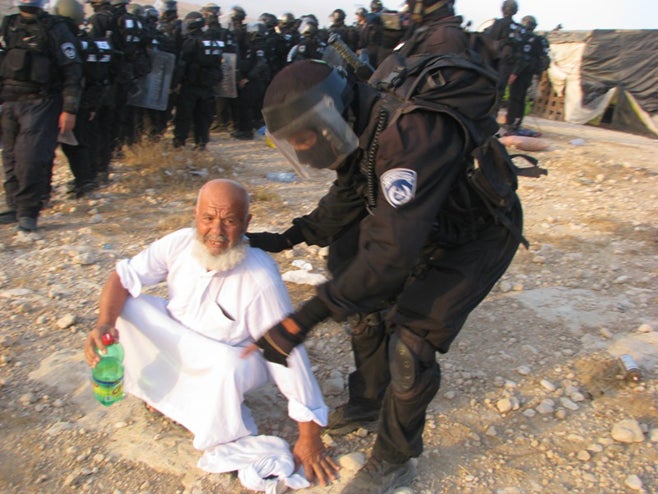
In a pre-dawn raid on July 27, 2010, Israeli security forces destroyed all 45 homes, animal pens, and other structures in the village of al-Araqib, leaving more than 300 people homeless, about half of them children under 16. Nearly 90,000 Palestinian Arab Bedouins, the indigenous inhabitants of the Negev (Naqab) region of southern Israel, live in dozens of "unrecognized" towns. Because the Israeli authorities refuse to recognize their towns and villages, the Bedouins risk the destruction of their homes at any time.

"Tearing down an entire village and leaving its inhabitants homeless without exhausting all other options for settling longstanding land claims is outrageous," said Joe Stork, deputy Middle East director at Human Rights Watch. "The attack on these Israeli citizens' property shows that Israel's discriminatory policies toward Palestinian Arab Bedouin have not changed."

The July 27 raid began around 4:30 a.m. when 1,300 armed police officers in riot helmets and shields blocked the entrance to the village and entered it. The force included mounted cavalry, helicopters, inspectors from the Israel Land Administration (ILA) - the government agency responsible for managing the 93 percent of Israeli land owned by the state, and demolition crews operating bulldozers, according to witnesses and video images viewed by Human Rights Watch.

The crews forcibly removed the villagers, mostly children and elderly people, from their homes before the demolition operation began. Awad Abu Freih, spokesman for the al-Araqib civil committee, told Human Rights Watch that residents were unarmed and stayed in their homes after police arrived in a form of passive resistance. Bulldozers also destroyed carob and olive trees, chicken coops, and other structures, residents said.

The Israeli police foreign press spokesman, Mickey Rosenfeld, told Human Rights Watch that the police acted on a court order issued 11 years ago but not previously executed. The operation "was done quietly and sensitively and in coordination with the village representatives," Rosenfeld said. Abu Freih denied that there had been any coordination. Rosenfeld added that Land Administration officials evacuated al-Araqib residents to an area close to the nearby city of Rahat, where, he claimed, they had additional residences.

Ortal Tzabar, a Land Administration spokeswoman, confirmed in a statement to Human Rights Watch that the authorities also uprooted 850 olive trees that she said were "to be replanted elsewhere."

Abu Freih and Ye'ela Raanan, spokeswoman for the Regional Council for the Unrecognized Villages, a local organization, said that only a few dozen people from al-Araqib have other homes. Some residents may have spent the night with friends or relatives in Rahat after the demolitions, Raanan said, but "there are at least 250 people now who don't have another option." Raanan said she was at al-Araqib during the operation and that residents began on July 28 to build makeshift tents on the site with wooden frames and cheap fabric.

Residents and Israeli rights activists told Human Rights Watch that police began assembling at the village late Monday evening. At 12:15 a.m., the Kiryat Gat Peace Court (court of first instance) rejected an appeal filed by village residents contending that the state had no legal grounds to demolish their homes.

The Negev Coexistence Forum, a Bedouin rights group, said in a statement that al-Araqib existed before the creation of Israel in 1948 and that residents returned there after being evicted by the state in 1951. Many of the unrecognized villages are around Beer Sheva, the Negev's largest city. The current draft of a metropolitan plan for Beer Sheva designates the land where al-Araqib is located as a "recreational area" and as an area for "forest and forestation."

A lawyer who represents several al-Araqib residents and who asked not to be named, said that the Israeli government issued "evacuation orders" in 2002 to nine people in the village based on Article 21 of the Property Law, which allows for the owner of a piece of property - in this case, the state of Israel claims to own the property - to evict anyone residing on it illegally. But, he said, in the eight years since then authorities had not made any attempt to carry out these orders.

While the village population has grown since then, no other residents received evacuation or demolition orders until June of this year, the lawyer said, when several others received letters from the government threatening them with house demolition. These letters were based on Article 64 of the Repossession Law (Hotza'a Lapoal), which says the authorities may also evict other residents, interpreted by the state and the courts to include those in a vaguely-defined "legal relation" with anyone against whom other orders have been issued.

Israeli authorities carried out the demolitions despite pending legal claims to the land that Al-Araqib residents are pursuing in Beer Sheva District Court. Abu Freih, the al-Araqib civil committee spokesman, told Human Rights Watch that over a dozen such land claims are pending. One resident and human rights activist, Nouri al-Okbi, testified in court that the Israeli government confiscated 820 dunams (82 hectares) of land from his family, without compensation, when they were expelled in 1951.

The state contends that the Bedouin have never had recognized land claims in the area. Al-Okbi's lawyer, Michael Sfard, recently produced evidence in court, however, that appeared to show that the Jewish National Fund had bought land in this area from Bedouin owners during British rule, as did Ottoman authorities before then. This, he said, indicated that the area had customarily been recognized as belonging to the Bedouin.

The demolitions came two days after Prime Minister Binyamin Netanyahu made comments in a government meeting, as reported by Israeli media, about the "threat" of losing a Jewish majority in the Negev region. "We are under real attack on this issue [of Israel as a Jewish state]," Netanyahu was quoted as saying in a July 25 government meeting regarding amendments to the citizenship law. "The meaning could be that different elements will demand national rights within Israel, for example, in the Negev, if we allow for a region without a Jewish majority. It has happened in the Balkans, and it is a palpable threat."

Israel has demolished thousands of Negev Bedouin homes since the 1970s, and over 200 since 2009. Israeli authorities have demolished many structures in al-Araqib in the past, although never the entire village. The Land Administration also began spraying villagers' crops with herbicides in 2002 as a mechanism to cause evacuation, a practice deemed illegal by the Israeli Supreme Court in 2007.

"Israel employs systematically discriminatory policies in the Negev," Stork said. "It is tearing down historic Bedouin villages before the courts have even ruled on pending legal claims, and is handing out Bedouin land to allow Jewish farmers to set up ranches."

Background
Tens of thousands of Bedouin citizens in southern Israel live in "unrecognized" villages like al-Araqib. Because the government considers the villages illegal, it has not connected them to basic services and infrastructure such as water, electricity, sewage treatment, and garbage disposal. Although the villages do not appear on official maps, some existed before the state of Israel was established in 1948. Others sprang up after the Israeli army forcibly displaced Bedouin tribes from their ancestral lands immediately following the 1948 war. Israel passed laws in the 1950s and 1960s enabling the government to lay claim to large areas of the Negev where the Bedouin had formerly owned or used the land. Planning authorities ignored the existence of Bedouin villages when they created Israel's first master plan in the late 1960s.

Israeli officials contend that they are simply enforcing zoning and building codes and insist that Bedouin can relocate to seven existing government-planned townships or a handful of newly recognized villages. The government-planned townships are seven of the eight poorest communities in Israel and are ill-equipped to handle any influx of new residents. Many - if not most - Bedouin have rejected relocating to the townships, which have minimal infrastructure, high crime rates, scarce job opportunities, and insufficient land for traditional livelihoods such as herding and grazing. In addition, the state requires Bedouin who move to the townships to renounce their ancestral land claims - unthinkable for most Bedouin, who have claims to land passed down from parent to child over generations.

Bedouin constitute 25 percent of the population of the northern Negev, but occupy less than 2 percent of its land. Over the past decade, Israeli authorities have allocated large tracts of land in this region, and public funds, for the creation of private ranches and farms. There are 59 such "individual farms" in the Negev - only one allocated to a Bedouin family and the rest to Jewish families - that stretch over 81,000 dunams of land, greater than the total land area granted to the seven planned Bedouin townships housing 85,000 people. The Israeli human rights organization Adalah says the state has connected these farms to national electric and water grids, despite the fact that some lack proper planning permits. In a series of laws, the latest passed on July 12, the state retroactively legalized such farms and authorized the establishment of more.

Human Rights Watch documented the systematic discrimination that Bedouin citizens face in a130-page report, "Off the Map," released in March 2008.

Israel ratified the International Covenant on Economic, Social and Cultural Rights in 1991, requiring it to guarantee the right to housing. The United Nations Committee responsible for interpreting the covenant has said this means governments can carry out forced evictions only in "the most exceptional circumstances," and even then only in accordance with human rights principles requiring the government to consult with the affected individuals or communities, identify a clear public interest requiring the eviction, ensure that those affected have a meaningful opportunity to challenge the eviction, and provide appropriate compensation and adequate alternative land and housing arrangements.

Another right at stake is the right to property, set out in the Universal Declaration of Human Rights. The 2007 UN Declaration of the Rights of Indigenous Peoples, opposed by only two states in the world - the US and Canada - states that indigenous peoples have the right to lands they traditionally owned, occupied or otherwise used, and that states should give legal recognition to this. It also says that no relocation of indigenous peoples should take place without their free, prior, and informed consent and only after prior agreement on just and fair compensation.

In December 2008, the Goldberg Commission, appointed by the government in late 2007 to find a solution for the land claims of residents of the unrecognized villages, recommended that the state recognize villages that have a "critical mass" of permanent residents and that do not interfere with other state planning. In practice this would be limited to the recognition of only a few of the dozens of unrecognized villages. The commission also called for the establishment of several claims committees to deal with Bedouin ownership claims and provide financial compensation for expropriated land. In May 2009, the government established the Prawer Committee to outline a plan to implement the Goldberg Commission's recommendations.

Friday, June 11, 2010

Pride Toronto in hiding after spirited denunciation from queer leaders

No one takes giant shame placard from former honorees
Marcus McCann

Armed with an oversized cardboard shame award, a group of queers trying to give back their trophies ran into a problem on June 7: the offices of Pride Toronto (PT) were locked.

As one, two and eventually three police cruisers showed up, it became increasingly clear than no one from PT was going to accept the giant shame certificate nor the statuettes from former grand marshals, honoured dykes and other honorees.

A police officer on hand said that no one was inside the building but that someone from PT had alerted police to the protest on Sunday, apparently out of fear it would lead to vandalism.

After PT announced that its board had voted 4-3 to ban the term “Israeli Apartheid” from the parade, queer community leaders mobilized to pressure PT’s board to reverse its decision. First, Alan Li refused to accept the title of grand marshal, then Jane Farrow declined the honoured dyke title. Since then, both Michelle Walker (community service award) and ILGA (international marshals) have turned down honours.

During the press conference, PT issued a statement on its website, saying the decision to ban the term "Israeli Apartheid" was not taken lightly.

"The board of Pride Toronto listened to members of our community," it said. "What we heard overwhelmingly was that the use of the words 'Israeli Apartheid' made participants feel unsafe."

Tim McCaskell, a member of Queers Against Israeli Apartheid (QuAIA), spoke to Xtra after PT's release.

"If people feel unsafe, I would suggest that they are being manipulated," he said. "If the word is 'uncomfortable,' well, Pride makes a lot of people uncomfortable."

An hour earlier, you could have heard a pin drop when James Loney approached the podium at the 519 Community Centre, where more than 100 queers gathered for a press conference before marching on the PT office.

Loney — a peace activist who spent four months as a hostage in Iraq — was one of nearly two dozen PT honorees    giving back their awards.

“Us queers know it in our bones: silence equals death,” Loney said, as he discussed how silence affected him and his partner following his abduction.

Video of the press conference:


Loney was joined by Farrow, Walker and a raft of others who spoke against PT. On hand were:

Queer leaders carried a "Shame Award" to the doorstep of Pride Toronto's Dundonald St office.
James Loney (“Fearless” Theme Award, 2006)
Zahra Dhanani (Honoured Dyke, 2006)
Sky Gilbert (Grand Marshal, 2000)
Faith Nolan (Honoured Dyke, 2009)
El-Farouk Khaki (Grand Marshal, 2009)
Rachel Epstein (Honoured Dyke, 2007)
Gareth Henry (International Grand Marshal, 2008)
Anna Willats (Honoured Dyke, 2008)
JP Hornick (Grand Marshal, 2002)
John Greyson (Arts & Culture Award, 2009)
Savoy Howe (Award for Excellence in Sports, 2008)
Leonardo Zuniga (Human Rights Award, 2009)
Matthew Cutler (Youth Award, 2009)
Michelle Walker (Community Service Award, 2010)
Jane Farrow (Honoured Dyke, 2010)

Six others were to return their awards but couldn’t attend in person:

Gloria Careaga and Renato Sabbadini (International Grand Marshals, 2010)
Faisal Alam (Spirituality Award, 2009)
Victor Mukasa (International Grand Marshal, 2009)
Salah Bachir (Grand Marshal, 2005)
Rosanna Flamer-Caldera (International Grand Marshal, 2007)
Alan Li (Grand Marshal, 2010)

Discontent with PT went beyond its banning of “Israeli Apartheid,” as speaker after speaker drew links between the act of censorship and other moves to whitewash the celebrations.

Farrow pointed out that performers on all PT stages must sign an agreement promising not to say anything offensive or political. Farrow says the clause, which has been in effect since 2008, was defended by PT organizers as preventing musicians from endorsing, for instance, mayoral candidates.

“This is not speech that anyone needs to be protected from,” she said.

JP Hornick, one of the women charged in the Pussy Palace raids, decried the de-sexing and de-politicizing of Pride.

“This is not a parade; it’s a march. It’s about sex. It’s about who we fuck,” she said.

Anna Willats, Pride Toronto's honoured dyke in 2008, told the boisterous room that queers need to take back Pride “if we want to put on a World Pride [in 2014] that doesn’t look like the Santa Claus Parade.”

Performer, playwright and provocateur Sky Gilbert remembered his experience of being told not to perform sex acts on his float in the late ’90s, after he gave head to a dyke’s strap-on dildo the year before.

He also defended PT executive director Tracey Sandilands — sort of.

“I’m sure that she’s a nice person. I suspect that she’s maybe a nice person. Tracey Sandilands is the new face of corporate Pride, but she’s just doing her job,” he said, adding that political queers have allowed Pride to become a sanitized spectacle.

Musician Faith Nolan says that she’s been following as alternative Pride events spring up. She was invited to perform at one — apparently to be held at the Gladstone — which was to be a non-political show of unity that didn’t choose sides between PT and QuAIA.

“I looked at it and I emailed them back and said, 'Absolutely not,’” adding, “If you don’t stand for something, you’ll fall for anything.”

Groups will outline plans for alternative Pride celebrations at a community meeting at The 519 tonight (Monday, June 7), at 6:30pm. The proceedings will be streamed at xtra.ca. (UPDATE: Watch our recording below. First chunk missing due to internet connection issues at the event — our apologies!)

Wednesday, March 17, 2010

Pressure Grows on U.S. to Tamp Down Its Spat with Israel

Benjamin Netanyahu is clearly feeling lucky. As his skirmish with the Obama Administration over Israel's settlement activity in East Jerusalem entered its second week on Tuesday, the Israeli Prime Minister was pushing back against Washington's demands. U.S. Secretary of State Hillary Clinton has put the onus on Israel to "demonstrate its commitment" to the peace process by reversing a plan to build new housing units in East Jerusalem (occupied by Israel since 1967); declaring its readiness to hold substantial negotiations with the Palestinians on all final-status issues (including Jerusalem, whose control by Israel Netanyahu has repeatedly insisted is non-negotiable); and making other gestures such as freeing Palestinian prisoners and easing the siege of Gaza. But the Israeli leader insisted on Monday that the Jerusalem construction plans wouldn't change, and on Tuesday he answered Clinton by saying that "the government of Israel has proven over the last year that it is committed to peace, both in words and actions." Clearly, the Israeli leader is through eating crow following the furor caused by his government's public humiliation of U.S. Vice President Joe Biden last week.


Netanyahu appears to sense the political winds at his back. While the initial response by many in Israel had been to berate him over the provocation during Biden's visit, mounting pressure from Washington on a wider range of issues may turn the domestic political tide in his favor. Netanyahu last year strengthened his domestic political position by defying the Obama Administration's demand for a complete settlement freeze as a step toward resuming peace talks. And besides his own right-wing coalition urging him to stay the course, a wider range of Israeli leaders may be leery of allowing Washington to dictate Israel's actions.


As he moves to defuse the crisis on his own terms, Netanyahu may also believe that the political balance in Washington will tip in his favor. U.S. public opinion remains far more favorable to Israel than to the Palestinians, and with the annual conference of the influential America Israel Public Affairs Committee (AIPAC) due to begin in Washington on Sunday, Netanyahu — who is expected to speak at the event, as is Clinton — appears to be hanging tough. AIPAC fired a warning shot earlier this week, blaming the Administration for the breakdown and urging it to "move away from public demands and unilateral deadlines directed at Israel."

With a number of prominent Republicans excoriating the Administration over the spat and some Democrats increasingly uncomfortable in an election year when many will struggle to hold on to their congressional seats, Netanyahu may be betting that the pressure is greater on Obama to tamp down the tension.

But the Obama Administration will be considering more than simply the narrow concerns of U.S. electoral politics. The showdown with Netanyahu underscores just how little progress Washington has made in resuscitating the moribund Middle East peace process. The limited "proximity talks" over which the latest row broke out are themselves an indicator of just how poor the chances are of brokering a consensual peace agreement between the current Israeli and Palestinian leaderships, even as events on the ground steadily erode the prospects for creating a viable Palestinian state alongside Israel.

The current showdown reflects a recognition by the Administration that getting the peace process back on track may require a willingness to press Israel into actions that its current leaders are unlikely to take of their own volition, and that's an unappealing choice for a politically vulnerable Administration. But there are other voices making themselves heard in ways that preclude an easy retreat. Indeed, there's a growing belief in Washington that U.S. national interests across the region are imperiled by a failure to resolve the Israeli-Palestinian conflict in a manner minimally acceptable to the Arab world — a two-state solution based on the 1967 borders, with East Jerusalem as the Palestinian capital. After the East Jerusalem settlement announcement, Biden was reported by Israeli media to have told Netanyahu behind closed doors, "What you're doing here undermines the security of our troops who are fighting in Iraq, Afghanistan and Pakistan. That endangers us, and it endangers regional peace."

Biden's reported comments may simply be channeling a perspective coming from within the U.S. military, which now has nearly 200,000 troops stationed in the Muslim countries of Centcom's Area of Responsibility (AOR). Centcom chief General David Petraeus was blunt about the impact on his mission of the Israeli-Palestinian impasse in testimony submitted to U.S. Senators on Tuesday: "The enduring hostilities between Israel and some of its neighbors present distinct challenges to our ability to advance our interests in the AOR," Petraeus said in prepared remarks, adding, "The conflict foments anti-American sentiment, due to a perception of U.S. favoritism for Israel. Arab anger over the Palestinian question limits the strength and depth of U.S. partnerships with governments and peoples in the AOR and weakens the legitimacy of moderate regimes in the Arab world. Meanwhile, al-Qaeda and other militant groups exploit that anger to mobilize support. The conflict also gives Iran influence in the Arab world through its clients, Lebanese Hizballah and Hamas." The general made clear that "progress toward resolving the political disputes in the Levant, particularly the Arab-Israeli conflict, is a major concern for Centcom."

The message from the comments attributed to Biden, and from Petraeus' testimony, is clear: This is not simply about the Israelis and Palestinians; U.S. national interests are at stake. And that creates pressure on the Administration not to allow the peace process to remain stalled.

Nor are the Palestinians going to wait passively for what Senator Joseph Lieberman calls a "family dispute" to amiably resolve itself. After all, for the Palestinians, that "family" relationship has been a disaster, and they'll seek to drive a wedge on the issue by pushing back against Israeli encroachment in East Jerusalem and elsewhere. Palestinian activists have for weeks been protesting against Israeli construction activities in East Jerusalem, and on Tuesday those escalated with a "Day of Rage" called by Hamas, which led to fierce clashes between youths and Israeli police. The symbolic importance of Jerusalem throughout the Arab world makes protest there a touchstone issue that could generate a surge of outrage that the Palestinian Authority may be unable to restrain, particularly given Israel's intent to keep on building. Hamas is certainly more than happy to encourage a grass-roots challenge to the negotiation policy of Palestinian Authority President Mahmoud Abbas in the form of protests in Jerusalem — and many leaders in Abbas' own Fatah movement, equally tired of waiting for diplomacy to deliver, are joining in. Settler groups on the Israeli side, too, are likely to up the ante. So even if the Administration manages to get "proximity talks" back on track, the battle for Jerusalem is likely to intensify.


Friday, March 5, 2010

MIDEAST: Occupation Turns Palestinian Women Into Breadwinners

By Mel Frykberg
Sawsan Daba is happy to have found some employment with the Women's Programme Centre in Gaza.    / Credit:Mel Frykberg/IPS


Sawsan Daba is happy to have found some employment with the Women's Programme Centre in Gaza.

Israel’s occupation of the Palestinian territories, with its ubiquitous closures, checkpoints, military raids and arrests, has decimated the Palestinian economy in the West Bank and Gaza.

The World Bank (WB) warned over a year ago that unless Israel eased its restrictions on movement and access in the West Bank the Palestinian economy would further deteriorate.

In February the WB released another report, ‘Checkpoints and Barriers: Searching for Livelihoods in the West Bank and Gaza, Gender Dimensions of Economic Collapse’. The report outlines the devastating impact Israel’s occupation has caused to Palestinians financially, and women in particular.

As many Palestinian men - the traditional breadwinners - have been imprisoned, killed or injured by the Israel Defence Forces (IDF) Palestinian women have been increasingly forced to find new and novel ways to feed their families and keep a roof over their heads.

"High rates of unemployment and poverty have forced many women to become the breadwinners for their families due to many Palestinian men being imprisoned for political offences and unemployed," says Reem Abboushi, executive director of Asala or The Palestinian Business Women’s Association.

"Many women have also been widowed with large families to raise. Earning money can mean the difference between starvation and survival for these women and their families," Abboushi told IPS.

Asala, based in the central West Bank city of Ramallah, was established in 1997 as a micro-financing organisation aimed at empowering Palestinian women through financing their business ventures.

"We specifically chose to help female entrepreneurs because otherwise over 90 percent of our loans would have gone to men who have more business experience," says Abboushi.

In Palestine’s patriarchal society many women find it hard to get loans from the commercial banks as they are unable to provide collateral and few have business experience. The ownership of homes, land and buildings is mostly held by men.

Palestinian women’s participation in the workforce is among the world’s lowest, but it registered a slight increase during the period most affected by economic decline and rising male unemployment, from 14 percent in 2000 to 16 percent in 2007.

This period coincides with the outbreak of the second Palestinian uprising or Intifadah when Israel launched a security crackdown throughout the West Bank. Israel’s separation barrier, which cuts through Palestinian land dividing villagers and farmers from their agricultural land, was built during this period.

Hitherto, tens of thousands of Palestinian men worked as day labourers in Israel. Now the vast majority are unable to get the requisite security permits from the Israeli authorities to work inside the Green Line.

Palestinian women have resorted to a multitude of survival strategies which include searching for jobs in the public sector and the services industry.

Home industry, including food production and other goods, selling or bartering food coupons, borrowing from neighbours and volunteering with charitable organisations, has also grown.

The WB report states that many women - in particular middle-aged and those with little education - have also turned to a range of informal activities. These comprise petty trading in Gaza, grocery shop-keeping, sewing, agriculture, and livestock production.

The difficulties the women have faced include unequal pay in low-status and unprotected jobs. The inability to get loans from banks, limited education, business inexperience and the restrictions placed on women in a patriarchal society moving in traditionally male fields have all added up.

However, while it has been very tough for the women both financially and emotionally, for some it has brought a sense of empowerment and independence.

"Democracy and gender equality will be brought to Palestine and Palestinian women through employment opportunities and the chance for economic self-development.

"We don’t need international donors spending millions on human rights and democracy courses for Palestinians," Abboushi told IPS.

"We have carried out surveys amongst our clientele. Ninety-five percent of the women found that they become more assertive in decision-making regarding finances following their new role as the breadwinners.

"This can have a positive effect on the entire home as women often use the money to purchase better quality food, clothing and household items for their families," explains Abboushi.

The women also found they became more involved in other decision making, such as who their daughters would marry, which had traditionally been the exclusive role of male family members.

"A new independence is forced on them as they have to go out and buy raw materials, bring the merchandise home and promote their goods. Many of them report a more positive interaction with their neighours and more respect from their communities in general," says Abboushi.

The Women’s Programme Centre in Gaza city is funded by Oxfam in conjunction with the UN Relief and Works Agency (UNRWA). The centre trains and employs Palestinian seamstresses from the refugee camps and donates the clothing they make to Gaza’s poor and destitute.

The 30 women and 14 men in the Gaza city centre, and another centre in the Shati refugee camp, work six hours a day, three days a week, earning about 240 US dollars a month.

"The programme has helped women from poverty-stricken families, where there is no breadwinner, to take home a modest salary to help support their children and men folk, most of whom are unemployed," Oxfam’s Elena Qleibo told IPS.

Sawsan Muhammed Daba, 49, has seven children to support. Her husband lost his job as a construction worker due to spinal injuries while her son was laid off from a local factory due to the closure of many business and factories in Gaza following Israel’s economic embargo of the strip.

"Now I am able to help feed my family. Coming to work also helps me, emotionally and psychologically, to get away from the depressing atmosphere at home," Daba told IPS.

Sunday, July 19, 2009

Israeli Settlers Versus the Palestinians

By NINA BURLEIGH / EFRAT

In a hilltop suburb South of Jerusalem called Efrat, Sharon Katz serves a neat plate of sliced cake inside her five-bedroom house, surrounded by pomegranate, olive and citrus trees that she planted herself. She glances out the window at the hills where, she believes, David and Abraham once walked. "We are living in the biblical heartland," she sighs.

It is a heartland the prophets would not recognize, replete as it is with pizza parlor, jazz nights at the coffee shop, grocery store and yellow electronic gate with machine-gun-wielding guards. Efrat is one of 17 settlements that make up a bloc called Gush Etzion, located not in Israel but in the occupied West Bank. The Katzes (Sharon, husband Israel and five children) consider themselves law-abiding citizens. They publish a small community magazine and take part in civic projects. Sharon raises money for charity by putting on tap-dancing and theater shows. And yet to much of the outside world, the Katzes are participating in an illegal land grab forbidden by the Geneva Conventions, which prohibit an occupying power from settling its own civilians on militarily controlled land. Some Israelis have admitted as much. While Benjamin Netanyahu, then as now Prime Minister, was negotiating with Palestinian leader Yasser Arafat in 1998, Foreign Minister Ariel Sharon got on Israeli radio and urged Israelis to settle more land fast. "Grab the hilltops, and stake your claim," he said. "Everything we don't grab will go to them." (See pictures of life in the West Bank settlements.)

The Palestinians ("them") hate the settlements as a reminder of occupation, proof that if and when any agreement with Israel is forged, they will never get back the land they call theirs. The settlements have joined other intractable issues — like the desire of Palestinian refugees to return to villages their families left 60 years ago — that have stymied every effort to find peace in the Middle East for a generation. The Obama Administration says negotiations between the Palestinians and the Israelis can only proceed if Israel agrees to stop settling occupied land. "The settlements have to be stopped in order for us to move forward," said Barack Obama when he met with Netanyahu in May. But for Israeli politicians on both the left and the right, even agreeing to freeze the settlements — much less dismantling them — is easier said than done. And the Katzes are one of the reasons why. (Read "Despite Jewish Concerns, Obama Keeps Up Pressure on Israel.")

It wasn't always so. After the Six-Day War in 1967, two groups of then rare (now commonplace) religious nationalists settled one small site each in the Galilee and Efrat. At the time, the Israeli government had no intention of settling seized Arab land and sheepishly described the settlements as military bases. Over the years, though, Israeli governments of all political persuasions have supported colonizing the West Bank — providing money, building permits and water and sewage services, as well as constructing special settlers-only roads. The number of settlers has grown fast in the past 15 years, as Israeli troops have pulled out of Arab cities and moved into the countryside, where they protect the Jewish population centers. In 1995, according to Israeli census figures, 138,000 settlers lived in the West Bank and Gaza. Now in the West Bank alone (no settlers remain in Gaza), there are nearly 300,000, mostly nestled together in heavily guarded blocs, living among 2.5 million unwelcoming Arabs. An additional 200,000 Israelis live in East Jerusalem, which Israel "annexed" in 1967.

A Gathering of the Exiles
Over the years, the Israeli government has paid lip service to the idea of opposing settlements, mainly by evacuating small outposts while supporting the large, suburban-style blocs. In 2005, Israel turned Gaza over to Palestinian control, ceding major settlements for the first time in 30 years. For the settlers, who frequently justify their presence as sanctioned by God, that act was a benchmark provocation and — in the view of religious nationalists — a divine repudiation of Israel's failure to settle yet more land. The government compensated each of the Gaza families with up to $400,000, but the money is of little interest to Sharon Katz and others in Efrat. They intend to stay put.

The Katz family moved to Efrat from Woodmere, N.Y., in 1985, after a family visit to Israel during which Sharon had an epiphany while her children played with some newly arrived Ethiopians. "I looked at my sons in their Izod shirts next to these children from Africa, and I saw black, white, black," she says. "The Bible talks about the ingathering of the exiles, and here were these children all together." The Katzes don't think their town is an obstacle to peace. They can sometimes see Palestinian Arabs on the green flats far below but have no interaction with them. Most people in Efrat take bulletproof buses to Jerusalem, 15 minutes away, via a "bypass road" — one of a vast network Israel has built in the West Bank. The Katzes believe Arabs arrived in the area only in the 1970s. "People tried to build here many times and failed because the conditions were very harsh, rocky, no water," Israel Katz explains. "Jews are very stubborn people. If they want something, they won't stop. Jews started coming here and to talk of a community. That's when Arabs started coming here." (See pictures of 60 years of Israel.)

The Netanyahu government, like its predecessors, makes a distinction between what it calls "legal" settlements like the Gush Etzion bloc (pop. 75,000) and "illegal" outposts deeper in the West Bank. Within sight of the Arab city of Nablus, settler Itay Zar, 33, lives in a two-room shanty with his wife and their five children, above a stretch of road at risk from Palestinian snipers. Zar's father, Moshe Zar, is one of the biggest — and therefore most despised by Palestinians — Jewish buyers of Arab land in the West Bank. Zar grew up in the West Bank. His outpost — named Havat Gilad after an elder brother killed by Palestinians — consists of a dozen shabby metal shacks and trailers inhabited by 20 families, with 40 to 50 children among them. A plastic slide and swing set stand on a weedy corner of the arid hilltop. Havat Gilad gets electricity from generators and water from a hilltop tank. The Israeli government evacuated the settlement five years ago but recently agreed to transport its children to school. "We are on a mission," Zar tells TIME. "We didn't come here for fun, although we have fun sometimes. When we came here, this land was deserted. Since the Jews came back, it has started to flourish."

To reinforce the spiritual mission, Zar erected a yeshiva that houses 35 young men. Their families pay about $250 a month for room, board and religious instruction centered on their role in God's plan to populate the occupied area with Jews. The settlement's spiritual leader, Arie Lipo, 35, sporting a 9-inch ginger beard and an ankle-length white gown, tells TIME he battled Israeli solders during the last evacuation, but he talks softly of a kind of peace. "We build small heavens here," he says. "We are the people of the Bible. If Obama fights what God has done in bringing the people of the Bible here from the four corners of the earth, he will fall. Now the question is, Who is the boss? God? Or Obama?"

In the absence of divine intervention, resolution of the settlement conflict will have to depend on human effort. Itay Zar and Sharon Katz are profoundly unlike each other, but Palestinians revile them equally. To the Arabs, Israeli settlements have sliced and diced up territory that once belonged to them, taking scarce resources like water and requiring special checkpoints that make their daily lives a misery. Down the hillside a few miles from the Katz home, Naim Sarras, 49, a Christian Palestinian farmer, vehemently disputes the claim that Arabs arrived only in the 1970s. He displays a long row of grapevines with thick trunks, and papers from the Ottoman era that he says prove his family has farmed the land for 150 years. He can no longer sell much of his produce because the Israeli government requires him to label it PRODUCT OF ISRAEL and the Palestinian Authority forbids that. But he can't afford to leave the fields fallow — and open to Israeli confiscation. Three Sarras brothers and a cousin tend the fields under the constant surveillance of video cameras at the edge of a nearby settlement. They complain that settlers from the Gush Etzion bloc have come in the night and uprooted or poisoned olive trees. "I am willing to live with Israelis," Sarras says. "But they will not live with us." Shaul Goldstein, mayor of the Gush Etzion regional council, defends his community's dealings with local Arabs. "We have the right to have cameras to protect our communities," says Goldstein, 49, a builder who constructed many of the Etzion homes. He insists he has Palestinian friends and says, "When I saw someone had uprooted trees, we condemned it very, very dramatically. I don't accept any kind of violence."

Plumbing and Powerful Men
For every Itay Zar (there are at least 100 hilltop settlements like his in the West Bank), there are thousands of Sharon Katzes in communities with plumbing and Little League. These suburban settlers make up the established West Bank colonies that Israel does not want to relinquish — in fact, would like to expand. So far, Netanyahu has not directly challenged Obama on the settlements, other than to say he won't stop "natural growth" (that is, houses for expanding families). Since the Israeli army is always skirmishing with radicals like Zar, giving up the occasional outpost is politically feasible, even popular. But challenging powerful men like Goldstein ("He has a lot of friends in America," former President Jimmy Carter told TIME on his way into a meeting with the mayor) and law-abiding citizens like Sharon Katz is another matter. Politically, it is not easy for Netanyahu to face down the settlers. But if he does nothing, Obama will have to confront the Israelis more directly than has any other President since George H.W. Bush, who threatened to refuse granting Israel $10 million in loan guarantees as long as the expansion of settlements continued.

In Israel, settlers from suburban towns to hilltop outposts alike express contempt for Obama. The U.S. gave $2.4 billion in aid to Israel last year, but Israel Katz says the cash does not entitle a U.S. President to "tell us how to live." He adds, "He is butting into another country's interests. I don't think Israel tells Obama what to do."

In the end, even if Obama continues to apply pressure, the solution to the settlement question will have to come from inside Israel. For many Israelis, the settlements are not a matter of ideology — they simply offer a cheap place to live for a growing population. Still others see no need for settlements at all. Two opinion polls in June had very different results. In one, 56% supported Obama's position; in the other, 56% opposed it. As the settlers build, tacitly assisted by the state, activists often campaign against them. "This is about the borders of morality. Do we want to rape 3 million people to obtain a national narrative?" says Dror Etkes, who works for an Israeli human-rights organization, Yesh Din, that challenges settlements in court. "The settlers are a small minority of strong militants. I don't think they will provoke a civil war, but I think disengagement will be the hardest trauma in Israel's history."

Sitting around their kitchen table, with grandchildren's plastic toys scattered on a deck beyond sliding-glass doors, the Katz family doesn't look or sound militant. Indeed, to American ears, their version of the national narrative sounds rather familiar. "I would love it that the little outposts someday have their own playgrounds and Little League," Sharon Katz says. "Israel shouldn't leave any hilltop! How did communities start out in the American West? With one log cabin. When we bought this land, it was a rocky hillside. Look what it looks like today."

— With reporting by Aaron J. Klein and Jamil Hamad/Jerusalem