Translation

.يولد جميع الناس أحرارا متساوين في الكرامة والحقوق. وقد وهبوا عقلا وضميرا وعليهم أن يعامل بعضهم بعضا بروح الإخاء‎
FoxLingo German Spanish French Arabic Czech Greek Hungarian Italian Polish Portuguese Romanian Russian Serbian Slovenian Thai Turkish
Showing posts with label War. Show all posts

Tuesday, June 22, 2010

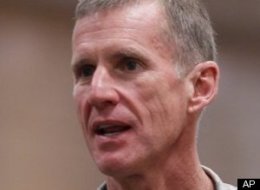
Stanley McChrystal, summoned to Washington after 'Rolling Stone' Interview

Mcchrystal Rolling Stone
The top U.S. commander in Afghanistan has been summoned to Washington to explain derogatory comments about President Barack Obama and his colleagues, administration officials said Tuesday.
 
Gen. Stanley McChrystal, who publicly apologized Tuesday for using "poor judgment" in an interview in Rolling Stone magazine, has been ordered to attend the monthly White House meeting on Afghanistan and Pakistan in person Wednesday rather than over a secure video teleconference, according to officials who spoke on condition of anonymity because they were not authorized to speak publicly. He'll be expected to explain his comments to Obama and top Pentagon officials, these officials said.

Obama has the authority to fire McChrystal. His predecessor, Gen. David McKiernan, was sacked on grounds that the military needed "new thinking and new approaches" in Afghanistan.

Chairman of the Joint Chiefs of Staff Adm. Mike Mullen has told McChrystal of his "deep disappointment" over the article, a spokesman said.

The article in this week's Rolling Stone depicts McChrystal as a lone wolf on the outs with many important figures in the Obama administration and unable to persuade even some of his own soldiers that his strategy can win the war.

The interview describes McChrystal, 55, as "disappointed" in his first Oval Office meeting with Obama. The article says that although McChrystal voted for Obama, the two failed to connect from the start. Obama appointed McChrystal to lead the Afghan effort in May 2009. Last fall, though, Obama called McChrystal on the carpet for speaking too bluntly about his desire for more troops.

"I found that time painful," McChrystal said in the article, on newsstands Friday. "I was selling an unsellable position."

Obama agreed to dispatch an additional 30,000 U.S. troops to Afghanistan only after months of study that many in the military found frustrating. And the White House's troop commitment was coupled with a pledge to begin bringing them home in July 2011, in what counterinsurgency strategists advising McChrystal regarded as an arbitrary deadline.

In Kabul on Tuesday, McChrystal issued a statement saying: "I have enormous respect and admiration for President Obama and his national security team, and for the civilian leaders and troops fighting this war and I remain committed to ensuring its successful outcome."
 
"I extend my sincerest apology for this profile," the statement said. "It was a mistake reflecting poor judgment and should never have happened."
 
WATCH: McChrystal apologizes
Mullen talked with McChrystal about the article Monday night, Capt. John Kirby, Mullen's spokesman said. In a 10-minute conversation, the chairman "expressed his deep disappointment in the piece and the comments" in it, Kirby said.

The Rolling Stone profile, titled "The Runaway General," emerged from several weeks of interviews and travel with McChrystal's tight circle of aides this spring.

In the interview, McChrystal he said he felt betrayed by the man the White House chose to be his diplomatic partner, Ambassador Karl Eikenberry. If Eikenberry had the same doubts, McChrystal said he never expressed them until a leaked internal document threw a wild card into the debate over whether to add more troops last November. In the document, Eikenberry said Afghan President Hamid Karzai was not a reliable partner for the counterinsurgency strategy McChrystal was hired to execute.

McChrystal accused the ambassador of giving himself cover.

"Here's one that covers his flank for the history books," McChrystal told the magazine. "Now, if we fail, they can say 'I told you so.'"

Caitlin Hayden, spokeswoman for the U.S. embassy in Kabul, said Eikenberry and McChrystal "are fully committed to the president's strategy and to working together as one civilian-military team."

McChrystal has a history of drawing criticism, despite his military achievements.

In June 2006 President George W. Bush congratulated McChrystal for his role in the operation that killed Abu Musab al-Zarqawi, the leader of al-Qaida in Iraq. As head of the special operations command, McChrystal's forces included the Army's clandestine counterterrorism unit, Delta Force.

He drew criticism for his role in the military's handling of the friendly fire shooting of Army Ranger Pat Tillman – a former NFL star – in Afghanistan. An investigation at the time found that McChrystal was "accountable for the inaccurate and misleading assertions" contained in papers recommending that Tillman get a Silver Star award.

McChrystal acknowledged he had suspected several days before approving the Silver Star citation that Tillman might have died by fratricide, rather than enemy fire. He sent a memo to military leaders warning them of that, even as they were approving Tillman's Silver Star. Still, he told investigators he believed Tillman deserved the award.

This week's development comes as criminal investigators are said to be examining allegations that Afghan security firms have been extorting as much as $4 million a week from contractors paid with U.S. tax dollars and then funneling the spoils to warlords and the Taliban, according to a U.S. military document. The payments are intended to ensure safe passage through dangerous areas they control.

The payments reportedly end up in insurgent hands through a $2.1 billion Pentagon contract to transport food, water, fuel and ammunition to American troops stationed at bases across Afghanistan.
__
Associated Press Writer Pauline Jelinek contributed to this report.
The top U.S. war commander in Afghanistan apologized Tuesday for a magazine profile in which his aides are quoted mocking Vice President Joe Biden and Richard Holbrooke, the special U.S. representativ...
 

Friday, May 28, 2010

US: Act to End Lord’s Resistance Army Violence in Central Africa

President Barack Obama should move swiftly to implement landmark legislation he signed today committing the US to help civilians in central Africa threatened by the Lord's Resistance Army (LRA), a coalition of 49 human rights, humanitarian, and faith-based groups said today. The rebel group has carried out one of the world's longest-running and most brutal insurgencies.

The Lord's Resistance Army Disarmament and Northern Uganda Recovery Act of 2009 was signed into law during a White House ceremony today that included key members of Congress and representatives of civil society organizations. It states that it is US policy to support efforts "to protect civilians from the Lord's Resistance Army, to apprehend or remove Joseph Kony and his top commanders from the battlefield in the continued absence of a negotiated solution, and to disarm and demobilize the remaining LRA fighters." It also requires President Obama to develop a comprehensive, multilateral strategy to protect civilians in central Africa from LRA attacks and take steps to permanently stop the rebel group's violence. Furthermore, it calls on the United States to increase humanitarian assistance to countries currently affected by LRA violence and to support economic recovery and transitional justice efforts in Uganda.


The coalition of supporting organizations includes groups in Democratic Republic of Congo and South Sudan - where communities face ongoing attacks by the LRA - as well as in Uganda, where the conflict originated.

Human Rights defenders in Niangara, a town in northern Congo deeply affected by recent LRA attacks, in a public letter to President Obama published last week, pleaded for concrete and urgent action against the LRA. "We feel forgotten and abandoned. Our suffering seems to bring little attention from the international community or our own government," the letter says. "We live each day with the fear of more LRA attacks. What chance do we have if no one hears our cries and if no one comes to our aid?"

The law was introduced into the US Senate and House of Representatives in May 2009, and has since become the most widely supported Africa-specific legislation in recent Congressional history. The law was cosponsored by a bipartisan group of 65 Senators and 201 Representatives, representing 49 states and 90% of US citizens. Tens of thousands of Americans mobilized in support of the legislation, participating in hundreds of meetings with Congressional offices across the country. 

"For years civilians in central Africa have suffered immensely from LRA violence," said Anneke Van Woudenberg, senior Africa researcher at Human Rights Watch. "This legislation gives President Obama a clear mandate to work with international and national partners to apprehend indicted LRA commanders as part of a comprehensive strategy to permanently stop LRA atrocities."

"President Obama should move swiftly to take advantage of this historic opportunity to help bring closure to one of the worst human rights crises of our day," added Van Woudenberg.

LRA violence has plagued central Africa for more than two decades. In northern Uganda, thousands of civilians were killed and nearly two million displaced by the conflict between the rebels and the Ugandan government. In July 2005, the International Criminal Court issued arrest warrants for the senior leaders of the LRA for crimes they committed in northern Uganda, but the suspects remain at large. Though the rebel group ended attacks in northern Uganda in 2006, it then moved its bases to the northern Democratic Republic of Congo and has since committed acts of violence against civilians in Congo, Sudan, and the Central African Republic. Kony and his top commanders sustain their ranks by abducting civilians, including children, to use as soldiers and sexual slaves.

In December 2008, following the collapse of a negotiations process, Sudan, Uganda, and Congo began a joint military offensive, "Operation Lightening Thunder," against the rebel group, with backing from the United States. In the subsequent 17 months the LRA has dispersed into multiple smaller groups and has brutally murdered more than 1,500 civilians and abducted over 1,600 people, many of them children. LRA violence has often targeted churches, school and markets, and includes the massacre of over 300 Congolese civilians in an attack last December.  

"If left unchecked, the LRA leadership will continue to kill and abduct throughout central Africa, threatening stability in four countries and potentially undermining the referendum in southern Sudan. The LRA is a clear threat to international peace and security," said John Prendergast, co-founder of the Enough Project. "The US now is tasked with leading a global effort to end this threat once and for all."

The law also aims to help secure a lasting peace in Uganda by increasing assistance to war-affected communities in northern Uganda and supporting initiatives to help resolve longstanding divisions between Uganda's north and south. It seeks to increase funding for transitional justice initiatives and calls on the Ugandan government to reinvigorate its commitment to a transparent and accountable reconstruction process in war-affected areas.

"Until now the world has turned its back to the suffering of our people," said Bishop Samuel Enosa Peni of the Episcopal Church of the Sudan's Nzara Diocese, which has been deeply affected by LRA violence. "We are praying for US and international leaders to hear our cries and end this violence once and for all."

Supporting organizations include:
Human Rights Watch
Resolve Uganda, USA
Enough Project, USA
Invisible Children, USA
Refugees International, USA
Athletes for Africa / GuluWalk, USA
Genocide Intervention Network, USA
Global Action for Children, USA
Citizens for Global Solutions, USA
Institute on Religion and Democracy, USA
International Center for Religion & Diplomacy, USA
Foundation for Human Rights Initiative, Uganda
Advocates Coalition for Development and Environment, Uganda
Grassroots Reconciliation Group, Uganda
Centre d'Intervention Psychosociale (CIP), Niangara, Democratic Republic of Congo
Voix des Opprimes, Niangara, Democratic Republic of Congo
Commission Paroissiale Justice et Paix, Niangara, Democratic Republic of Congo
Société Civile Niangara, Democratic Republic of Congo
Société Civile Faradje, Democratic Republic of Congo
Commission Justice et Paix (Dungu-Duru), Democratic Republic of Congo
Encadrement des Femmes Indigènes et Ménages Vulnérables (EFIM), Democratic Republic of Congo
Centre de Recherche sur l'Environnement, la Démocratie et les Droits de l'Homme (CREDDHO), Democratic Republic of Congo
Action Humanitaire pour le Développement Intégral (AHDI), Democratic Republic of Congo
Centre d'Appui pour le Développement Rural Communautaire (CADERCO), Democratic Republic of Congo
Fondation Mère et Enfant (FME), Democratic Republic of Congo
Campagne Pour la Paix (CPP), Democratic Republic of Congo
Fondation Point de vue des Jeunes Africains pour le Développement (FPJAP), Democratic Republic of Congo
Action Sociale pour la Paix et le Développement (ASPD), Democratic Republic of Congo
Programme d'Appui a la lutte contre la misère (PAMI), Democratic Republic of Congo
Groupe d'Hommes pour la Lutte Contre les Violences (GHOLVI), Democratic Republic of Congo
Association des Jeunes Engagés pour le développement et la santé (AJDS), Democratic Republic of Congo
Action Globale pour la Promotion Sociale et la paix (AGPSP), Democratic Republic of Congo
Union d'Action pour les Initiatives des Développement (UAID), Democratic Republic of Congo
Africa Justice Peace and Development (AJPD), Democratic Republic of Congo
Synergie des Femmes pour les Victimes des Violences Sexuelles  (SFVS), Democratic Republic of Congo
Ligue pour la Solidarité Congolaise (LSC), Democratic Republic of Congo
Collectif des Organisations des Jeunes Solidaires du Congo (COJESKI), Democratic Republic of Congo
Nzara Diocese, Episcopal Church of the Sudan, South Sudan
Tombura-Yambio Diocese, Catholic Church, South Sudan
Nabanga Development Agency, South SudaMaridi Service Agency, South Sudan
Young Women Christian Association, South Sudan
Mundri Relief & Development Association, South Sudan
New Sudan Women Association, South Sudan
Gbudue Construction Company, South Sudan
Yubu Development Association, South Sudan
Zande Cultural Association, South Sudan
Yambio Farmers Association, South Sudan
Joint Effort for Support of Orphans, South Sudan

Thursday, March 6, 2008

Israel keeps its promise of a 'Holocaust' in Gaza

'Barbarous' siege

The Gaza Strip, with a population of some 1.5 million, has been placed under a total siege by the Israeli army since June 2007, shortly after Hamas took control over the strip from Fatah. Later that year, in September, the Israeli government declared Gaza a "hostile entity" and stepped up its military attacks. In January 2008, Israel decided to further reduce the amount of fuel, electricity, food and water supplies into Gaza, justifying the collective punishment as a 'response' to the Palestinian resistance firing home-made shells at the nearby Israeli town of Sderot (see this report about the humanitarian implications of the siege).

The decision by the Israeli government to reduce electricity supplies to the Gaza Strip came after the Israeli Supreme Court rejected a petition against the plan filed by ten Palestinian and Israeli human rights groups. The human rights groups said the measures "violate international laws" as they deliberately cause harm to the civilians and deprive them from the basic energy they need to run vital services. The cut of diesel supplies had already contributed to 20% electricity deficit in Gaza, with power outages of over eight hours a day and directly affecting hospitals, medical centres, water pumps, public transportation and other vital services.

On February 17th, the ambulance service in Gaza announced a complete halt of work due to what the Health Ministry described as "severe shortage of fuel." Many patients have also been denied necessary medical treatment outside due to the siege, in what some described as "a matter of revenge". According to Palestinian medical sources, well over a hundred Palestinian patients, including many children, have so far died because of the siege [ 1 2 3 ].

As Gazans scrambled for supplies, Palestinian resistance fighters blew open the Israeli-built steel walls that make the borders between the Gaza Strip and Egypt on January 23rd. Hundreds of thousands of Palestinians poured into Egypt's Sinai peninsula, breathing a collective sigh of relief following a half-year of total closure of all Gaza border crossings. However, the Egyptian border guards soon started sealing off the iron border again. The Rafah crossing, south of Gaza, is the sole outlet to the outside world for Gaza's 1.5 million residents since June last year.

On February 20th, several European Union lawmakers urged Israel to refrain from inflicting "collective punishment" on the Palestinian residents in the Gaza Strip. In a press conference titled "Coming back from Gaza and Sderot", with the participation of members from different political groups of the European Parliament who took part to the fact-finding mission to Israel and Palestine between 2 and 7 February, 2008, Jill Evans MEP (Green) affirmed that "the situation in Palestine is reaching breaking point. The siege is an inhuman and illegal collective punishment of the people in Gaza and is causing huge suffering. It has to be stopped. There has to be international action to lift the siege, end the occupation and resume peace negotiations."

Concluding a visit to Palestine and Israel, the United Nations' Undersecretary General for humanitarian affairs John Holmes made similar remarks and called for reopening the borders of the Gaza Strip in order to relief the suffering of the residents.

Earlier that year, a report authored by the UN Special Rapporteur John Dugard concluded that "Palestinian terrorism" is the "inevitable consequence" of Israeli occupation. While "Palestinian terrorist acts are deplorable," it added, "they must be understood as being a painful but inevitable consequence of colonialism, apartheid or occupation."

On February 26th, just before the escalation started, the report was briefly flagged up by Associated Press. Israel was quick to reject the 'claims' as "inflammatory" and the report has since been ignored by the Western corporate media in a continuation of their biased reporting on the Israeli aggression against Palestinians (see this MediaLens alert).

'Holocaust' in Gaza

On February 29th, the Israeli deputy Defense Minister provoked outrage after threatening Palestinians with a "holocaust". Matan Vilnai told the Israeli army radio that "the more [rocket] fire intensifies and the rockets reach a longer range, they [the Palestinians] will bring upon themselves a bigger holocaust because we will use all our might to defend ourselves." The same twisted logic is used by the far-right and Holocaust deniers to blame Jewish people for the Nazi Holocaust.

However, preparations for a large-scale invasion of the Gaza Strip seem to have been under way long before that provocative comment. The Israeli government had reportedly already approved a military plan, similar to the US invasion of Iraq in 2003. According to the Jewish Press website, Israeli sources said that a plan, drafted by the Israeli military's general staff, had been endorsed by the Israeli defense minister Ehud Barak.

On February 7th, during a visit to an Israeli military base in the south of Israel, Barak said the Israeli army will "intensify its military operations" in the Gaza Strip, allegedly to stop Palestinian home-made Qassam rockets that continue to be launched from Gaza at Israeli targets. He added that Israel will eventually "put an end" to the attacks by continuing its military operation and imposing punishments and fortifying the nearby Israeli communities surrounding the Gaza Strip. On February 10th, the Defense Minister confirmed that his army will carry out more strikes on Gaza.

Meanwhile, another Israeli minister called for the "total annihilation" of some Gaza neighbourhoods. Me'air Shetrit called for responding to what he termed "sabotaging operations" by "totally annihilating some Gaza neighbourhoods" so that "the residents of the Gaza Strip will understand how serious the Israeli threats are." Other Israeli politicians have made similar comments.

On February 11th, Barak stated that he had ordered the Israeli army to start preparing for the wide-scale offensive in Gaza. He told the Knesset's Foreign Affairs and Security Committee that his troops are "attacking the Palestinian coastal region day and night, with a high chance for those attacks to expand." On February 17th, he again vowed to strike back heavily against Palestinians, particularly the ruling Hamas in Gaza, as home-made shells continue to hit Israeli areas adjacent to Gaza. At the same time, Israeli prime minister Ehud Olmert, while giving a speech at a conference of Jewish agencies leaders, granted the Israeli army the "upper hand" in deciding how to strike what he called "perpetrators of terror", first and foremost those who belong to Hamas.

Since coming to power after the 2006 democratic elections, the Islamist group has repeatedly proposed a long-term truce with Israel. Israel, however, has repeatedly shunned such offers, branding Hamas a "terrorist group". In June 2007, Israel imposed a total siege on Gaza after Hamas took over the coastal territory, amidst a power struggle with Fatah, president Mahmud Abbas's party, which has been committed to 'peace negotiations' with Israel (see this interesting Vanity Fair article).

Last year, after killing more than 300 Palestinians in the Gaza Strip in air strikes and ground offensives, Israel still failed to stop the home-made shells fired by Palestinian fighters into adjacent Israeli towns.

'Full-scale war'

Since the siege started in June 2007, Israeli air strikes and ground incursions, allegedly targeting Palestinian militants, have become an almost daily occurrence, often killing civilians and destroying residential buildings.

For example, on February 7th, Palestinian medical sources reported that six Palestinians, including one teacher, were killed and several residents were injured in three separate Israeli air strikes that were supposed to target groups of Palestinian militants in different areas in the Gaza Strip. On February 15th, eight Palestinians, mainly members of one family, were killed and nearly eighty others injured when the Israeli air force fired missiles at the house of one of the leaders of the Islamic Jihad in Al-Boreij refugee camp in central Gaza. (Many more incidents can be found on the IMEMC, PNN and IE websites.)

On February 14th, an undercover Israeli force attacked several Palestinian homes in the eastern side of Rafah, southern Gaza, and rounded up 30 men, aged between 15 and 50, and took them to a nearby military base at the Rafah-Israel border. The area located near the Gaza International Airport has suffered frequent Israeli attacks since the beginning of the Palestinian Intifada (uprising) in September 2000.

On Wednesday, 27 February, 2008, the Israeli army stepped up its air strikes and ground 'incursions' in what many observers described as a "full-scale, one-sided war". According to the Israeli Information Center for Human Rights in the Occupied Territories (B’Tselem), 106 Palestinians were killed in the Gaza Strip between February 27th and March 3rd, and at least 54 of them, including 25 children, did not take part in any fighting. Al-Mezan Center For Human Rights put the number at 107, including 55 civilians, of whom 27 were children and 6 women. The Israeli Chief of Staff had claimed that 90 percent of those killed were "armed".

On Wednesday evening, an Israeli strike on the northern part of Gaza killed three Palestinian children, bringing the death toll within 24 hours to 12. Palestinian medical sources confirmed that the three children's bodies reached hospital dismembered, while at least 17 others were wounded, including 6 children. By Friday, the Israeli government announced that its army has completed preparations for a wide-scale offensive against Gaza (more).

Around 1am on Saturday, at least 30 tanks and bulldozers, supported by a battalion of infantry troops attacked the Jabalyia refugee camp in the northern part of the Gaza Strip. Palestinian medical sources reported that at least 26 Palestinians killed and 62 injured, bringing the death toll since Wednesday to 56. Eyewitnesses said Israeli troops and tanks invaded Jabalyia and opened fire at resident homes, while Israeli helicopters were firing missiles at civilians homes and cars (more).

Even civilian facilities, such as medical centres, were not spared. On February 28th, for example, an Israeli air strike aimed at the Ministry of the Interior building in Gaza also destroyed the nearby Palestinian Medical Relief Society (PMRS) head office. PMRS is one of the largest non-governmental health service providers in Palestine, reaching 1.4 million Palestinians in over 490 cities, towns and villages. The attack also hit a nearby residential building, killing a five-month-old baby. The The disability rehabilitation sector in Palestine, part of the Network of the Non-governmental Organizations, also reported that the Israeli army had targeted several facilities that deal with rehabilitation and killed Hammad Mirshid, 47, who suffered a hearing impairment. The army also broke into a rehabilitation facility, causing a lot of damage, and used it as a military post.

By now, the war in Gaza had attracted the international community and media's attention. The Palestinian Ministry of Health announced that some hospitals in Gaza could no longer provide medical care because they have no electricity or medical supplies. Medical crews reported that they came under fire as they tried to evacuate the injured from Jabalyia refugee camp. The Al-Jazeera Arabic correspondent in the Gaza Strip, Hiba Abu Shamalih, also reported that she came under fire along with her camera crew as they were covering the events in Gaza. The Palestinian President Mahmoud Abbas said on Saturday that the ongoing Israeli attacks on Gaza were "more than a holocaust."

Meanwhile, the Israeli army announced that Palestinian militants killed two Israeli soldiers and destroyed a military vehicle on Saturday. Palestinian resistance groups also fired 13 home-made shells at nearby Israeli areas, injuring three civilians in the southern Israeli town of Sderot that borders the Gaza Strip. The Al-Qassam brigades, the armed wing of the Hamas movement, said that 8 of its fighters were killed on Saturday during armed clashes with the Israeli army. The Al-Quds brigades of the Islamic Jihad also said that three of their fighters were killed in clashes on that same day.

'Not over'

Israeli forces pulled out on Sunday-Monday overnight after five days of bloodshed. But Israeli Prime Minister Ehud Olmert warned that the withdrawal of troops from Gaza does not mean Israel's military operation there is over, adding that "what happened in recent days was not a one-off event."

Indeed, just after the Israeli army announced ending its offensive in the Gaza Strip, Palestinian medical sources reported that 8 Palestinians, said to be Hamas fighters, were killed by Israeli shells on different parts of Gaza on Monday dawn (more).

Later on, a senior Israeli official, quoted by Reuters, said Israel had called a "two-day interval" while US Secretary of State Condoleezza Rice visits Jerusalem and the West Bank on Tuesday and Wednesday, which is meant to move Israeli-Palestinian peace negotiations forward. Rice, however, has already told reporters in Egypt that Hamas is "trying to destroy the peace talks." Hamas's spokesperson, Sami Abu Zuhri, said Rice's statement was part of her intention to "give the green light" to the ongoing war on the Hamas movement and the Palestinian resistance. Palestinian president Mahmud Abbas had formally suspended contacts with Israel in protest at its attacks on Gaza.

Protests and solidarity

Since the start of the siege in June 2007, there have been many mass protests inside Palestine and Gaza itself. A massive demonstration was held at the Erez Checkpoint in Beit Hanoun, north Gaza, on January 26th, where people assembled on both sides of the fence to protest against the siege and the humanitarian crisis in Gaza. On February 11th, flower farmers in the city of Beit Lahiya, north Gaza, decided to destroy about 500,000 square meters of flower plants in protest at their inability to export their produce due to ongoing Israeli blockade on Gaza. On February 14th, a large number of Gaza vehicles stopped engines for half an hour in protest at the continued Israel cut of fuel supplies to the region. On February 25th, thousands of women, children and men formed a human chain around the Gaza Strip in protest at the Israeli siege (more). Peaceful demonstrations also took place in Bethlehem, Nazareth and other places in Palestine and Israel.

Many defiant actions by Israeli activists have also been reported. For example, a convoy of food supplies, provided by a group of Israeli peace activists, entered Gaza on February 19th through the Israeli-controlled commercial crossing of Sufa in southern Gaza.

More recently, the entirety of the West Bank was on strike on Sunday, February 2nd, in solidarity with the mourners and lost souls of the Gaza Strip. The streets of Jenin and Nablus were filled with protesters, while in Ramallah Hamas and Fateh called a joint demonstration. Kids were seen at the Wall in Ramallah throwing stones, and the same happened in Bethlehem at Rachel's Tomb. The air was said to have been full of acrid smoke as children set tires on fire and dumped out garbage cans and set them ablaze (report).

Palestinian protests were often violently attacked by Israeli forces. Seven Palestinian teenagers were injured on February 2nd when Israeli troops attacked a demonstration organised by the villagers of Bil'in, a village near Ramallah known internationally for its non-violent protests (more). On the same day, one Palestinian boy was killed and at least 45 were injured when the Israeli army attacked protests standing in Hebron, south West Bank, in solidarity with the people of Gaza. On February 3rd, Israeli forces imposed a curfew on a western Jenin village, which saw a non-violent demonstration against the Israeli aggression in Gaza. A Palestinian teenager was killed and several others injured on the same day when Israeli army troops attacked a protest organised by school students in the village of Al-Mazra'a Al-Sarqiya, near Ramallah.

Since the start of the siege, there have also been numerous solidarity demonstrations and actions throughout the world. To list only a few of those reported on Indymedia sites worldwide, the past few months have seen protests in Israel, Portland, Washington DC, St. Petersburg (FL), Seattle, Berkeley, Dublin [2], The Hague, Berlin, London [2 3 4 5] , Manchester, Sheffield [2], Wales and elsewhere.

Called by the Popular Committee Against the Siege (PCAS), February 23rd saw a global day of action against the Israeli blockade on Gaza. Mass demonstrations and protests took place in around 30 countries across Europe, Asia, Africa and the two Americas. In many cities, lights also went off for half an hour in solidarity with the people of Gaza (see also the End Gaza Siege website). As the chairman of the Gaza Committee Jamal al-Khudari put it: "The demonstrations we saw on TV screens in many countries indicate a genuine support for the Palestinian people."


Monday, February 11, 2008

Pentagon Charges Sept. 11 Suspects

The Pentagon has charged six detainees at Guantanamo Bay with murder and war crimes in connection with the Sept. 11 terror attacks, and officials said Monday the United States will seek the death penalty.

Brig. Gen. Thomas W. Hartmann said the charges lay out a long-term sophisticated plan by the al-Qaida terrorist network to attack the United States of America. The attack over six years ago killed nearly 3,000 people.

Hartmann, the legal adviser to the U.S. military tribunal system, said the six include Khalid Sheik Mohammed, the suspected mastermind of the attacks, in which hijacked planes were flown into buildings in New York and Washington. Another hijacked plane crashed in the fields of western Pennsylvania.

The military will recommend that the six men be tried together before a military tribunal. But the cases may be clouded because of recent revelations that Mohammmed was subject to a harsh interrogation technique known as waterboarding -- which critics call torture.

Asked what impact that will have on the case, Hartmann said it will be up to the military judge to determine what evidence is allowed.

Prosecutors have been working for years to assemble the case against suspects in the attacks that prompted the Bush administration to launch its global war on terror.

The other five men being charged are: Mohammed al-Qahtani, the man officials have labeled the 20th hijacker; Ramzi Binalshibh, said to have been the main intermediary between the hijackers and leaders of Al Qaeda; Ali Abd al-Aziz Ali, known as Ammar al-Baluchi, a nephew of Khalid Sheikh Mohammed, who has been identified as Mohammed's lieutenant for the 2001 operation; al-Baluchi's assistant, Mustafa Ahmad al-Hawsawi; and Waleed bin Attash, a detainee known as Khallad, who investigators say selected and trained some of the hijackers.

Sunday, September 2, 2007

“Tactical Momentum” in Iraq and Our New Sunni “Friends”

In an August 25 article in the New York Times (”Hear a General, Hug a Sheik: Congress Does the Iraq Circuit,” by Sheryl Gay Stolberg and Damien Cave) we learn that the encouraging, but misleading, phrase “Tactical Momentum” is apparently being used by General David Petraeus in his briefings of the many Congressmen making the pilgrimage to Iraq of late. This phrase, or something similar, is likely to feature prominently in Gen. Petraeus’ report this month on the situation in Iraq.

That choice of words suggests that a process is underway inside Iraq of expanding and sustainable stability, which would have to involve the resolution of the deep ethno-sectarian rifts that have been tearing that already battered country apart. Gen. Petraeus and others speaking out in support of the current surge also commonly assert or imply strongly that the gains made in recent months in predominantly Sunni Arab areas of Iraq are the direct result of the surge. This simply is not the case.

By far, the gains made in mainly Sunni Arab portions of Iraq, especially al-Anbar province, are the result of rising anger among many Sunni Arabs over the abuses associated with al-Qaeda in Iraq cadres in their midst — resentment that has been building since 2004. This has very little to do with the current surge. Indeed, only around 5,000 additional US troops of almost 30,000 sent to Iraq since the beginning of the surge have gone to al-Anbar because the focus of the surge was the Baghdad area.

Furthermore, this alliance of convenience between US forces and Sunni Arab tribal notables and insurgents is bitterly opposed by the Shi’a-dominated Maliki government and its supporters because there is no desire on their part to have armed Sunni Arabs assemble more freely, acquire still more arms one way or another without US interference, or join local Iraqi security forces in large numbers. In effect, what has been going on is the formation, with US acquiescence, of Sunni Arab militias. Yet, by encouraging and exploiting this phenomenon, American troops, alongside such forces, have dealt severe blows to al-Qaeda in Iraq — perhaps the most encouraging successes in Iraq since 2003.

Nonetheless, those now helping us in al-Anbar and other largely Sunni Arab strongholds remain deeply opposed to the American occupation and fiercely oppose the Shi’a and Kurdish dominated government in Baghdad. This is why one senior American commander working with these elements reportedly has instructed his men not to trust our new best friends. If and when al-Qaeda in Iraq has been crushed, these same Sunni Arabs might well turn once again against the next two parties on their hit list. As a result, we would want to make sure that when that time arrives, we get out of their way as expeditiously as possible. This is almost certainly why General Odierno mentioned recently the possibility of pulling out of some areas in al-Anbar once they are “stabilized” (i.e. made free of al-Qaeda in Iraq).

There should be little reason to fear that once these Sunni Arab elements have defeated al-Qaeda in Iraq that, in the absence of US forces, these elements would invite the terrorists back in. Having betrayed such fanatical jihadists and fought against them alongside US forces, allowing them to return would carry the very real risk of bloody retribution.

Meanwhile, the profound political problems plaguing Iraq, which the surge was supposed to resolve by creating the necessary “space” or security environment, continue unabated. In fact, they appear to be worsening, in part because of the military cooperation between US forces and Sunni Arabs. Additionally, the Iraqi government remains dysfunctional. It is not only unable to pass the benchmarks so earnestly desired by Washington but, in fact, seems unwilling to do so because the idea of providing Sunni Arabs with a greater share of the political and financial pie (so Sunni Arabs will more readily buy in to the political process) is something anathema to many Shi’a and Kurds.

Unfortunately, many political figures across the political spectrum back here in the US don’t understand what is happening in Iraq. Supporters of the Bush Administration believe recent successes relating to Iraq’s Sunni Arabs are the result of the surge and that Iraq can be progressively stabilized by a continued US presence. Many of those on the other side of the political spectrum believe there has not been much success and to the extent there is, any progress would support the Administration’s case for remaining in Iraq.

Neither view holds water. The success in Sunni areas is real, but Iraq’s lethal ethno-sectarian fault-lines remain and opposition to occupation among our new Sunni Arab allies has not waned. The latter almost certainly will demand that we withdraw from their areas of Iraq once we finish helping them destroy the terrorists in their midst.

Consequently, lest we risk renewed resistance in predominantly Sunni Arab areas of the country farther down the road, the US should do just that. This would allow us to pull out of the previously most dangerous portions of Iraq in a more orderly and peaceful fashion. To avoid getting caught in the middle between Sunni and Shi’a, Washington should not wait too long before ordering a withdrawal from the rest of the country too.

Wayne White