Translation

.يولد جميع الناس أحرارا متساوين في الكرامة والحقوق. وقد وهبوا عقلا وضميرا وعليهم أن يعامل بعضهم بعضا بروح الإخاء‎
FoxLingo German Spanish French Arabic Czech Greek Hungarian Italian Polish Portuguese Romanian Russian Serbian Slovenian Thai Turkish
Showing posts with label discrimination. Show all posts

Sunday, August 1, 2010

Israel: Halt Demolitions of Bedouin Homes in Negev

2010_Israel_Negev3.JPG
 
Pre-Dawn Raid Destroys Entire Village
August 1, 2010

Joe Stork, deputy Middle East director at Human Rights Watch

(Jerusalem) - The Israeli government should immediately impose a moratorium on demolishing the homes of Bedouin citizens, Human Rights Watch said today. The government should also fully compensate those whose homes and property it has destroyed and allow them to return to their village pending a final agreement with the displaced that respects their rights under international law.

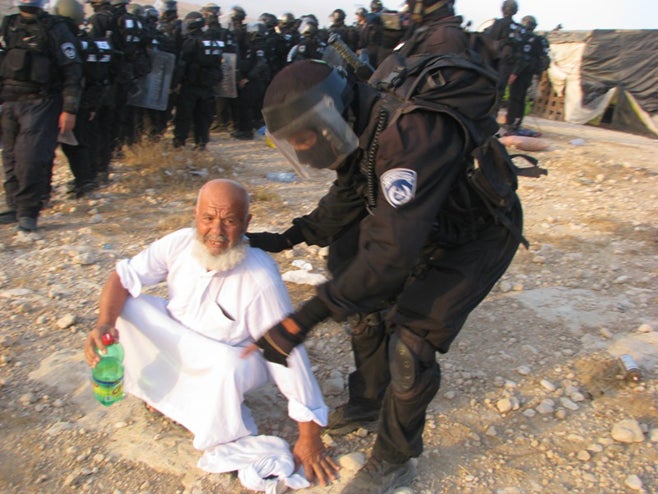
In a pre-dawn raid on July 27, 2010, Israeli security forces destroyed all 45 homes, animal pens, and other structures in the village of al-Araqib, leaving more than 300 people homeless, about half of them children under 16. Nearly 90,000 Palestinian Arab Bedouins, the indigenous inhabitants of the Negev (Naqab) region of southern Israel, live in dozens of "unrecognized" towns. Because the Israeli authorities refuse to recognize their towns and villages, the Bedouins risk the destruction of their homes at any time.

"Tearing down an entire village and leaving its inhabitants homeless without exhausting all other options for settling longstanding land claims is outrageous," said Joe Stork, deputy Middle East director at Human Rights Watch. "The attack on these Israeli citizens' property shows that Israel's discriminatory policies toward Palestinian Arab Bedouin have not changed."

The July 27 raid began around 4:30 a.m. when 1,300 armed police officers in riot helmets and shields blocked the entrance to the village and entered it. The force included mounted cavalry, helicopters, inspectors from the Israel Land Administration (ILA) - the government agency responsible for managing the 93 percent of Israeli land owned by the state, and demolition crews operating bulldozers, according to witnesses and video images viewed by Human Rights Watch.

The crews forcibly removed the villagers, mostly children and elderly people, from their homes before the demolition operation began. Awad Abu Freih, spokesman for the al-Araqib civil committee, told Human Rights Watch that residents were unarmed and stayed in their homes after police arrived in a form of passive resistance. Bulldozers also destroyed carob and olive trees, chicken coops, and other structures, residents said.

The Israeli police foreign press spokesman, Mickey Rosenfeld, told Human Rights Watch that the police acted on a court order issued 11 years ago but not previously executed. The operation "was done quietly and sensitively and in coordination with the village representatives," Rosenfeld said. Abu Freih denied that there had been any coordination. Rosenfeld added that Land Administration officials evacuated al-Araqib residents to an area close to the nearby city of Rahat, where, he claimed, they had additional residences.

Ortal Tzabar, a Land Administration spokeswoman, confirmed in a statement to Human Rights Watch that the authorities also uprooted 850 olive trees that she said were "to be replanted elsewhere."

Abu Freih and Ye'ela Raanan, spokeswoman for the Regional Council for the Unrecognized Villages, a local organization, said that only a few dozen people from al-Araqib have other homes. Some residents may have spent the night with friends or relatives in Rahat after the demolitions, Raanan said, but "there are at least 250 people now who don't have another option." Raanan said she was at al-Araqib during the operation and that residents began on July 28 to build makeshift tents on the site with wooden frames and cheap fabric.

Residents and Israeli rights activists told Human Rights Watch that police began assembling at the village late Monday evening. At 12:15 a.m., the Kiryat Gat Peace Court (court of first instance) rejected an appeal filed by village residents contending that the state had no legal grounds to demolish their homes.

The Negev Coexistence Forum, a Bedouin rights group, said in a statement that al-Araqib existed before the creation of Israel in 1948 and that residents returned there after being evicted by the state in 1951. Many of the unrecognized villages are around Beer Sheva, the Negev's largest city. The current draft of a metropolitan plan for Beer Sheva designates the land where al-Araqib is located as a "recreational area" and as an area for "forest and forestation."

A lawyer who represents several al-Araqib residents and who asked not to be named, said that the Israeli government issued "evacuation orders" in 2002 to nine people in the village based on Article 21 of the Property Law, which allows for the owner of a piece of property - in this case, the state of Israel claims to own the property - to evict anyone residing on it illegally. But, he said, in the eight years since then authorities had not made any attempt to carry out these orders.

While the village population has grown since then, no other residents received evacuation or demolition orders until June of this year, the lawyer said, when several others received letters from the government threatening them with house demolition. These letters were based on Article 64 of the Repossession Law (Hotza'a Lapoal), which says the authorities may also evict other residents, interpreted by the state and the courts to include those in a vaguely-defined "legal relation" with anyone against whom other orders have been issued.

Israeli authorities carried out the demolitions despite pending legal claims to the land that Al-Araqib residents are pursuing in Beer Sheva District Court. Abu Freih, the al-Araqib civil committee spokesman, told Human Rights Watch that over a dozen such land claims are pending. One resident and human rights activist, Nouri al-Okbi, testified in court that the Israeli government confiscated 820 dunams (82 hectares) of land from his family, without compensation, when they were expelled in 1951.

The state contends that the Bedouin have never had recognized land claims in the area. Al-Okbi's lawyer, Michael Sfard, recently produced evidence in court, however, that appeared to show that the Jewish National Fund had bought land in this area from Bedouin owners during British rule, as did Ottoman authorities before then. This, he said, indicated that the area had customarily been recognized as belonging to the Bedouin.

The demolitions came two days after Prime Minister Binyamin Netanyahu made comments in a government meeting, as reported by Israeli media, about the "threat" of losing a Jewish majority in the Negev region. "We are under real attack on this issue [of Israel as a Jewish state]," Netanyahu was quoted as saying in a July 25 government meeting regarding amendments to the citizenship law. "The meaning could be that different elements will demand national rights within Israel, for example, in the Negev, if we allow for a region without a Jewish majority. It has happened in the Balkans, and it is a palpable threat."

Israel has demolished thousands of Negev Bedouin homes since the 1970s, and over 200 since 2009. Israeli authorities have demolished many structures in al-Araqib in the past, although never the entire village. The Land Administration also began spraying villagers' crops with herbicides in 2002 as a mechanism to cause evacuation, a practice deemed illegal by the Israeli Supreme Court in 2007.

"Israel employs systematically discriminatory policies in the Negev," Stork said. "It is tearing down historic Bedouin villages before the courts have even ruled on pending legal claims, and is handing out Bedouin land to allow Jewish farmers to set up ranches."

Background
Tens of thousands of Bedouin citizens in southern Israel live in "unrecognized" villages like al-Araqib. Because the government considers the villages illegal, it has not connected them to basic services and infrastructure such as water, electricity, sewage treatment, and garbage disposal. Although the villages do not appear on official maps, some existed before the state of Israel was established in 1948. Others sprang up after the Israeli army forcibly displaced Bedouin tribes from their ancestral lands immediately following the 1948 war. Israel passed laws in the 1950s and 1960s enabling the government to lay claim to large areas of the Negev where the Bedouin had formerly owned or used the land. Planning authorities ignored the existence of Bedouin villages when they created Israel's first master plan in the late 1960s.

Israeli officials contend that they are simply enforcing zoning and building codes and insist that Bedouin can relocate to seven existing government-planned townships or a handful of newly recognized villages. The government-planned townships are seven of the eight poorest communities in Israel and are ill-equipped to handle any influx of new residents. Many - if not most - Bedouin have rejected relocating to the townships, which have minimal infrastructure, high crime rates, scarce job opportunities, and insufficient land for traditional livelihoods such as herding and grazing. In addition, the state requires Bedouin who move to the townships to renounce their ancestral land claims - unthinkable for most Bedouin, who have claims to land passed down from parent to child over generations.

Bedouin constitute 25 percent of the population of the northern Negev, but occupy less than 2 percent of its land. Over the past decade, Israeli authorities have allocated large tracts of land in this region, and public funds, for the creation of private ranches and farms. There are 59 such "individual farms" in the Negev - only one allocated to a Bedouin family and the rest to Jewish families - that stretch over 81,000 dunams of land, greater than the total land area granted to the seven planned Bedouin townships housing 85,000 people. The Israeli human rights organization Adalah says the state has connected these farms to national electric and water grids, despite the fact that some lack proper planning permits. In a series of laws, the latest passed on July 12, the state retroactively legalized such farms and authorized the establishment of more.

Human Rights Watch documented the systematic discrimination that Bedouin citizens face in a130-page report, "Off the Map," released in March 2008.

Israel ratified the International Covenant on Economic, Social and Cultural Rights in 1991, requiring it to guarantee the right to housing. The United Nations Committee responsible for interpreting the covenant has said this means governments can carry out forced evictions only in "the most exceptional circumstances," and even then only in accordance with human rights principles requiring the government to consult with the affected individuals or communities, identify a clear public interest requiring the eviction, ensure that those affected have a meaningful opportunity to challenge the eviction, and provide appropriate compensation and adequate alternative land and housing arrangements.

Another right at stake is the right to property, set out in the Universal Declaration of Human Rights. The 2007 UN Declaration of the Rights of Indigenous Peoples, opposed by only two states in the world - the US and Canada - states that indigenous peoples have the right to lands they traditionally owned, occupied or otherwise used, and that states should give legal recognition to this. It also says that no relocation of indigenous peoples should take place without their free, prior, and informed consent and only after prior agreement on just and fair compensation.

In December 2008, the Goldberg Commission, appointed by the government in late 2007 to find a solution for the land claims of residents of the unrecognized villages, recommended that the state recognize villages that have a "critical mass" of permanent residents and that do not interfere with other state planning. In practice this would be limited to the recognition of only a few of the dozens of unrecognized villages. The commission also called for the establishment of several claims committees to deal with Bedouin ownership claims and provide financial compensation for expropriated land. In May 2009, the government established the Prawer Committee to outline a plan to implement the Goldberg Commission's recommendations.

Los ilegales, parte de la vida estadounidense

ISABEL PIQUER Corresponsal en Nueva York 01/08/2010 08:00

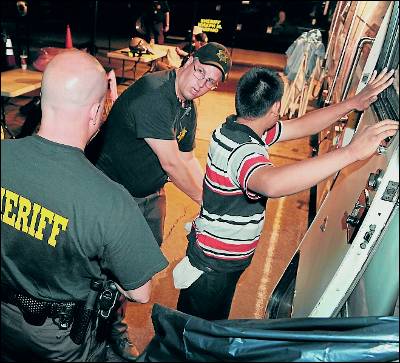
Dos agentes detienen a un inmigrante irregular

Dos agentes detienen a un inmigrante irregular.Se calcula que en Estados Unidos viven unos 12 millones de sin papeles, más o menos la misma cifra que en toda la Unión Europea. En Arizona representan el 8% de la población y juegan un papel esencial en el sector turístico, el mayor negocio del estado.

Estados Unidos, por razones históricas obvias, siempre ha sido, pese a las apariencias, bastante acomodaticio con sus irregulares porque los necesita económicamente. Los indocumentados pueden meter a sus niños en las escuelas y recibir atención médica de urgencia.

Así lo estipula la Corte Suprema que en 1982 declaró que ningún estado podía negarse a educar hijos de irregulares, porque suponía discriminarlos. Cuatro años más tarde, en 1986, el Congreso aprobaba el Emergency Medical Treatmen and Active Labor Act (EMTALA), que obliga a todos los hospitales y ambulancias a asistir a cualquiera que necesitara atención médica inmediata, independientemente de su ciudadanía, estatus legal, o capacidad de pago.

Integración económica
La idea es integrar al indocumentado en la vida económica antes que en la legal. Algunos estados, como Maine, New México y Tennesee otorgan permisos de conducir a los sin papeles.

La preocupación por la inmigración ilegal, especialmente en tiempos de crisis cuando escasea el empleo, ha endurecido las políticas de los estados hacia los indocumentados. Y no sólo en Arizona. Esta semana, la Asociación de Libertades Civiles de Nueva York ha denunciado que uno de cada cinco distritos escolares de la ciudad pedía información sobre el estatus migratorio de los niños que optaban a una plaza. Aunque ningún escolar fue expulsado, la asociación advirtió del precedente que creaba.

Estados Unidos no tiene documento nacional de identidad. Las piezas que más se usan para los quehaceres diarios son las licencias de conducir que otorgan los estados, y para asuntos más serios, el número de Seguridad Social, que, como su nombre no indica en absoluto, suma la historia crediticia de cada habitante. En Estados Unidos se es lo que se debe y lo que se gasta. En este país de tradición anglosajona, una de las libertades del individuo es no tener que llevar papeles, contrariamente a Europa. De ahí que la ley de Arizona levantara tantas ampollas.

Ningún policía en Estados Unidos puede detener o simplemente parar en la calle a un latino, por ejemplo, porque piense que es ilegal. Le puede detener por saltarse un stop y de paso pedirle los papeles. La iniciativa de Arizona daba a las fuerzas del orden un poder migratorio hasta ahora sólo reservado a las autoridades federales. Pero no era el único problema. Al no haber documento de identidad, resultaba incluso complicado pedirle una prueba de nacionalidad a un estadounidense.

Friday, March 12, 2010

Is this Love?

I cant seem to be able to get time these days. But, I have to.

Today is Friday. That is when we shall see whether or not the government in Kenya will be protecting its gay citizens in Mombasa against anti-gay attacks, which are supposed to occur after the Friday Prayers. 1pm today.

But, here is another, very personal development.

First, it would be instructive to read the whole report at LGBT Asylum news.

And, then you get to the bottom of the report, there is this poster.
David Kuria Mbote happens to be the director of Gays and Lesbians of Kenya. He wrote this article in response to some homophobic insult from a priest justifying the lynching of gay people.

And, for this poster, here is my translation of the Swahili above. It is not perfect, but I know I have it right.

Basically, besides the pic of David, with his full names, email address, GALCK phone number, a verse from the bible is quoted. 

'If a man sleeps with another man like he sleeps with a woman, both men have done something extremely bad. It is a must for them to be killed, and their blood shall be on their own heads' 

My swahili fails at the translation of what verse in the bible it is. Something, maybe Leviticus 20:23

Yeah, Isn't this love?

Just hope and Pray David, that you are safe after this kind of hate thing.

And, according to LGBT asylum news, do you want to know what ProjectSee is?

No. They are not Kenyans.
Ugandans? No, they are not Ugandans.
Then where the hell are these guys coming from who are nakedly threatening a poor Kenyan with death? Here is the answer.

ProjectSee.com, which is based in Kansas City, is raising funds to 'equip our Kenyan Brothers with Cameras, Banners, Fliers, Posters, Bus Fare; the Tools they Need to STOP Exporting Evil'.

Yes, they are Americans. At least that is what I surmise.

Surely, the Culture Wars, America's Culture wars are here in Africa.

Friday, March 5, 2010

Vatikan Chorsänger und Platzanweiser im homosexuellen Prostitution Skandal

Ghinedu Ehiem, a Nigerian, was dismissed by the Vatican from a prestigious choir after his name appeared in transcripts of police wiretaps. 
 
In the wiretaps, Mr Eheim is allegedly heard negotiating over the procurement of male prostitutes. 

The VaticanThe wiretaps were carried out in connection with a probe into corruption in contracts to build public works, including the planned venue in Sardinia of last year's G8 summit. 

Among four people arrested last month in the corruption probe was Angelo Balducci, an engineer who is a board member of Italy's public works department and a construction consultant to the Vatican. 

Balducci is also a member of an elite group called "Gentlemen of His Holiness" – ushers who are called to serve in the Vatican's Apostolic Palace on major occasions such as when the pope receives heads of state or presides at big events. 

Balducci was arrested on corruption charges and the allegations of prostitution emerged only later. 

Excerpts of the wiretaps and police documents published in the Italian newspaper La Repubblica showed that Ehiem, 40, had been in regular contact with Balducci before Balducci's arrest last month and the subject of their conversation was gay sex. 

A police document prepared for magistrates and published in part by La Repubblica said Balducci was in contact with Ehiem and an Italian who were part of what the police called "an organised network ... to abet male prostitution". 

It was not immediately possible to contact Ehiem's lawyer. 

A Vatican source said Balducci, who is still in jail, has been dismissed from the elite group of ushers and that his name would not appear in the next edition of the Vatican's directory. 

"He obviously can't come back here after being accused of these things," the source told Reuters. 

The latest black eye for the Vatican comes on the heels of major paedophilia scandals involving the abuse of children by priests in Ireland, Germany and the United States. 

Balducci's lawyer, Franco Coppi, one of Italy's highest profile lawyers, said he had no comment on the newest accusations against his client, saying: "We have much more serious things to be concerned with right now," referring to the corruption charges.

Friday, February 26, 2010

Selektive Moral

Some people do think it is easy to get asylum.

No. It isnt. Even when one is gay. Part of the reason I will fight tooth and nail to make sure that I have exhausted all the necessary steps to stay in Uganda, and only seek asylum as a very last resort.
This report of a Gay Ugandan asylum seeker is the one which has set me off.

Fact, I will need to have a very good reason for leaving Uganda to face the indignity that is described in this article. A reason like the loss of my life. Yes, I know, (sighhhhh!), another reason to bury my head in the sand like an ostrich. Dont worry, life is too precious for me to throw away. Inspite of the Bahati Bill.

Frank Mugisha talks about being Gay in Uganda, here. I havent watched the film. My link is too slow. But, I am sure he says all the good things....! Or the bad things, whatever your take. And, Julius Kaggwa on NPR radio.

But, since the topic is selective morality, let me get back to it.

You, of course have heard of Uganda's Gay Porn showing Pastor. If you havent, where have you been hiding? Come out, here is the feed. And, the reactions.
Did I point out that the Honourable minister for morals in Uganda, Minister of Ethics and Integrity, the Honourable James Nsaba-Buturo is a very close friend of the Gay Porn Show pastor? Maybe it did skip my mind. But, I wrote to the press, and had that letter copied to the Minister of Morals. As the 'Concerned Citizen' gug.

But, the Minister of Uganda's Morals is a very interesting guy. These days, he doesnt speak so much about the huge evil immorality of the homosexuals who he wants to forget about human rights, and surrender their right to life and liberty.
I think someone asked him to shut up. But, I may be wrong.

He still speaks about corruption.
Do you know who the Ugandan Public think are the most corrupt politicians? Museveni, Mbabazi, Muhwezi - Top Most Corrupt Politicians? They are effectively the dear President, the Minister of Defence, and the Minister for something. I think one or the other of those is related to the President.

Who defends the President? the Rt, Honourable Nsaba-Buturo.
However, the Minister in charge of instilling Ethics and Integrity, James Nsaba Buturo, dismissed the ACCU's findings as unscientific. "It is dangerous, wrong to make such bold statements about people of high authority basing on people's opinions which may not be informed. It is not a reliable measure in any way. ACCU needs to move to scientific methods of gathering evidence and needs to make wider consultations before making such accusations. They need hard evidence to make such a case. In which corruption case has the President been cited, for example?" Buturo asked.
Has enough been said without bringing the heavy eye of authority on me? It can be scathing. Burning.... but my beef is with the Minister of Ethics whose view of morality is very, err, selective.

But then, he is a politician, not so?

Intellectual Dishonesty. I dont speak English as a first language. Sometimes the words just fail to roll off my tongue.

I was looking for that particular duo, Intellectual dishonesty, and I did fail to get it. It was in relation to some people who vehemently support Ssempa, and his doings... the porn show plus. And, Bahati, who seems to be convinced that the bill he wrote will not kill me. Or, is that the exact translation and what I want to mean by 'intellectual dishonesty'? Telling a lie, for the lie's sake. Dishonouring ones own intelligence, to gain your way.

I have to go and think about that.

Me, when I am dishonest, I try to be a good hypocrite. Of course, I do tell lies....

Be well, and have a lovely day

Here, it is raining cats, dogs, and assorted other livestock. Be good.


PS.

One cannot talk about selective morality without mentioning some of our own pastors. Ugandan pastors, I mean. (Oups, I have mentioned one, havent I?)
Anyway, during the Pastor Wars, 5 pastors ganged up to accuse one of their colleagues of being a homosexual. So, the accusations stood for some time, and their fellow fought that war, and they found themselves on the back burner. According to the police report, these pastors had actually paid money to the men who were accusing the prominent pastor rival.

Are you with me?

Ok. Now, Benny Hinn is reported to be dealing with divorce papers. And, so says the red rug rubbish, sodomy on a trip to Uganda is cited. I hate not to be able to confirm things, but the red rug writes lies for the sake of selling the paper. Anyway, the red rug headline yesterday; 'Benny Hinn Sodomised Top Kampala Pastor.'
Today, one of the articles is that Male and Kyazze, two of the pastors that accused their rivals of sodomy take this as vindication. So, they took the chance to say they know the pastor who was so 'sodomised'
I think, soon is coming another episode in the Pastor Wars. If you want to really know more of those, search Pastor Wars on this blog.
And, yes, the selective morality of Uganda's 'Christian Pastors' is sometimes overwhelming. They do embarass even me, sodomite as I am. What intellectual incompetence! It is breathtaking. But, what have they done wrong?
Be well

Have a great day, chill and all.


Sunday, July 19, 2009

Israeli Settlers Versus the Palestinians

By NINA BURLEIGH / EFRAT

In a hilltop suburb South of Jerusalem called Efrat, Sharon Katz serves a neat plate of sliced cake inside her five-bedroom house, surrounded by pomegranate, olive and citrus trees that she planted herself. She glances out the window at the hills where, she believes, David and Abraham once walked. "We are living in the biblical heartland," she sighs.

It is a heartland the prophets would not recognize, replete as it is with pizza parlor, jazz nights at the coffee shop, grocery store and yellow electronic gate with machine-gun-wielding guards. Efrat is one of 17 settlements that make up a bloc called Gush Etzion, located not in Israel but in the occupied West Bank. The Katzes (Sharon, husband Israel and five children) consider themselves law-abiding citizens. They publish a small community magazine and take part in civic projects. Sharon raises money for charity by putting on tap-dancing and theater shows. And yet to much of the outside world, the Katzes are participating in an illegal land grab forbidden by the Geneva Conventions, which prohibit an occupying power from settling its own civilians on militarily controlled land. Some Israelis have admitted as much. While Benjamin Netanyahu, then as now Prime Minister, was negotiating with Palestinian leader Yasser Arafat in 1998, Foreign Minister Ariel Sharon got on Israeli radio and urged Israelis to settle more land fast. "Grab the hilltops, and stake your claim," he said. "Everything we don't grab will go to them." (See pictures of life in the West Bank settlements.)

The Palestinians ("them") hate the settlements as a reminder of occupation, proof that if and when any agreement with Israel is forged, they will never get back the land they call theirs. The settlements have joined other intractable issues — like the desire of Palestinian refugees to return to villages their families left 60 years ago — that have stymied every effort to find peace in the Middle East for a generation. The Obama Administration says negotiations between the Palestinians and the Israelis can only proceed if Israel agrees to stop settling occupied land. "The settlements have to be stopped in order for us to move forward," said Barack Obama when he met with Netanyahu in May. But for Israeli politicians on both the left and the right, even agreeing to freeze the settlements — much less dismantling them — is easier said than done. And the Katzes are one of the reasons why. (Read "Despite Jewish Concerns, Obama Keeps Up Pressure on Israel.")

It wasn't always so. After the Six-Day War in 1967, two groups of then rare (now commonplace) religious nationalists settled one small site each in the Galilee and Efrat. At the time, the Israeli government had no intention of settling seized Arab land and sheepishly described the settlements as military bases. Over the years, though, Israeli governments of all political persuasions have supported colonizing the West Bank — providing money, building permits and water and sewage services, as well as constructing special settlers-only roads. The number of settlers has grown fast in the past 15 years, as Israeli troops have pulled out of Arab cities and moved into the countryside, where they protect the Jewish population centers. In 1995, according to Israeli census figures, 138,000 settlers lived in the West Bank and Gaza. Now in the West Bank alone (no settlers remain in Gaza), there are nearly 300,000, mostly nestled together in heavily guarded blocs, living among 2.5 million unwelcoming Arabs. An additional 200,000 Israelis live in East Jerusalem, which Israel "annexed" in 1967.

A Gathering of the Exiles
Over the years, the Israeli government has paid lip service to the idea of opposing settlements, mainly by evacuating small outposts while supporting the large, suburban-style blocs. In 2005, Israel turned Gaza over to Palestinian control, ceding major settlements for the first time in 30 years. For the settlers, who frequently justify their presence as sanctioned by God, that act was a benchmark provocation and — in the view of religious nationalists — a divine repudiation of Israel's failure to settle yet more land. The government compensated each of the Gaza families with up to $400,000, but the money is of little interest to Sharon Katz and others in Efrat. They intend to stay put.

The Katz family moved to Efrat from Woodmere, N.Y., in 1985, after a family visit to Israel during which Sharon had an epiphany while her children played with some newly arrived Ethiopians. "I looked at my sons in their Izod shirts next to these children from Africa, and I saw black, white, black," she says. "The Bible talks about the ingathering of the exiles, and here were these children all together." The Katzes don't think their town is an obstacle to peace. They can sometimes see Palestinian Arabs on the green flats far below but have no interaction with them. Most people in Efrat take bulletproof buses to Jerusalem, 15 minutes away, via a "bypass road" — one of a vast network Israel has built in the West Bank. The Katzes believe Arabs arrived in the area only in the 1970s. "People tried to build here many times and failed because the conditions were very harsh, rocky, no water," Israel Katz explains. "Jews are very stubborn people. If they want something, they won't stop. Jews started coming here and to talk of a community. That's when Arabs started coming here." (See pictures of 60 years of Israel.)

The Netanyahu government, like its predecessors, makes a distinction between what it calls "legal" settlements like the Gush Etzion bloc (pop. 75,000) and "illegal" outposts deeper in the West Bank. Within sight of the Arab city of Nablus, settler Itay Zar, 33, lives in a two-room shanty with his wife and their five children, above a stretch of road at risk from Palestinian snipers. Zar's father, Moshe Zar, is one of the biggest — and therefore most despised by Palestinians — Jewish buyers of Arab land in the West Bank. Zar grew up in the West Bank. His outpost — named Havat Gilad after an elder brother killed by Palestinians — consists of a dozen shabby metal shacks and trailers inhabited by 20 families, with 40 to 50 children among them. A plastic slide and swing set stand on a weedy corner of the arid hilltop. Havat Gilad gets electricity from generators and water from a hilltop tank. The Israeli government evacuated the settlement five years ago but recently agreed to transport its children to school. "We are on a mission," Zar tells TIME. "We didn't come here for fun, although we have fun sometimes. When we came here, this land was deserted. Since the Jews came back, it has started to flourish."

To reinforce the spiritual mission, Zar erected a yeshiva that houses 35 young men. Their families pay about $250 a month for room, board and religious instruction centered on their role in God's plan to populate the occupied area with Jews. The settlement's spiritual leader, Arie Lipo, 35, sporting a 9-inch ginger beard and an ankle-length white gown, tells TIME he battled Israeli solders during the last evacuation, but he talks softly of a kind of peace. "We build small heavens here," he says. "We are the people of the Bible. If Obama fights what God has done in bringing the people of the Bible here from the four corners of the earth, he will fall. Now the question is, Who is the boss? God? Or Obama?"

In the absence of divine intervention, resolution of the settlement conflict will have to depend on human effort. Itay Zar and Sharon Katz are profoundly unlike each other, but Palestinians revile them equally. To the Arabs, Israeli settlements have sliced and diced up territory that once belonged to them, taking scarce resources like water and requiring special checkpoints that make their daily lives a misery. Down the hillside a few miles from the Katz home, Naim Sarras, 49, a Christian Palestinian farmer, vehemently disputes the claim that Arabs arrived only in the 1970s. He displays a long row of grapevines with thick trunks, and papers from the Ottoman era that he says prove his family has farmed the land for 150 years. He can no longer sell much of his produce because the Israeli government requires him to label it PRODUCT OF ISRAEL and the Palestinian Authority forbids that. But he can't afford to leave the fields fallow — and open to Israeli confiscation. Three Sarras brothers and a cousin tend the fields under the constant surveillance of video cameras at the edge of a nearby settlement. They complain that settlers from the Gush Etzion bloc have come in the night and uprooted or poisoned olive trees. "I am willing to live with Israelis," Sarras says. "But they will not live with us." Shaul Goldstein, mayor of the Gush Etzion regional council, defends his community's dealings with local Arabs. "We have the right to have cameras to protect our communities," says Goldstein, 49, a builder who constructed many of the Etzion homes. He insists he has Palestinian friends and says, "When I saw someone had uprooted trees, we condemned it very, very dramatically. I don't accept any kind of violence."

Plumbing and Powerful Men
For every Itay Zar (there are at least 100 hilltop settlements like his in the West Bank), there are thousands of Sharon Katzes in communities with plumbing and Little League. These suburban settlers make up the established West Bank colonies that Israel does not want to relinquish — in fact, would like to expand. So far, Netanyahu has not directly challenged Obama on the settlements, other than to say he won't stop "natural growth" (that is, houses for expanding families). Since the Israeli army is always skirmishing with radicals like Zar, giving up the occasional outpost is politically feasible, even popular. But challenging powerful men like Goldstein ("He has a lot of friends in America," former President Jimmy Carter told TIME on his way into a meeting with the mayor) and law-abiding citizens like Sharon Katz is another matter. Politically, it is not easy for Netanyahu to face down the settlers. But if he does nothing, Obama will have to confront the Israelis more directly than has any other President since George H.W. Bush, who threatened to refuse granting Israel $10 million in loan guarantees as long as the expansion of settlements continued.

In Israel, settlers from suburban towns to hilltop outposts alike express contempt for Obama. The U.S. gave $2.4 billion in aid to Israel last year, but Israel Katz says the cash does not entitle a U.S. President to "tell us how to live." He adds, "He is butting into another country's interests. I don't think Israel tells Obama what to do."

In the end, even if Obama continues to apply pressure, the solution to the settlement question will have to come from inside Israel. For many Israelis, the settlements are not a matter of ideology — they simply offer a cheap place to live for a growing population. Still others see no need for settlements at all. Two opinion polls in June had very different results. In one, 56% supported Obama's position; in the other, 56% opposed it. As the settlers build, tacitly assisted by the state, activists often campaign against them. "This is about the borders of morality. Do we want to rape 3 million people to obtain a national narrative?" says Dror Etkes, who works for an Israeli human-rights organization, Yesh Din, that challenges settlements in court. "The settlers are a small minority of strong militants. I don't think they will provoke a civil war, but I think disengagement will be the hardest trauma in Israel's history."

Sitting around their kitchen table, with grandchildren's plastic toys scattered on a deck beyond sliding-glass doors, the Katz family doesn't look or sound militant. Indeed, to American ears, their version of the national narrative sounds rather familiar. "I would love it that the little outposts someday have their own playgrounds and Little League," Sharon Katz says. "Israel shouldn't leave any hilltop! How did communities start out in the American West? With one log cabin. When we bought this land, it was a rocky hillside. Look what it looks like today."

— With reporting by Aaron J. Klein and Jamil Hamad/Jerusalem

Thursday, June 11, 2009

Gay marriage banned in California - again

proposition_8For less than six months, it was legal for members of the same sex to marry one another in the state of California, USA. Since November last year, however, same-sex marriage has been banned there, as a result of a legal amendment known as "Proposition 8". The ban was upheld last month in the California Supreme Court, sparking massive protests across the state.

Proposition 8 states explicitly that "only marriage between a man and a woman is valid or recognized in California". In November last year, Californians voted 52% to 48% in favour of this amendment, effectively banning same-sex marriage. The issue went to the Supreme Court in March this year as a result of a series of legal challenges.

Highest-funded campaign
Millions of dollars were raised on both sides of the campaign, making it the highest-funded outside the presidential election. The "Yes to Prop 8" campaign raised $39.9 million dollars (€28.1 million), primarily through Catholic, Mormon and other religious organisations, with support from many prominent Republican politicians. The campaign focused on a perceived threat to heterosexual marriage and the sanctity of the family.

Hollywood joins the campaign
The "No to Prop 8" campaign raised $43.3 million (€30.5 million), and concentrated on the message that marriage should be a universal human right. Hollywood was notably involved, with a wide spectrum of celebrities announcing their support for same-sex marriage, from George Clooney and Drew Barrymore to Whoopi Goldberg and Steven Spielberg.

proposition_8_2Worldwide recognition of same-sex partnerships
In the USA, it is currently only legal for same-sex couples to marry in three states (Massachusetts, Connecticut, and Iowa). Civil unions are recognised, however, in a further ten states.

Elsewhere in the world, gay marriage is legally recognised in Belgium, Canada, Norway, Sweden, Spain, the Netherlands and South Africa. Civil unions are legally recognised in a further fifteen countries, including Germany and the United Kingdom. Same-sex couples in Austria do not yet have the right to marry, nor are civil unions recognised.

In many countries, including Austria, gay and lesbian couples are discriminated against in areas of tax law, social security, child support, adoption rights and access to fertility treatments.

Same-sex unions for Austria?
Austria’s profil magazine reported last month that the SPÖ and ÖVP had come to an agreement over the issue of gay marriage. The report suggested that a legal bill to introduce civil unions would be introduced before the parliamentary summer break, and would take effect from January 1, 2010.

The Justice Minister, Claudia Bandion-Ortner, has subsequently denied that this is the case, though she has indicated that she would like to see a solution before the end of the year. However, with the summer break only six weeks away, it looks like neither Austrians nor Californians will have the right to a same-sex union by the time 2010 rolls around.

Monday, February 2, 2009

MALAWI: Brunott Eliya, "I was fired because I am HIV positive"

Brunott Eliya, 34, who lives in southwestern Malawi, in the district of Mangochi on the shore of Lake Malawi, was fired from his position as branch manager of a bakery because he was found to be HIV positive.

He told IRIN/PlusNews his story

"I used to be a hard worker and my employer was happy with my performance. Everything was going very well for me until the day I told my employer that I was HIV positive. That was on 5 June 2007. "I plucked up the courage and told my boss that I was HIV positive - I actually thought I would get support and compassion from my boss, but all I got was a shock of my life.
"From that day on I was told not to touch his pens, cups and everything else that he uses in his office for fear of infecting him. I don't know whether he has the right information on HIV/AIDS, but I think he needs some awareness.

"He literally told me not to be close to [him] or touch him at all. It did not take long for him to fire me. He just told me that my services were no longer required there. "The doctors said I am strong, I can work. The job I was doing was light in nature because it was ... [mainly] paperwork. I am taking antiretroviral drugs now.

My wife too is on antiretroviral therapy.

"I have been to the Labour Office several times to [ask them to] help me on the matter but very little has been achieved. The Labour Office calculated what was due to me and the amount came up to K88,000 [US$628.57] but my employer only managed to give me K26,000 [$185.7].
"I have accepted my new status and I am not complaining that I am HIV positive. I have also taken the initiative to counsel people. I have since joined the Mangochi AIDS Support Organisation. We give support and care to people living with HIV.

"I have seen so many people who are living with HIV working, sometimes contributing better than those who are not HIV positive. I know of people who are HIV positive who are holding senior positions. Why then should I be segregated?"

Wednesday, December 3, 2008

UN envoy hits Israel 'apartheid'

Alan Johnston, BBC News, Gaza

The envoy criticised Israeli controls on the movement of people
A UN human rights envoy has compared Israel's occupation of the Palestinian territories to elements of apartheid.

The UN's Special Rapporteur, John Dugard, describes the regime as being designed to dominate and systematically oppress the occupied population.

Mr Dugard is a South African professor of international law assigned to monitor Israeli human rights abuses.

He has extensively studied apartheid in South Africa and has compared it to what he saw under Israeli rule.

Special rapporteurs are independent experts appointed by the UN secretary general to present reports on human rights to the organisation.

Throughout the West Bank ... settlers are given preferential treatment over Palestinians in terms of movement
John Dugard
UN human rights envoy

Their findings do not represent UN policy.

In a new report, Mr Dugard says: "Israel's laws and practices certainly resemble aspects of apartheid".

He points to what he describes as "unashamed discrimination" against Palestinians in favour of Israeli settlers.

"It is difficult to resist the conclusion that many of Israel's laws and practices violate the 1966 Convention on the Elimination of all forms of Racial Discrimination," says the report.

"House demolitions in the West Bank and East Jerusalem are carried out in a manner that discriminates against Palestinians.

"Throughout the West Bank, and particularly in Hebron, settlers are given preferential treatment over Palestinians in terms of movement (major roads are reserved exclusively for settlers), building rights and army protection and laws governing family re-unification".

A Palestinian man is arrested in Ramallah, West Bank
The report says Israeli practices are discriminatory against Palestinians
The report ranges widely over the events of the past year and focuses on the Israeli military assault on Gaza during the summer.

This came after Palestinian militants captured an Israeli soldier, who they are still holding.

The army also described its campaign as an effort to stop the firing of crudely-made rockets from Gaza into nearby Israeli towns and villages.

Militant groups like Islamic Jihad often describe these attacks as retaliation for army raids and killings.

During the reporting period, two Israelis died and 30 others were injured in these random Palestinian attacks on civilian targets, and Mr Dugard says that they clearly constitute war crimes.

'Controlled strangulation'

But his report also condemns the two Israeli offensives launched to counter the missile threat from Gaza.

Four hundred Palestinians died, and some 1,500 were injured - many of them civilians. Three Israeli soldiers were killed.

Mr Dugard says that this was a "grossly disproportionate and indiscriminate" response that led to the army committing "multiple war crimes".

He also criticises the very tight controls that Israel maintains over the flow of goods and people in and out of Gaza.

These add to the poverty-stricken territory's chronic economic problems - contributing to mounting levels of unemployment and desperation.

Mr Dugard says that Israel is imposing a policy of "controlled strangulation" that is helping to give rise to a failed state on its doorstep.

The Israelis argue that their border controls around Gaza are necessary for security reasons.

Militants have attacked crossing points in the past, and a suicide bomber recently emerged from Gaza and killed three civilians in the Israeli resort city of Eilat.

And more broadly, Israel has dismissed Mr Dugard's report as being one-sided.

A foreign ministry spokesman, Mark Regev, said that it was a product of what he called "rank politicisation" of the UN's human rights apparatus.

"This is the promoting of partisan, one-sided political attitudes which frankly don't serve the interests of anyone who is seriously interested in human rights," Mr Regev said.

BBC News, Gaza

A Palestinian man passes Israeli security near the al-Aqsa mosque
The envoy criticised Israeli controls on the movement of people
A UN human rights envoy has compared Israel's occupation of the Palestinian territories to elements of apartheid.

The UN's Special Rapporteur, John Dugard, describes the regime as being designed to dominate and systematically oppress the occupied population.

Mr Dugard is a South African professor of international law assigned to monitor Israeli human rights abuses.

He has extensively studied apartheid in South Africa and has compared it to what he saw under Israeli rule.

Special rapporteurs are independent experts appointed by the UN secretary general to present reports on human rights to the organisation.

Throughout the West Bank ... settlers are given preferential treatment over Palestinians in terms of movement
John Dugard
UN human rights envoy

Their findings do not represent UN policy.

In a new report, Mr Dugard says: "Israel's laws and practices certainly resemble aspects of apartheid".

He points to what he describes as "unashamed discrimination" against Palestinians in favour of Israeli settlers.

"It is difficult to resist the conclusion that many of Israel's laws and practices violate the 1966 Convention on the Elimination of all forms of Racial Discrimination," says the report.

"House demolitions in the West Bank and East Jerusalem are carried out in a manner that discriminates against Palestinians.

"Throughout the West Bank, and particularly in Hebron, settlers are given preferential treatment over Palestinians in terms of movement (major roads are reserved exclusively for settlers), building rights and army protection and laws governing family re-unification".

A Palestinian man is arrested in Ramallah, West Bank
The report says Israeli practices are discriminatory against Palestinians
The report ranges widely over the events of the past year and focuses on the Israeli military assault on Gaza during the summer.

This came after Palestinian militants captured an Israeli soldier, who they are still holding.

The army also described its campaign as an effort to stop the firing of crudely-made rockets from Gaza into nearby Israeli towns and villages.

Militant groups like Islamic Jihad often describe these attacks as retaliation for army raids and killings.

During the reporting period, two Israelis died and 30 others were injured in these random Palestinian attacks on civilian targets, and Mr Dugard says that they clearly constitute war crimes.

'Controlled strangulation'

But his report also condemns the two Israeli offensives launched to counter the missile threat from Gaza.

Four hundred Palestinians died, and some 1,500 were injured - many of them civilians. Three Israeli soldiers were killed.

Mr Dugard says that this was a "grossly disproportionate and indiscriminate" response that led to the army committing "multiple war crimes".

He also criticises the very tight controls that Israel maintains over the flow of goods and people in and out of Gaza.

These add to the poverty-stricken territory's chronic economic problems - contributing to mounting levels of unemployment and desperation.

Mr Dugard says that Israel is imposing a policy of "controlled strangulation" that is helping to give rise to a failed state on its doorstep.

The Israelis argue that their border controls around Gaza are necessary for security reasons.

Militants have attacked crossing points in the past, and a suicide bomber recently emerged from Gaza and killed three civilians in the Israeli resort city of Eilat.

And more broadly, Israel has dismissed Mr Dugard's report as being one-sided.

A foreign ministry spokesman, Mark Regev, said that it was a product of what he called "rank politicisation" of the UN's human rights apparatus.

"This is the promoting of partisan, one-sided political attitudes which frankly don't serve the interests of anyone who is seriously interested in human rights," Mr Regev said.

Thursday, October 30, 2008

Homosexual men have significantly lower personal incomes than heterosexual individuals

A new study in the Canadian Journal of Economics provides the first evidence on sexual orientation and economic outcomes in Canada. The study found that gay men have 12 percent lower personal incomes and lesbians have 15 percent higher personal incomes than heterosexual men and women.

Christopher S. Carpenter of The Paul Merage School of Business at the University of California Irvine used data from the Canadian Community Health Survey which includes standard demographic questions as well as self-reports on sexual orientation.

Like previous patterns found in the U.S. and the U.K., results show that gay men have significantly lower personal incomes than similarly situated straight individuals, while lesbians have significantly higher personal incomes than straight women.

Also, similar to gay and straight differences in the U.S., gay men and lesbians in Canada are more likely to live in urban areas and more highly educated than heterosexuals in Canada.

Wednesday, March 12, 2008

Gay Iranian man loses asylum plea

Two Iranian men about to be hanged for homosexual acts in 2005
Iran has regularly executed people it has convicted of homosexual acts
An Iranian homosexual man who has said he will be executed if he is deported from the Netherlands has had his claim for asylum overturned.

Mehdi Kazemi has said his life is in danger if he is returned to Iran, where he says his boyfriend named him as a partner before being executed.

Homosexual acts are illegal in the Islamic republic.

A Dutch spokesman said Mr Kazemi would now be sent to the UK, the first European country he entered.

A claim for asylum in the UK had already been turned down.

Application turned down

His case has become a campaign cause for gay rights activists across Europe.

Mr Kazemi, 19, said he had travelled to Britain in 2005 to study English, and learned that his lover in Iran had been executed for sodomy, his lawyer Borg Palm said.

After his asylum application was turned down, he fled to the Netherlands in 2006, having narrowly avoided being sent back to Iran.

Dutch immigration authorities are more lenient towards homosexual Iranians, who are afforded special status because of the regime's hard line against them.

'Life in danger'

The Dutch are refusing to consider the case. Under the EU's 2003 Dublin Regulation, the state the applicant first enters is responsible for processing their application.

Mr Kazemi says his life will be in danger not only because he has been named as a homosexual, but also because of the extensive media coverage of his case,.

Mr Kazemi's uncle - who is in the UK - said the family was considering an appeal to the European Court.

A statement from Britain's immigration service said: "We examine with great care each individual case before removal and we will not remove anyone who we believe is at risk on their return."

Iran executed two teenage men in 2005 after authorities convicted them of raping a young boy.

BBC Europe

Saturday, March 8, 2008

Homosexual intolerance thrives

by: Bailey Singletary

A few weeks ago, a 14-year-old boy fired two bullets into the head of a 15-year-old fellow male student in the computer lab at their school. It has been rumored that the boy was shot because he was gay and asked the shooter to be his valentine earlier in the week.

Hate crimes happen every day with no national media coverage, but this was a headline on most U.S. newspapers. I was appalled when I read the story, even though I've read stories before about people being killed because of sexual orientation.

The question that must be asked is this: Who or what is teaching this young boy to hate someone because of whom that person chooses to be with in life?

The young boy, Lawrence King, began to show his feminine side by wearing makeup and women's clothing to school. When people made fun of him, he simply said they couldn't change the person he was.

Teasing is a normal part of junior high school. I was teased because I looked somewhat like a bird due to my skinniness, but no one put a gun to my head because of it.

But when it comes to violence that reaches beyond a bully pushing the nerdy kid around, there is a huge problem in the school and in the home of the violent child.

Some people have gone so far as to say that the killer is just as much of a victim as King. The media is claiming that the shooter, Brandon McInerney, is simply a victim of homophobia. That's like saying James Earl Ray, who shot and killed Martin Luther King Jr., is simply a victim of racism, as well as members of the Ku Klux Klan.

It is hard to convince me that this child of 14 wasn't taught somewhere in his life that gay people shouldn't be alive. Normal 14-year-old boys don't bring guns to school and shoot another student in the head just because he's gay. Although violence is never the answer, I can understand the bully waiting for the boy outside of class to beat him to a pulp, but the idea of intentional murder at such a young age is absolutely terrifying.

Thankfully, McInerney will be tried as an adult. But his parents also should be brought into the mix at some point in time, because they have probably taught him that being gay isn't OK.

I know some people take the Bible very literally, and there are many people who do not agree with homosexuality, so this case is somewhat being blown to the side.
But if a 14-year-old was killed because of the color of his skin, this would be a much bigger deal.

My question is this: Why is homophobia not on the same level as sexism, racism and anti-Semitism? It seems to me that there are too many people in this world teaching children that not everyone is created equal and that it's OK to hate someone because of whom he or she loves.
© Copyright 2008 The Reflector

Thursday, March 6, 2008

Don't send me back to Malaysia, gay man pleads

Montrealer scheduled to be deported today fears he will be imprisoned in homeland

ELIZABETH THOMPSON

His voice cracking and his eyes filling with tears, Montreal resident Kulenthiran Amirthalingam made a last-ditch effort yesterday to avoid being deported today to his native Malaysia, saying he fears he will be thrown in prison simply because he is gay.

But his trek through a driving snowstorm to Ottawa in a bid to persuade Immigration Minister Diane Finley to grant him a ministerial certificate to allow him to stay in Canada appears to have been for naught.

An Immigration Department spokesperson simply said people are expected to leave once their options have run their course.

Finley's office didn't return a phone call from The Gazette.

Amirthalingam's case highlights what some say is an emerging trend by homosexuals who face imprisonment or danger in their home countries to claim refugee status in Canada.

Amirthalingam said he first arrived in Canada in July 2002, then applied for refugee status in January 2003 after he returned to his home country on a visit only to be harassed by the family of his former lover and thrown into jail.

"For five days, I was physically, verbally, sexually harassed by the police there," Amirthalingam told reporters.

His refugee claim was rejected, however, on the ground the panel hearing his claim did not believe it was credible.

Outremont MP Thomas Mulcair of the New Democratic Party called on Finley yesterday to allow Amirthalingam to remain on humane and compassionate grounds. Amirthalingam was learning French and volunteering with local community groups, he noted.

"In Parliament, despite the profound differences that sometimes exist on issues involving our society or the economy, there are some human values that unite us. And stopping somebody from being deported to face imprisonment and possibly torture, not for anything he has done but because of who he is, goes against Canadian values," Mulcair said, a tremor in his voice.

In addition to the problems Amirthalingam faces because of his homosexuality, he is diabetic, has a heart condition and is blind in one eye, Mulcair added.

Mulcair wrote a letter to Finley last week and received a verbal response Monday in which her office refused even to consider the request not to deport Amirthalingam.

Amnesty International and Montreal lawyer Julius Grey have also written letters to Finley, asking her to use her ministerial powers to stop the planned deportation.

In its travel report for Malaysia, the Canadian government warns Canadians that homosexuality is against the law in that country.

"Homosexuality is illegal," the department's website says.

"Convicted offenders may face lengthy jail sentences and fines."

Matthew McLauchlin, co-chairman of the NDP's gay, lesbian, bisexual and transgender positive action committee, said Amirthalingam's case illustrates an emerging trend in refugee issues and highlights the shortcomings in Canada's refugee system in evaluating their cases.

"There is a young man in Toronto who was told the judge didn't think he was gay because he wasn't having sex at age 14 when he was living non-status with Seventh-day Adventists," McLauchlin said.

"There have been women told they couldn't be lesbian because they have long hair and showed up for the interviews in high heels.

"These people have no training whatsoever in how to deal with these issues."

There were an estimated 2,000 gay and lesbian refugee claimants in 2004, McLauchlin said.

Immigration and Refugee Board officials did not return a phone call from The Gazette.