Translation

.يولد جميع الناس أحرارا متساوين في الكرامة والحقوق. وقد وهبوا عقلا وضميرا وعليهم أن يعامل بعضهم بعضا بروح الإخاء‎
FoxLingo German Spanish French Arabic Czech Greek Hungarian Italian Polish Portuguese Romanian Russian Serbian Slovenian Thai Turkish

Saturday, August 14, 2010

Congo: LRA Conducts Massive Abduction Campaign

New Regional Strategy Needed to Protect Civilians and Rescue Children
2010_CAR_LRA_03b.jpg
This ten-year-old boy was abducted by the LRA in Bamudanga, northern Democratic Republic of Congo, on May 27, 2010. Some weeks later he managed to escape.


The LRA continues its horrific campaign to replenish its ranks by brutally tearing children from their villages and forcing them to fight. The evidence points to Joseph Kony, the LRA leader, as the author of this atrocious campaign.
Anneke Van Woudenberg, senior Africa researcher
(Washington, DC) - The Ugandan rebel Lord's Resistance Army (LRA) has abducted more than 697 adults and children in a largely unreported campaign in the Central African Republic and the neighboring Bas Uele district of northern Democratic Republic of Congo over the past 18 months, Human Rights Watch said today. Nearly one-third of those abducted have been children, many of whom are being forced to serve as soldiers or are being used for sex by the group's fighters.
During the abduction campaign, the LRA has brutally killed adults and children who tried to escape, walked too slowly, or were unable to bear the heavy loads they were forced to carry, Human Rights Watch found in its investigations in the region. The LRA has killed at least 255 adults and children, often by crushing their skulls with clubs. In dozens of cases, the LRA forced captive children to kill other children and adults.

"The LRA continues its horrific campaign to replenish its ranks by brutally tearing children from their villages and forcing them to fight," said Anneke Van Woudenberg, senior Africa researcher at Human Rights Watch. "The evidence points to Joseph Kony, the LRA leader, as the author of this atrocious campaign."
Human Rights Watch called on the affected governments and their allies to strengthen their protection of civilians and to put greater emphasis on efforts to rescue the abducted children and others.

A month-long Human Rights Watch research mission to the Central African Republic (CAR) and the Bas Uele district of northern Congo from July 12 to August 11, 2010, in which over 520 civilians were interviewed, including 90 former abductees, in individual and focus group interviews, found that the LRA's abduction campaign was similar in both countries and is having a devastating impact on affected communities.

In southeastern CAR, the LRA began large-scale abductions on July 21, 2009, and to date has abducted 304 people, including many children. The LRA first attacked the villages surrounding Obo, before moving west toward Rafai, Guérékindo, Gouyanga, Kitessa and Mboki, along the Congolese border, and north toward Djema, Baroua, and Derbissaka. Most recently, on June 12 and 13, 2010, the LRA abducted 16 people in farms surrounding the town of Rafai, including a mother and her 2-year-old daughter, both of whom the rebels later killed.

A similar LRA abduction campaign is under way in the remote Bas Uele district of Congo. On March 15, 2009, the LRA attacked the town of Banda, abducting some 80 people. In the months that followed, the LRA progressed westward, conducting raids on the towns and villages of Dakwa, Bayule, Disolo, Esse, and further north in Digba, Sukadi, and Gwane, among others.

On May 27, 2010, the LRA attacked numerous villages near Ango, the territorial capital, abducting 23 people, including 16 children. Some abductees who later escaped told Human Rigths Watch that the LRA questioned them about the location of schools in Ango, indicating the rebels may have been seeking specifically to abduct children. The LRA advance was halted when they encountered Congolese soldiers less than 15 kilometers from Ango, forcing them to change direction.

During the LRA's campaign in Bas Uele between March 2009 and June 2010, the rebels abducted at least 375 people, at least 127 of them children, most ages 10 to 15. More recent information indicates that there have been more LRA attacks.
There has been very little reporting of the LRA's numerous abuses in the region because it is so remote and communications are so poor. Few humanitarian agencies are working there, and there is only a small United Nations presence.
Tens of thousands of people have fled the area. In southeastern CAR an estimated 15,000 to 20,000 people have sought refuge in the main towns, leaving entire villages abandoned. In the last few months, the government has deployed about 200 troops to the area to help protect civilians, too few to provide adequate protection. The Ugandan army has made some troops available to help protect civilians in the area.

Civilian protection concerns in Bas Uele district are even greater. An estimated 54,000 civilians have been displaced in the district or have sought refuge across the border in CAR. The Congolese army has deployed an army battalion to the area, but it is ill-equipped and has little or no transportation and communications equipment.

The UN peacekeeping mission in Congo, MONUSCO, with 19,000 peacekeepers across the country, has only 1,000 in the LRA-affected areas of northeastern Congo - far too few for the scale and geographical breadth of the problem. No peacekeepers are based in Bas Uele district. In the past two months, the MONUSCO base in Dingila, Bas Uele district, was closed and new MONUSCO bases expected to open in Dakwa and Digba have not yet been established.

"The protection of civilians under LRA attack across central Africa is woefully inadequate, with some communities receiving no protection or humanitarian aid at all," Van Woudenberg said. "National governments, the Ugandan army, and the UN need to take urgent steps to protect people from these LRA attacks."

A Vicious Abduction CampaignHuman Rights Watch's field investigations have found that LRA combatants often attack villages early in the morning or late in the day, when residents are likely to be home. The LRA fighters grab their victims and tie them to one another at the waist in long human chains. The abductions are usually followed by extensive looting of food, clothing, salt, and other items, which are loaded in heavy bundles onto the captives' heads, backs, and shoulders before they are marched off into the forest.

A 40-year-old woman from Guerekindo in southeastern CAR told Human Rights Watch how on March 29, 2010, she watched in horror as the LRA tied up her husband and five young children in a human chain, loaded them with the household's goods, and dragged them out of their home. She was left on her own with twin infants and has had no news of her missing family members.

According to former abductees, once away from a main road, the LRA force their captives to work for hours or days shelling peanuts, a staple crop in the area, or pounding rice or manioc to prepare for cooking. Those who work too slowly are beaten. The LRA rebels prohibit captives from speaking to one another and from eating, drinking water, or going to the toilet without permission.

Once the work is completed, some adults may be released, though they are usually viciously beaten or otherwise humiliated first. In Digba, Bas Uele, on September 27, 2009, the LRA whipped each of the 12 Congolese adult abductees with branches, then with a machete after they had worked all night shelling peanuts, before releasing them. A 41-year-old teacher in the group was punished more severely because he spoke English.

In another case, following large-scale abductions in Banda, the LRA forced their Congolese captives to dance for their freedom, releasing some adults only after they had danced for several hours. A woman who was released told Human Rights Watch: "I still remember the horrors of that night and being forced to look happy while I danced for my life. I am terrified that the LRA will come back."

Adults who are not released may be kept as porters, forced to march at a rapid pace to the LRA's next location, heavily loaded with pillaged goods. Those who cannot keep up are killed. On May 6, the LRA killed a 42-year-old Central African man named Bungu near Meskine, in CAR, who was loaded down with basins of peanuts and bags of rice. When he fell in a swamp area and was unable to get up, an LRA combatant beat him on the head with a heavy wooden club, crushing his skull.

Adults who make it to an LRA camp are often killed instead of released. One 12-year-old Congolese girl told Human Rights Watch that she was forced to participate in killing dozens of adults who had reached an LRA camp to prevent them from revealing its location to government soldiers or the Ugandan army.

"The LRA tied the hands of the victims behind their back, a cord around their legs, and placed the victims face down on the ground," she said. "Then the LRA would give us children a heavy wooden stick and force us to beat them on the head till they died."

Brutalization of Children
Human Rights Watch found that abducted children are usually separated from the adults and kept close to the LRA commanders. They are rarely released. They quickly learn to obey the LRA's rules and to speak Acholi, the commanders' language, and are exposed to immense brutality to integrate them into the group. The LRA forces many children, as part of their indoctrination, to kill other children who try to escape or fail to obey the rules.

Of the 45 children interviewed by Human Rights Watch, most of those who had been with the LRA a month or more had been forced to kill other children. Human Rights Watch received information of at least 42 children killed by other child abductees in 2009 and 2010, though the figure is probably much higher.

Military training begins within months of captivity. Many children as young as 10 or 11, abducted in Congo, CAR, and Southern Sudan in 2008 and 2009, are now armed with guns and participate in LRA attacks. LRA combatants use mind control methods to get children to forget their lives back home and to view other human beings as animals. Witnesses to LRA attacks and those who were abducted told Human Rights Watch that the young LRA combatants are usually the most vicious and are ordered to carry out the beatings and killings.

The LRA assigns abducted girls to commanders for sex or as servants. Refusing sexual relations often results in death. A 17-year old Congolese girl, Osanna, abducted in Banda in March 2009, protested when a commander tried to rape her. The LRA tied her up and forced other children abducted from Banda to kill her by taking turns hitting her on the head with a heavy wooden stick. Her 12-year-old sister was forced to participate.

Children who escape are deeply traumatized by what they have experienced. One 15-year-old boy who had spent eight months with the LRA before he escaped told Human Rights Watch: "I am no longer the same. I often think about how many people I killed and then I can't sleep. I will never forget what they made me do."

Ordered From LRA's Central Command
The available information strongly indicates that the LRA's central command has been ordering these abductions, which have been conducted in a manner consistent with the LRA's well-established practices. Abductees who spent months with the LRA before managing to escape said the abduction campaign was carried out on orders from Kony that LRA commanders should replenish their ranks.

At least four former abductees who spent months or years with the LRA and had learned to speak Acholi told Human Rights Watch that there was a clear order from Kony to his commanders to abduct children. Some indicated that the abduction campaign was to enable the LRA to return to Uganda. Human Rights Watch has also seen transcripts of two oral messages from Kony in May in CAR, indicating that he continues to communicate with a number of his commanders.

Human Rights Watch research found that the campaign in CAR is led by Gen. Okot Odhiambo, the LRA's second in command, and by LRA groups acting under the direct command of Kony. In Bas Uele, the campaign is led by Lt. Col. Kidega, a senior LRA commander who has a number of smaller LRA groups under his command. Human Rights Watch also received reports of abductions and killings by Gen. Caesar Acelam in the areas around Yalinga and Bria in the Haut-Kotto prefecture of CAR.

Three of the LRA's leaders, including Kony and Odhiambo, are sought by the International Criminal Court under arrest warrants issued in July 2005 for war crimes and crimes against humanity in northern Uganda. All three remain at large and continue to commit atrocities.

Long History of LRA AtrocitiesThe recent LRA abductions and killings are part of the rebel force's longstanding practice of atrocities and abuse. Pushed out of northern Uganda by the Ugandan military in 2005, the LRA now operates in the remote border area between southern Sudan, Congo, and CAR.

In December 2008, the governments of the region, led by the Ugandan armed forces and with intelligence and logistical support from the United States, opened a military campaign against the LRA in northeastern Congo, known as Operation Lightning Thunder. The military campaign failed to end the violence or to apprehend the LRA's leaders. Instead, the LRA spread out across the central African region and have continued their campaign against civilians.

Human Rights Watch has previously reported on widespread and horrific killings in the Haut Uele district in northern Congo, including two deadly LRA rampages: one over the 2008 Christmas period, when 865 were killed, and a massacre in the Makombo area in December 2009, which resulted in the deaths of at least 345 civilians.

Human Rights Watch has urged the US government to swiftly carry out the legislation signed by President Barack Obama on May 26 to develop a comprehensive strategy to protect civilians in central Africa from LRA attacks, bring LRA leaders implicated in atrocities to justice, and, together with regional governments, end violence by the rebel group.

Sunday, August 1, 2010

Israel: Halt Demolitions of Bedouin Homes in Negev

2010_Israel_Negev3.JPG
 
Pre-Dawn Raid Destroys Entire Village
August 1, 2010

Joe Stork, deputy Middle East director at Human Rights Watch

(Jerusalem) - The Israeli government should immediately impose a moratorium on demolishing the homes of Bedouin citizens, Human Rights Watch said today. The government should also fully compensate those whose homes and property it has destroyed and allow them to return to their village pending a final agreement with the displaced that respects their rights under international law.

In a pre-dawn raid on July 27, 2010, Israeli security forces destroyed all 45 homes, animal pens, and other structures in the village of al-Araqib, leaving more than 300 people homeless, about half of them children under 16. Nearly 90,000 Palestinian Arab Bedouins, the indigenous inhabitants of the Negev (Naqab) region of southern Israel, live in dozens of "unrecognized" towns. Because the Israeli authorities refuse to recognize their towns and villages, the Bedouins risk the destruction of their homes at any time.

"Tearing down an entire village and leaving its inhabitants homeless without exhausting all other options for settling longstanding land claims is outrageous," said Joe Stork, deputy Middle East director at Human Rights Watch. "The attack on these Israeli citizens' property shows that Israel's discriminatory policies toward Palestinian Arab Bedouin have not changed."

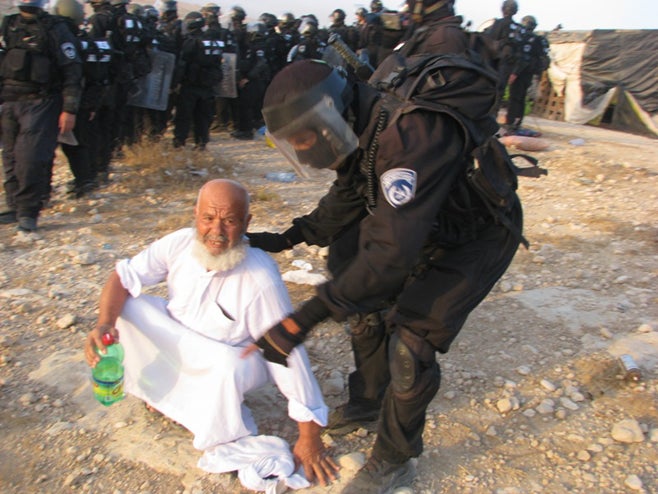
The July 27 raid began around 4:30 a.m. when 1,300 armed police officers in riot helmets and shields blocked the entrance to the village and entered it. The force included mounted cavalry, helicopters, inspectors from the Israel Land Administration (ILA) - the government agency responsible for managing the 93 percent of Israeli land owned by the state, and demolition crews operating bulldozers, according to witnesses and video images viewed by Human Rights Watch.

The crews forcibly removed the villagers, mostly children and elderly people, from their homes before the demolition operation began. Awad Abu Freih, spokesman for the al-Araqib civil committee, told Human Rights Watch that residents were unarmed and stayed in their homes after police arrived in a form of passive resistance. Bulldozers also destroyed carob and olive trees, chicken coops, and other structures, residents said.

The Israeli police foreign press spokesman, Mickey Rosenfeld, told Human Rights Watch that the police acted on a court order issued 11 years ago but not previously executed. The operation "was done quietly and sensitively and in coordination with the village representatives," Rosenfeld said. Abu Freih denied that there had been any coordination. Rosenfeld added that Land Administration officials evacuated al-Araqib residents to an area close to the nearby city of Rahat, where, he claimed, they had additional residences.

Ortal Tzabar, a Land Administration spokeswoman, confirmed in a statement to Human Rights Watch that the authorities also uprooted 850 olive trees that she said were "to be replanted elsewhere."

Abu Freih and Ye'ela Raanan, spokeswoman for the Regional Council for the Unrecognized Villages, a local organization, said that only a few dozen people from al-Araqib have other homes. Some residents may have spent the night with friends or relatives in Rahat after the demolitions, Raanan said, but "there are at least 250 people now who don't have another option." Raanan said she was at al-Araqib during the operation and that residents began on July 28 to build makeshift tents on the site with wooden frames and cheap fabric.

Residents and Israeli rights activists told Human Rights Watch that police began assembling at the village late Monday evening. At 12:15 a.m., the Kiryat Gat Peace Court (court of first instance) rejected an appeal filed by village residents contending that the state had no legal grounds to demolish their homes.

The Negev Coexistence Forum, a Bedouin rights group, said in a statement that al-Araqib existed before the creation of Israel in 1948 and that residents returned there after being evicted by the state in 1951. Many of the unrecognized villages are around Beer Sheva, the Negev's largest city. The current draft of a metropolitan plan for Beer Sheva designates the land where al-Araqib is located as a "recreational area" and as an area for "forest and forestation."

A lawyer who represents several al-Araqib residents and who asked not to be named, said that the Israeli government issued "evacuation orders" in 2002 to nine people in the village based on Article 21 of the Property Law, which allows for the owner of a piece of property - in this case, the state of Israel claims to own the property - to evict anyone residing on it illegally. But, he said, in the eight years since then authorities had not made any attempt to carry out these orders.

While the village population has grown since then, no other residents received evacuation or demolition orders until June of this year, the lawyer said, when several others received letters from the government threatening them with house demolition. These letters were based on Article 64 of the Repossession Law (Hotza'a Lapoal), which says the authorities may also evict other residents, interpreted by the state and the courts to include those in a vaguely-defined "legal relation" with anyone against whom other orders have been issued.

Israeli authorities carried out the demolitions despite pending legal claims to the land that Al-Araqib residents are pursuing in Beer Sheva District Court. Abu Freih, the al-Araqib civil committee spokesman, told Human Rights Watch that over a dozen such land claims are pending. One resident and human rights activist, Nouri al-Okbi, testified in court that the Israeli government confiscated 820 dunams (82 hectares) of land from his family, without compensation, when they were expelled in 1951.

The state contends that the Bedouin have never had recognized land claims in the area. Al-Okbi's lawyer, Michael Sfard, recently produced evidence in court, however, that appeared to show that the Jewish National Fund had bought land in this area from Bedouin owners during British rule, as did Ottoman authorities before then. This, he said, indicated that the area had customarily been recognized as belonging to the Bedouin.

The demolitions came two days after Prime Minister Binyamin Netanyahu made comments in a government meeting, as reported by Israeli media, about the "threat" of losing a Jewish majority in the Negev region. "We are under real attack on this issue [of Israel as a Jewish state]," Netanyahu was quoted as saying in a July 25 government meeting regarding amendments to the citizenship law. "The meaning could be that different elements will demand national rights within Israel, for example, in the Negev, if we allow for a region without a Jewish majority. It has happened in the Balkans, and it is a palpable threat."

Israel has demolished thousands of Negev Bedouin homes since the 1970s, and over 200 since 2009. Israeli authorities have demolished many structures in al-Araqib in the past, although never the entire village. The Land Administration also began spraying villagers' crops with herbicides in 2002 as a mechanism to cause evacuation, a practice deemed illegal by the Israeli Supreme Court in 2007.

"Israel employs systematically discriminatory policies in the Negev," Stork said. "It is tearing down historic Bedouin villages before the courts have even ruled on pending legal claims, and is handing out Bedouin land to allow Jewish farmers to set up ranches."

Background
Tens of thousands of Bedouin citizens in southern Israel live in "unrecognized" villages like al-Araqib. Because the government considers the villages illegal, it has not connected them to basic services and infrastructure such as water, electricity, sewage treatment, and garbage disposal. Although the villages do not appear on official maps, some existed before the state of Israel was established in 1948. Others sprang up after the Israeli army forcibly displaced Bedouin tribes from their ancestral lands immediately following the 1948 war. Israel passed laws in the 1950s and 1960s enabling the government to lay claim to large areas of the Negev where the Bedouin had formerly owned or used the land. Planning authorities ignored the existence of Bedouin villages when they created Israel's first master plan in the late 1960s.

Israeli officials contend that they are simply enforcing zoning and building codes and insist that Bedouin can relocate to seven existing government-planned townships or a handful of newly recognized villages. The government-planned townships are seven of the eight poorest communities in Israel and are ill-equipped to handle any influx of new residents. Many - if not most - Bedouin have rejected relocating to the townships, which have minimal infrastructure, high crime rates, scarce job opportunities, and insufficient land for traditional livelihoods such as herding and grazing. In addition, the state requires Bedouin who move to the townships to renounce their ancestral land claims - unthinkable for most Bedouin, who have claims to land passed down from parent to child over generations.

Bedouin constitute 25 percent of the population of the northern Negev, but occupy less than 2 percent of its land. Over the past decade, Israeli authorities have allocated large tracts of land in this region, and public funds, for the creation of private ranches and farms. There are 59 such "individual farms" in the Negev - only one allocated to a Bedouin family and the rest to Jewish families - that stretch over 81,000 dunams of land, greater than the total land area granted to the seven planned Bedouin townships housing 85,000 people. The Israeli human rights organization Adalah says the state has connected these farms to national electric and water grids, despite the fact that some lack proper planning permits. In a series of laws, the latest passed on July 12, the state retroactively legalized such farms and authorized the establishment of more.

Human Rights Watch documented the systematic discrimination that Bedouin citizens face in a130-page report, "Off the Map," released in March 2008.

Israel ratified the International Covenant on Economic, Social and Cultural Rights in 1991, requiring it to guarantee the right to housing. The United Nations Committee responsible for interpreting the covenant has said this means governments can carry out forced evictions only in "the most exceptional circumstances," and even then only in accordance with human rights principles requiring the government to consult with the affected individuals or communities, identify a clear public interest requiring the eviction, ensure that those affected have a meaningful opportunity to challenge the eviction, and provide appropriate compensation and adequate alternative land and housing arrangements.

Another right at stake is the right to property, set out in the Universal Declaration of Human Rights. The 2007 UN Declaration of the Rights of Indigenous Peoples, opposed by only two states in the world - the US and Canada - states that indigenous peoples have the right to lands they traditionally owned, occupied or otherwise used, and that states should give legal recognition to this. It also says that no relocation of indigenous peoples should take place without their free, prior, and informed consent and only after prior agreement on just and fair compensation.

In December 2008, the Goldberg Commission, appointed by the government in late 2007 to find a solution for the land claims of residents of the unrecognized villages, recommended that the state recognize villages that have a "critical mass" of permanent residents and that do not interfere with other state planning. In practice this would be limited to the recognition of only a few of the dozens of unrecognized villages. The commission also called for the establishment of several claims committees to deal with Bedouin ownership claims and provide financial compensation for expropriated land. In May 2009, the government established the Prawer Committee to outline a plan to implement the Goldberg Commission's recommendations.

Los ilegales, parte de la vida estadounidense

ISABEL PIQUER Corresponsal en Nueva York 01/08/2010 08:00

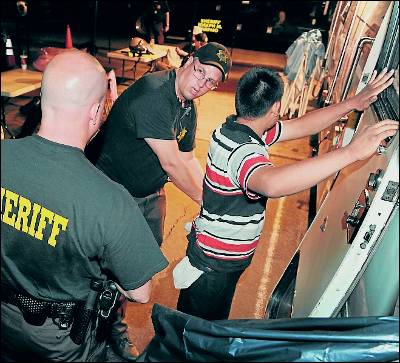
Dos agentes detienen a un inmigrante irregular

Dos agentes detienen a un inmigrante irregular.Se calcula que en Estados Unidos viven unos 12 millones de sin papeles, más o menos la misma cifra que en toda la Unión Europea. En Arizona representan el 8% de la población y juegan un papel esencial en el sector turístico, el mayor negocio del estado.

Estados Unidos, por razones históricas obvias, siempre ha sido, pese a las apariencias, bastante acomodaticio con sus irregulares porque los necesita económicamente. Los indocumentados pueden meter a sus niños en las escuelas y recibir atención médica de urgencia.

Así lo estipula la Corte Suprema que en 1982 declaró que ningún estado podía negarse a educar hijos de irregulares, porque suponía discriminarlos. Cuatro años más tarde, en 1986, el Congreso aprobaba el Emergency Medical Treatmen and Active Labor Act (EMTALA), que obliga a todos los hospitales y ambulancias a asistir a cualquiera que necesitara atención médica inmediata, independientemente de su ciudadanía, estatus legal, o capacidad de pago.

Integración económica
La idea es integrar al indocumentado en la vida económica antes que en la legal. Algunos estados, como Maine, New México y Tennesee otorgan permisos de conducir a los sin papeles.

La preocupación por la inmigración ilegal, especialmente en tiempos de crisis cuando escasea el empleo, ha endurecido las políticas de los estados hacia los indocumentados. Y no sólo en Arizona. Esta semana, la Asociación de Libertades Civiles de Nueva York ha denunciado que uno de cada cinco distritos escolares de la ciudad pedía información sobre el estatus migratorio de los niños que optaban a una plaza. Aunque ningún escolar fue expulsado, la asociación advirtió del precedente que creaba.

Estados Unidos no tiene documento nacional de identidad. Las piezas que más se usan para los quehaceres diarios son las licencias de conducir que otorgan los estados, y para asuntos más serios, el número de Seguridad Social, que, como su nombre no indica en absoluto, suma la historia crediticia de cada habitante. En Estados Unidos se es lo que se debe y lo que se gasta. En este país de tradición anglosajona, una de las libertades del individuo es no tener que llevar papeles, contrariamente a Europa. De ahí que la ley de Arizona levantara tantas ampollas.

Ningún policía en Estados Unidos puede detener o simplemente parar en la calle a un latino, por ejemplo, porque piense que es ilegal. Le puede detener por saltarse un stop y de paso pedirle los papeles. La iniciativa de Arizona daba a las fuerzas del orden un poder migratorio hasta ahora sólo reservado a las autoridades federales. Pero no era el único problema. Al no haber documento de identidad, resultaba incluso complicado pedirle una prueba de nacionalidad a un estadounidense.

EE UU dice que cuenta con un plan de ataque a Irán pero no quiere usarlo

El jefe del Estado Mayor Conjunto de EE UU ha revelado en una entrevista que es la militar es una alternativa a la diplomacia.

  • EE UU no quiere que Teherán posea armas nucleares por lo que no descartan una intervención armada para evitarlo.

Marines de EE UU

Un mando de alto rango del Pentágono dijo este domingo que EE UU cuenta con un plan de ataque a Irán en el caso de que fuera necesario recurrir a él para prevenir que Teherán se haga con un armas nucleares, pero que preferiría no tener que usarlo.

El jefe del Estado Mayor Conjunto de EE UU, el almirante Mike Mullen, confirmó en una entrevista en el programa dominical Meet the Press, de la cadena de televisión NBC, que el Gobierno dispone ya del plan de ataque, preparando en los últimos meses y cuya planificación no ha sido ocultada por el Pentágono.

El Gobierno de EE UU siempre ha dejado claro que emplea una estrategia de doble vía con Irán: la diplomática y la de las sanciones, pero al mismo tiempo nunca ha quitado de la mesa la opción militar, según recordó hoy Mullen a Teherán.

"Las opciones militares han estado sobre la mesa y siguen estándolo", señaló Mullen en la entrevista. "Espero que no tengamos que llegar a ese punto, pero es una opción importante y es una que es bien entendida" por Teherán, agregó, no obstante. Preguntado si el Ejército dispone de un plan de ataque contra Irán, el jefe del Estado Mayor Conjunto respondió: "sí lo tenemos".

En abril pasado, el secretario de Defensa, Robert Gates, se mostró, en una entrevista televisiva, satisfecho con la planificación, las previsiones y las estrategias del Gobierno ante la posibilidad de que Irán se convierta en un país con armas nucleares.

"Estoy muy satisfecho; satisfecho con el proceso de planificación, tanto dentro de este edificio como a nivel intergubernamental. Dedicamos mucho tiempo a Irán y seguiremos dedicándolo" a este asunto, aseguró. Mullen aseguró este domingo en NBC que las consecuencias de un potencial ataque contra Irán le "preocupan".

Una acción militar contra la República Islámica podría tener "consecuencias no buscadas que son difíciles de predecir en una parte del mundo increíblemente inestable", explicó.

No obstante, permitir que Teherán desarrolle armas nucleares también es inaceptable, recalcó. "Francamente, estoy extremadamente preocupado por las consecuencias de ambas" posibilidades, dijo el almirante. Por eso, expresó su esperanza de que la combinación del esfuerzo diplomático de la comunidad internacional y las sanciones lleven a Irán a suspender su programa nuclear.

Mullen subrayó que la decisión de un eventual ataque militar tendría que ser tomada por el presidente Barack Obama, y subrayó que tanto la amenaza de un Irán con arma nuclear como un ataque contra la República Islámica para parar el programa nuclear "tiene grandes desventajas".


Wednesday, July 28, 2010

Le parlement de Catalogne donne l'estocade aux corridas

par Vanessa Romeo

Le parlement de Barcelone a voté mercredi l'interdiction des corridas en Catalogne à partir de 2012, une première en Espagne exception faite des îles Canaries.

Soixante-huit députés ont voté l'interdiction, 55 s'y sont opposés et neuf se sont abstenus.

Ce résultat était attendu depuis qu'en décembre dernier le parlement catalan avait décidé de prendre en considération une pétition du groupe anti-corrida Prou! (Assez!), qui avait recueilli 180.000 signatures.

L'interdiction entrera en vigueur en 2012. Les dernières arènes actives de Barcelone, la capitale catalane, fermeront alors, de même que les rares autres encore en service dans le reste de la région.

Le groupe Prou! compte étendre sa campagne à d'autres régions d'Espagne.

Selon l'organisation Humane Society International, 250.000 taureaux meurent chaque année dans les arènes.
Au cours du débat, les députés ont invoqué, outre le traitement cruel infligé aux animaux, la défaveur que connaissent les corridas en Espagne où les arènes sont de moins en moins fréquentées.

"Il y a certaines traditions qui ne peuvent plus être maintenues alors que la société change. Il ne faut pas tout interdire mais certaines pratiques avilissantes doivent disparaître", a dit Josep Rull, député du parti nationaliste catalan CiU.

Mais pour Rafael Luna, élu du Parti populaire (conservateur), "interdire la corrida en cette période de crise économique est une folie". Les ventes de billets en Espagne et en France représenteraient chaque année environ 100 millions d'euros.

DÉSAFFECTION
Si les corridas connaissent une certaine désaffection en Espagne, elles sont pratiquées aussi au Portugal, dans le sud de la France et dans certains pays latino-américains: Colombie, Venezuela, Pérou, Equateur et Mexique. Dans certains pays, il est illégal de tuer le taureau dans l'arène.

Dans l'arène, le torero principal, le picador et les "peones" se servent de capes, de lances et de banderilles pour fatiguer le taureau. Le matador utilise une épée pour la rituelle mise à mort.

Les îles Canaries ont été la première région espagnole à interdire la corrida, en 1991.

Aux yeux de ses adversaires, la tauromachie impose aux animaux des souffrances gratuites qui n'ont pas leur place dans une société moderne.

Pour ses partisans, le face-à-face du torero et du taureau furieux magnifie une forme d'émotion qui plonge au coeur du caractère espagnol et qu'ont célébrée des artistes et des poètes de l'envergure de Pablo Picasso ou de Federico Garcia Lorca.

Ceux qui défendent la tradition font aussi valoir qu'elle crée des milliers d'emplois et constitue un élément central de l'attrait touristique du pays.

José Tomas devait toréer cet été à Barcelone dans le cadre d'une contre-campagne mais il a dû y renoncer après avoir été grièvement blessé d'un coup de corne en avril au Mexique.

Une interdiction serait une "terrible perte", a-t-il déclaré récemment au journal La Razon. "L'idée qu'ils puissent voler une partie de ce que vous admirez le plus, et qui a une telle importance dans votre vie, c'est très dur."

Commentateurs et parlementaires assurent que le mouvement anti-corrida n'est pas lié au séparatisme en Catalogne.
Mais pour Carlos Nunez, président de la fédération des éleveurs taurins, il est intégralement politique. "Les dirigeants politiques catalans en font un prétexte pour créer une identité artificielle", a-t-il dit.

Avec Alice Tozer, Guy Kerivel pour le service français, édité par Gilles Trequesser

Catalonia bullfight ban divides Spaniards

Barcelona - When prosperous Catalonia became the first part of mainland Spain to ban bullfighting on Wednesday, it sent a powerful signal to the rest of the country.

Namely, that bullfights are not an intrinsic and untouchable part of Spanish identity, but a form of animal abuse which can be abolished.

That was the message sent out by the 135-member regional parliament when it voted to approve a ban proposed by animal rights activists.

Spain's Canary Islands had already outlawed bullfights back in 1991, as part of a more general animal protection law, but that decision had gone largely unnoticed - the Catalan move, however, has ignited discussion and divided opinion across the rest of the country.

Movie director Agustin Diaz Yanes described it as a 'cultural tragedy' whilst anti-bullfighting activists hailed it as sending 'a message of progress to humanity.'
The Catalan decision takes place against a background of increased separatist feelings in the region of 7.5 million people, after Spain's Constitutional Court trimmed its autonomy rights.
Bullfighting opponents were forced to reject claims by conservatives that Catalonia wanted to abolish corridas - the Spanish word for bullfights - because it was a symbol of Spanishness.
'We are not talking about identities here, but about very serious ethical arguments against the ill-treatment of animals,' said Jordi Portabella from the leftist separatist party ERC.
Bullfights have traditionally been regarded as an important part of Spanish culture, and more than 11,000 bulls are killed annually.
Fans say the spectacle pits the intelligence of the human being against the brute force of the beast.
Bullfighting also has an economic side to consider, with an annual turnover of nearly 1.5 billion euros (1.9 billion dollars) and gives direct or indirect employment to around 200,000 people.
However, less than 27 per cent of Spaniards were interested in bullfighting in 2006, according to one poll - down from 38 per cent in 1999.
Bullfighting had long been on the decline in Catalonia, where the capital Barcelona declared itself an 'anti-bullfight' city in 2004, and dozens of other municipalities followed suit.
Two of Barcelona's three bullrings were closed down, leaving the Monumental as Catalonia's only bullring to still stage corridas on a regular basis.
The anti-bullfighting group Prou ('Enough' in Catalan) collected 180,000 signatures to request the ban which parliament then agreed to consider.
The Catalonia debate then spread to Madrid, where in response conservative regional Prime Minister Esperanza Aguirre announced that her region would declare corridas a part of its cultural heritage.
Animal rights activists retaliated by asking the Madrid regional parliament to discuss a Catalan-style ban.
But the bullfighting question has turned out to be complex, with intellectuals and artists taking sides both for and against.
Corridas 'represent a form of spiritual and emotional nourishment as intense and enriching as a concert by Beethoven, (or) a comedy by Shakespeare,' Peruvian author Mario Vargas Llosa wrote.
Bullfighting inspired the likes of painter Pablo Picasso and poet Federico Garcia Lorca, he argued, describing it as a 'sign of identity' for much of the Spanish-speaking world.
Bullfighting fans also stress the healthy life of the Iberian fighting bulls, which are raised in environmentally-friendly sanctuaries measuring a total of 400,000 hectares, and which would be closed if corridas were abolished.
Animal rights campaigners, on the other hand, stress the suffering of the bull, which gets long darts pushed into its body before the matador finally kills it with a sword - often after several failed attempts.
Bulls are herbivores which prefer to flee rather than fight, philosopher Jesus Mosterin wrote.
Critics also condemn bullfights as a cowardly bloodsport which leaves the animal no chance to defend itself. Matadors do get gored, but it is very rare for them to get killed by bulls.
The controversy is expected to continue even in Catalonia, where Spain's main opposition conservative People's Party (PP) has announced possible parliamentary or legal initiatives in order to overturn the ban.
Trying to prohibit bullfights was like prohibiting football , conservative representative Juan Manuel Albendea quipped - an ominous joke in a country which has just won the football World Cup.

Saturday, July 17, 2010

Etno Grupa Trag - Zvuci Balkana

In May 2008. they finished recording their first album, titled "Sounds of the Balkans." It is 15 tracks from the territory of Bosnia and Herzegovina, Serbia, Montenegro, Macedonia and Bulgaria. A special place on the album found the music Lijevča field, far less familiar to the audience as the folk music of the area before 2007. The explored zabiljžena.

On the set for several months. For the arrangement is primarily responsible Goran Ćetojević and vocal arrangements Valentina Milekic, but other members in their peculiar manner impressed them his personal seal. Recording cameramen and producers were Ninoslav Dobrijević - Tiki and Dragan Bosnjak - Bole. Photos to pack worked Vladimir Milaković. The design was done by Valentina Milekic, a technical editor Dragan Grahovac. The album was recorded in two studios: "Digital Boyler" and "Studio 4" in Banja Luka.

1. Falcon fly
2. Be merry, hosts
3. Seven hours of stroke
4. Carnation is the time saved
5. The string of songs from Montenegro
6. Moonlight
7. All the birds sang
8. Šetnala the Kuzum Stana
9. Judging from my e clear skies
10. Marijo, deli bela kumrijo
11. Udade the Živka Sirinićka
12. Vrbice, VRBO Green
13. We three sisters, we sing
14. Oh, Krajina
15. Navigate kume kićane wedding

MP3 320 kbps including full scans

HERE

Thursday, July 15, 2010

The Gay Closet; Uganda, and Germany

An expose of gay life in Uganda has Afrogay angry.

They've had a journalist infiltrate the Kampala gay community to try and ferret out what makes gay boys tick. It's not the first time this sort of thing has happened and the only thing that sets it apart is that this journalist has made a clumsy attempt to be balanced. That said, this journalist simply knows too much about the gay community for me to believe that he didn't get embedded deeper than he admits.And that is a great cause for discomfort.
The tactics the journalist are pretty basic and that he seems to be so successful merely attests to the humanity in all of us. But it is also a wake-up call for those Ugandan gay boys who seem unable to take the simplest precautions in this day and age when stalkers, blackmailers and malevolent people are on the prowl, with gay boys and girls as their target.
~
Indeed, for guys who are under pressure, the pressure of one of the most homophobic countries in the world, it is simply too easy to infiltrate us. And, it is possible.

Oh well....

To my friends out there, I must confess I am more paranoid than lots of people. I mean, I have aided connection and lessening of our isolation in more than one way. Yet I continue to be anonymous. I am gayuganda, gug. And that is who I want to be. Gay, and closeted, and damned shy! Some have more to lose than others. Maybe I am just a coward.

Yes, I know lots of people know who I am. But, not to the extent of opening up to people like in this journalist's expose.
Within a period of three weeks, I learnt that gay relationships are almost like straight ones. Those involved charm, seduce, deceive, try to manipulate with money and even plead with whoever they are interested in to give into them and yes, they also get cheated on It was a hot Tuesday morning and I was seated in front of my computer reading an online article about gays in Uganda. The page had a link to a website called icebreakersuganda.org.
I clicked on it out of curiosity. It is probably one of the boldest gay things I have seen in this country. It’s a website that encourages gay people to come out and embrace their sexuality (thus the name icebreaker) and it connects gay people in Uganda. The website has a guestbook link where visitors of the site can update any comments or ideas on their mind about the website.
However, most of the comments posted on the website’s guestbook are announcements of gay people who want to meet other gays for mere company, sex or love. Consequently, this segment of the website has been turned into a “lonely hearts” of sorts for gay people. Some of the posted messages are darkly explicit and complete with e-mail addresses and phone numbers.
One of the posted messages on the website was an announcement for a gay party of sorts. It had a phone number attached to it.
Gay, in the closet, in Uganda? Why the recklessness of those who are gay in Uganda?

Because it is very hard to live in self denial; and sometimes recklessness takes the place of despair.

I was mourning about the closet in Uganda. We are not alone. The German national team, the one which did so well in the World Cup of football? Well, they are a 'bunch of gays' Ha ha ha ha ha!
I am not alone in my woes about the goodness of the closet. Says one former manager of the Bundesliga-
The whole issue of gay players in the Bundesliga is a sensitive issue in Germany. In March former football manager Rudi Assauer provoked outrage outrage by saying there is ‘no place' for gay players in football.
Assauer, who was boss of Schalke in Germany, said: "Perhaps they are OK in other sports but not in football.
"If a player came to me and said he was gay I would say to him: 'You have shown courage.' But then I would tell him to find something else to do.
"That's because those who out themselves always end up busted by it, ridiculed by their fellow players and by people in the stands. We should spare them these witch-hunts."
His outburst is set to enrage world footballing authorities who are making concerted efforts to rid the game of homophobia.
Asked whether he had ever met a gay footballer during his many years as both player and manager, 65-year-old Assauer replied: "No, never.”
Ugh, of course German football is so holy a spot that no gay people make their way into that holy of holies. Self deception at its best

Saturday, July 3, 2010

UK Rejects ACTA Calls To Criminalize Illicit File-Sharing

A leaked ACTA document published by citizen advocacy group La Quadrature du Net revealed the intention to introduce criminal sanctions into the Anti-Counterfeiting Trade Agreement (ACTA) for file-sharing offenses.

The ACTA Chapter 2 Criminal Provisions document (.pdf) stated that “each party shall provide for effective proportionate and dissuasive penalties” to include “imprisonment and monetary fines”.

“The ACTA agreement, by its opacity and undemocratic nature, allows criminal sanctions to be simply negotiated,” commented Jérémie Zimmermann, spokesperson for La Quadrature du Net. “The leaked document shows that the EU Member States are willing to impose prison sanctions for non-commercial usages of copyrighted works on the Internet as well as for ‘inciting and aiding’, a notion so broad that it could cover any Internet service or speech questioning copyright policies.”

As noted by Zimmermann, the ACTA text includes proposals to apply criminal sanctions to “infringements that have no direct or indirect motivation of financial gain”. There are suggestions that “financial gain” could simply be obtaining anything without paying.

However, it seems that at least one country is showing a reluctance to go along with suggestions that file-sharers should feel the full weight of a criminal court. The UK Government has now said that it feels that criminal sanctions are an inappropriate way to deal with this type of copyright infringement.

“Acta should not introduce new intellectual property laws or offences. Instead, it should provide a framework to better enforce existing laws,” a UK Intellectual Property Office representative told ComputerActive.

Currently, personal-use file-sharing on a non-commercial scale is almost always considered a civil offense in the UK. However, there have been exceptions. In the case of the OiNK uploaders (who actually uploaded very little indeed), their cases were heard in a criminal court and they ultimately received fines and community service orders. This proves that when powerful enough people get involved, it’s trivial to escalate an offense way above its standing.

That said, it would be ridiculous to have small infringements dealt with by the criminal courts as a matter of course, so hopefully the UK Government stands strong. Jim Killock, Chief Executive at the Open Rights Group said the Government now needs to make its opposition to these proposals both public and clear to the US and EU.

Wednesday, June 30, 2010

UGANDA: Finally ready for male circumcision

The national policy will be launched in July 2010
RAKAI, 29 June 2010 (PlusNews) - The Ugandan government will begin a nationwide male circumcision programme in July as part of its HIV prevention strategy, a senior government official has said.

"We now have a national vision on how to move forward, and a government policy and communication strategy will be launched in July," said Dr Alex Opio, assistant commissioner for health services in the Ministry of Health.

"Circumcision will be carried out in national referral hospitals, district hospitals and health centre IVs [county level health centres] which have the capacity to conduct minor surgeries."

Why the delay?

The government began drafting the policy in 2008 and there has been criticism of the delay in launching the circumcision programme. In terms of the
National AIDS Strategic Plan 2007/8-2011/12, at least 160,000 men should have been circumcised by the end of 2010.

It had taken time to get all the government's ducks in a row. "We needed funding; PEPFAR [the United States President's Emergency Plan for AIDS Relief] has stepped in to give the ministry and its partners US$5 million for male circumcision over the next year," Opio said.

Unlike neighbouring Kenya, whose programme has already circumcised more than 100,000 men, medical male circumcision was relatively new to Uganda, where only 25 percent of the adult men are circumcised.

"Starting prematurely can do more harm than good; we needed to be sure we were truly ready to deliver safe medical circumcision before we launched," Opio commented.

The Rakai Health Sciences Programme (
RHSP), a medical research facility in central Uganda - one of three sites where research confirmed the protective effect of male circumcision against HIV - has circumcised more than 5,000 men, and is expanding its services to local district hospitals.
''Starting prematurely can do more harm than good; we needed to be sure we were truly ready to deliver safe medical circumcision before we launched''
"We have found pretty high levels of acceptance of male circumcision so far - about 60 percent," said Dr Rajab Kakaire, a medical officer at RHSP. "There is a limit to how many men will accept circumcision without an official government policy; some are sceptical about undergoing a procedure that the government hasn't officially endorsed."

Their figures match those of a 2008
study by Uganda's Makerere University and Family Health International, a reproductive health NGO, which found that 62 percent of men in four districts would consider being circumcised.

"It seems quite fashionable now, like somehow men who are circumcised are more civilised, more educated," said David Sembatya, a motorcycle taxi rider, or 'boda boda', in the neighbouring district of Lyantonde, where RHSP provides male circumcision at the district hospital. "I will definitely do it."

James Nkale, a clinical officer at RHSP, said prevention of HIV and other sexually transmitted infections, hygiene, and social status were among the reasons men were so keen to be circumcised. "Men also listen to women, who have better health seeking behaviour and are advising their partners to go for the service."

Misconceptions

Circumcision is a new concept to much of the population and there are some misconceptions. "Of course, the most common fear is pain - people associate circumcision with men wearing skirts and walking with a staggering gait," Nkale said.

"There are also some cultural practices that may be harmful ... some believe it is a curse to have sex with your official wife after circumcision, so the first sexual encounter after the procedure should be with another partner; others believe vaginal fluids are good for healing wounds, so they may have sex before they are properly healed. This is all anecdotal - we don't know how deep-seated these misconceptions are, so we need more studies."

Kakaire said another common perception was that male circumcision was a way of "Islamising" the population; in some ethnic communities the word for male circumcision is "okusilamula", which translates as "to make Muslim". "We discourage the use of that word, instead we use the word "okukomola", which means to trim," he noted.
More on male circumcision
 Zulu king revives male circumcision
 The fringe benefits of male circumcision rollout
 Clinics dispel male circumcision myths
 The cutting edge (multimedia)
Perhaps the biggest fear of male circumcision practitioners and the government is that men will become more sexually reckless after circumcision. "There is a legitimate fear of behavioural disinhibition as a result of being circumcised," Kakaire said. "However, a small qualitative study we did here [Rakai] showed no increase in risky behaviour as a result of the procedure."

The Ministry of Health's Opio said the message that male circumcision was not a "magic bullet" against HIV was central to the communication strategy. "It is just an additional tool in our prevention arsenal - it becomes part of the 'plus' in our ABC [Abstinence, Be faithful and Condomise]-plus strategy," he said.
Getting it right
Kakaire noted that good medical care and counselling were also critical to promoting circumcision, and RHSP has been training nurses, counsellors, and clinical and medical officers for more than two years. In the past year it has trained more than 170 health workers from across the country and is planning to double its training programmes to cope with demand.

One of the reasons this [RHSP] programme has been successful is that the clients get a complete service - from pre-op counselling to the procedure and post-op follow-up," he said. "Clients need to trust the programme for it to succeed."

"We are drawing up a roadmap that will guide the [national] programme," Opio said. "Training is ongoing and we are being careful to ensure that all practitioners of male circumcision follow standards set by our technical guidelines."

MIDDLE EAST: New HIV report turns up some surprises

A women's group meets in Upper Egypt to discuss
Statistics on the prevalence of HIV/AIDS in the Middle East are hard to come by but a new study launched on 28 June in the United Arab Emirates has attempted to gather all existing data into one place and add some analysis and action points for policymakers.

“In all previous reports we thought there was no HIV data from this region. But there turned out to be lots of data here,” said Laith Abu Raddad, director of the Biostatistics and Biomathematic Research Core at Weill Cornell Medical College in Qatar and the principal author of the study (not yet available online).

“This report is basically more like a scientific epidemiological study: Getting pieces of data, thousands of data that we managed to collect from every country in the region, putting them together and analysing them to see what they tell us in terms of HIV epidemiology,” he said.

The report, characterizing the HIV/AIDS epidemic in the Middle East and North Africa, is a joint effort of the World Bank, the UN Joint Programme on HIV/AIDS (UNAIDS) and the World Health Organization (WHO). It covers 23 countries that the three organizations include in their MENA (Middle East and North Africa) region.

According to UNAIDS, about 412,000 people were living with HIV in MENA by the end of 2008, up from 270,000 in 2001. The report said most new infections were from within commercial sex and drug-taking populations.

The report divides the MENA region into two categories according to HIV prevalence: the “subregion with considerable prevalence” (Djibouti, Somalia, Southern Sudan); and the Core MENA region, where HIV prevalence is described as “very limited” (the rest of MENA countries).

Sudan, Somalia and Djibouti

“In north Sudan, we used to think in the past that we have a much more serious problem of HIV but now the data set is more complete, it’s clear that north Sudan really is quite similar to the rest of the MENA countries. But in south Sudan we may have a generalized epidemic,” Abu Raddad said. A generalized epidemic is one that has spread beyond high-risk minority populations to the general population.

A 2003 UNAIDS and WHO report referred to in the study said Sudan had a 2.6 percent HIV prevalence rate.

Abu Raddad said Djibouti “was the Disneyland of risk behaviour” and had a large number of Ethiopian sex workers serving truck drivers and foreign army bases. “We have this corridor which is certainly full of HIV, but the rest of the country is fine,” he noted.

A 2008 UNAIDS report said Djibouti had a 3.4 percent HIV prevalence rate in its capital and a 1.1 percent rate outside it.

“Technically speaking, the HIV epidemics in Djibouti and Somalia are already generalized, but the context of HIV infection and risk groups in these countries suggests that HIV dynamics are mainly focused around concentrated epidemics in the commercial sex networks,” said the new report.
Pakistan, Afghanistan and Iran
oci
Pakistan faces a concentrated HIV epidemic among injecting drug users
The report said Pakistan and Iran, where HIV prevalence is low among the general population, faced concentrated HIV epidemics among injecting drug users (IDUs), while this was also a significant mode of transmission for HIV in Afghanistan.

“We know we have a concentrated epidemic among IDUs in Pakistan, and the increase was very rapid over the past few years. In Karachi, for example, we had near zero percent among this group in 2003 or 2004 and then within six months it jumped to 24 percent.”

He said this increase could be attributed to needle sharing, poverty and a lack of awareness.

Egypt and Tunisia

Egypt has a different pattern in terms of the spread of HIV. Surveys of risk groups showed that HIV prevalence was very low among IDUs and female sex workers (FSWs). “This is not a surprise for FSWs. In those kind of conservative countries in the region - and Egypt is one them - we see very little prevalence of HIV among FSWs. But having very low prevalence among IDUs is quite a surprise,” Abu Raddad said.

He said that Egypt appeared to be having an HIV epidemic among men having sex with men (MSM), at a prevalence rate of 6 percent.

“The country also has an interesting pattern. Usually HIV epidemics start with IDUs and then move to MSM, which we see in Iran and Pakistan. But this is not the case in some countries, like Egypt and Tunisia, where the epidemic is starting with MSM,” Abu Raddad said.
Dearth of data
Experts said that despite all the information from different sources that the new report brings together, the region still does not have enough data to form a coherent strategy to tackle HIV/AIDS. The report conceded that the MENA region “continues to be viewed as the anomaly in the HIV/AIDS world map”.

“This is because we have not invested enough in building the right surveillance systems, so we don’t have systems that actually detect and follow up on this issue,” Hind Khatib, regional director of UNAIDS, told IRIN.

“Political commitment should be matched with domestic resources and investment in human resources, which is limited in the region. You have to spend on your programmes and systems and you have to have strategic directions that are focused on the drivers of the epidemic,” Khatib said.

She said she hoped to see the governments of the many low-income countries in the region allocate more funds to HIV programmes, particularly in light of the fact that the financial crisis had made it harder for countries to be eligible for assistance from the Global Fund to Fight AIDS, Tuberculosis and Malaria.

Experts agreed that the main challenge for the region was the stigma of HIV/AIDS and discrimination against people living with it.

“We have to bring in the people living with HIV and the civil society. We have to open up in our thinking and policies,” Khatib said.